
Table of Contents
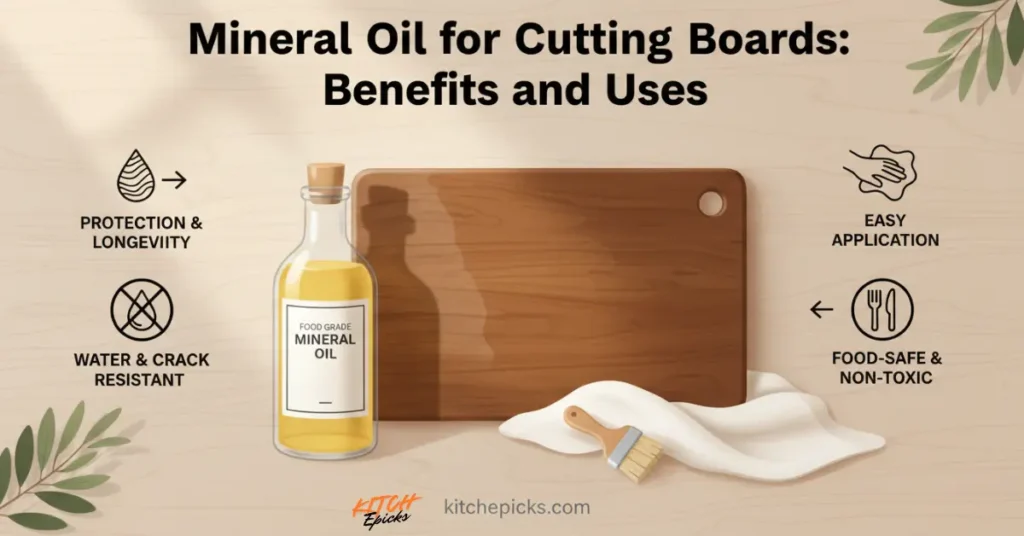
I’ve watched too many beautiful wooden surfaces crack, splinter, and harbor dangerous bacteria because their owners didn’t know about proper maintenance. After years of testing different products in my kitchen, I’ve discovered that mineral oil for cutting board care stands as the most reliable solution.
Your wood deserves better than neglect. Dry, damaged surfaces don’t just look terrible—they compromise food safety in your home.
Through countless experiments with various treatments and conditioners, I’ve found that this food-safe approach protects wooden kitchen tools better than any alternative. The results speak volumes: restored surfaces, extended longevity, and genuine peace of mind during meal preparation.
I’ll share exactly how this simple maintenance routine transforms your kitchen equipment. You’ll discover application techniques, product recommendations, and hygiene benefits that make this practice essential rather than optional. Proper wood care isn’t luxury—it’s necessary when you value quality tools and family health.
Why Your Cutting Board Needs Proper Oil Treatment
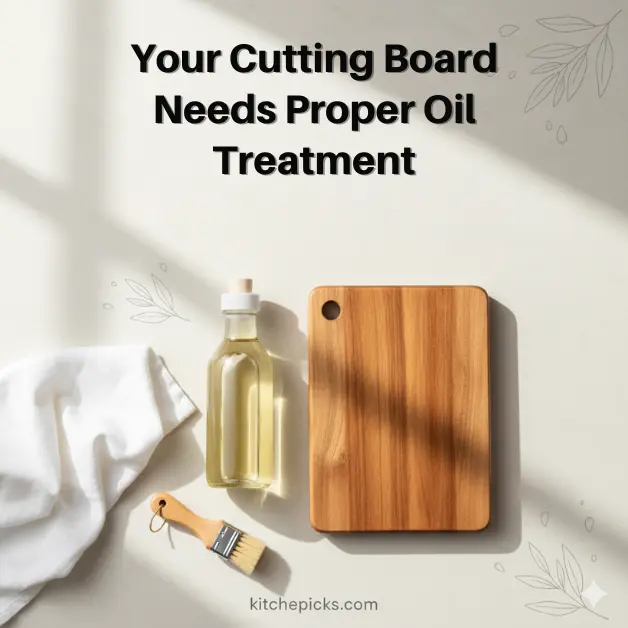
Let me be blunt: an untreated wooden cutting board is living on borrowed time. I’ve watched too many home cooks invest in beautiful walnut or maple boards, only to see them crack and warp within a year because they skipped this essential maintenance step.
Wood is naturally porous, and that’s both its strength and its weakness. Every time you wash your board or prepare juicy vegetables and meats on its surface, moisture seeps deep into those tiny pores. Without protection, this absorbed water wreaks havoc on the wood fibers.
The damage doesn’t happen overnight, but it’s inevitable. I’ve seen boards split right down the middle along the grain. I’ve watched surfaces turn gray and develop stubborn stains that no amount of scrubbing can remove. Proper wooden board protection prevents all of this.
Here’s what makes oil treatment so powerful: it creates an invisible barrier that seals those porous wood fibers. This barrier prevents moisture from penetrating while still allowing the wood to breathe. The result is a stable, protected surface that resists warping and cracking.
But there’s another benefit that surprised me when I first learned about it. Well-oiled wood actually maintains its natural antimicrobial properties better than untreated wood. Research published in the National Institutes of Health database confirms that certain wood species have antimicrobial activities that inhibit bacterial growth on cutting surfaces
Studies have shown that certain hardwoods can naturally inhibit bacterial growth, and this protection works best when the wood surface is properly maintained.
The financial argument for cutting board maintenance is equally compelling. A quality wooden cutting board costs anywhere from $50 to $200 or more. That’s a significant kitchen investment. With regular oil treatment, that same board can serve you faithfully for twenty, thirty, or even fifty years.
Compare that to neglected boards that need replacement every few years. The math is simple: spending a few dollars on mineral oil and fifteen minutes of care every month saves you hundreds of dollars over time.
| Condition | Untreated Board | Well-Maintained Board |
|---|---|---|
| Surface Appearance | Dry, gray, rough texture with visible stains | Rich color, smooth surface, minimal staining |
| Structural Integrity | Prone to cracks, warping, and splitting along grain | Stable shape, no cracks or warping |
| Moisture Resistance | Absorbs water quickly, stays damp longer | Repels moisture, dries evenly and completely |
| Expected Lifespan | 3-5 years with regular use | 20-50 years with proper care |
| Bacterial Concerns | Higher risk of bacterial harboring in damaged areas | Maintains natural antimicrobial properties |
I want you to think about what happens at the microscopic level. When water enters untreated wood, the fibers swell. When it dries out, they contract. This constant expansion and contraction creates stress within the wood structure.
Over time, these stresses accumulate. The wood develops microscopic fractures that grow into visible cracks. The surface becomes increasingly rough and difficult to clean properly.
Oil treatment stops this destructive cycle. The oil fills those pores and creates a stable environment where the wood fibers remain protected from dramatic moisture changes. This is the foundation of effective wooden board protection.
Think of it like this: oil treatment is preventive medicine for your cutting board. You wouldn’t wait until your car engine seizes to add oil. Why would you wait until your cutting board cracks to start protecting it?
The beauty of cutting board maintenance is its simplicity. Unlike many kitchen tasks, this one requires minimal time and effort. Yet the rewards are substantial: a board that performs better, looks beautiful, and lasts exponentially longer.
I’ve converted many skeptics over the years. They start with doubts about whether oil treatment really matters. Then they see their boards transform from dry and dull to rich and lustrous. They notice water beading on the surface instead of soaking in. They experience the satisfaction of using a tool that feels and performs like new, even after years of hard use.
Your cutting board deserves this level of care. It’s one of your most-used kitchen tools, and with proper treatment, it can become a cherished heirloom that you pass down to the next generation. That’s the power of understanding and implementing proper wood treatment practices.
Understanding Mineral Oil for Cutting Board Applications
Let me clear up the confusion surrounding mineral oil and why it’s the gold standard for cutting board care. This petroleum-derived product has earned its reputation through decades of safe use in kitchens worldwide. I’ve researched extensively to bring you the facts about what makes this treatment both effective and safe.
Mineral oil is a clear, odorless, and tasteless liquid that comes from refining crude petroleum. Before you worry about putting petroleum on your food preparation surfaces, understand that the refining process completely transforms this substance. The food grade mineral oil you’ll use bears no resemblance to the crude oil it originated from.
The key lies in understanding how purification creates a product that’s not only safe but ideal for cutting board maintenance. I trust this treatment because science backs up its safety profile completely.
The Science Behind Food Safety
The purification process removes every harmful compound from mineral oil, leaving behind a chemically stable substance that won’t react with your food. I find this fascinating because unlike plant-based oils, food safe mineral oil doesn’t oxidize or turn rancid over time. This stability means it won’t develop the unpleasant smell or taste that would compromise your cutting board.
The FDA regulates mineral oil under Title 21 of the Code of Federal Regulations. According to FDA guidelines , food-grade mineral oil must be highly refined to eliminate aromatic hydrocarbons and meet strict impurity limits. This oversight ensures that products labeled as food-grade meet strict pharmaceutical standards. I appreciate knowing that federal agencies monitor these products for consumer safety.
Here’s what makes the purification so effective: manufacturers use hydrogenation and distillation processes to remove aromatic hydrocarbons and other impurities. The result is a substance classified as USP (United States Pharmacopeia) grade. This means it meets the same purity standards used for medications.
Another critical advantage I want you to understand is that mineral oil creates an inhospitable environment for bacterial growth. Its non-porous nature prevents microorganisms from establishing colonies on your cutting board surface. This protective quality gives me confidence when recommending it for food preparation areas.
The chemical stability of food grade mineral oil for cutting board treatment means it won’t break down into harmful compounds. Unlike some natural alternatives, it remains inert and safe indefinitely. I’ve never encountered a case where properly refined mineral oil caused food contamination issues.
Distinguishing Quality from Risk
Not all mineral oils carry the same safety profile, and this distinction could affect your family’s health. I need to emphasize the critical difference between food-grade and regular industrial mineral oil. This knowledge will protect you from making a dangerous mistake.
Food safe mineral oil undergoes extensive purification that industrial versions skip entirely. The industrial products may contain additives, fragrances, or impurities that are absolutely unsafe for food contact. I’ve seen people mistakenly use baby oil or furniture polish, not realizing these products contain harmful chemicals.
Baby oil, for instance, often includes added fragrances and vitamin E. While these ingredients are fine for skin care, they don’t belong on surfaces that touch your food. The fragrance compounds can transfer to your ingredients and compromise flavors.
When shopping for cutting board treatment, I always look for specific designations on the label. These certifications tell you immediately whether a product is safe:
- USP Grade: Meets United States Pharmacopeia purity standards
- Food Grade or Food Safe: Explicitly approved for food contact surfaces
- NSF Certified: Tested and approved by the National Sanitation Foundation
- White Mineral Oil: Another term for highly refined, colorless food-grade product
I recommend avoiding any mineral oil product that doesn’t clearly state its food-grade status. The price difference between food-grade and industrial mineral oil is minimal, but the safety difference is enormous. Don’t risk your health trying to save a few dollars.
The table below shows the key differences I want you to remember when selecting mineral oil:
| Characteristic | Food Grade Mineral Oil | Regular Mineral Oil | Baby Oil |
|---|---|---|---|
| Purification Level | USP pharmaceutical grade | Industrial grade only | Cosmetic grade with additives |
| Food Contact Safety | FDA approved and safe | Not safe for consumption | Contains unsafe fragrances |
| Odor and Taste | Completely odorless and tasteless | May have petroleum smell | Strong artificial scent |
| Regulatory Status | NSF and FDA certified | No food safety certification | Only cosmetic approval |
| Price Range | $8-15 per 16 oz bottle | $5-8 per 16 oz bottle | $4-7 per 16 oz bottle |
I always verify certifications before purchasing food grade mineral oil for cutting board maintenance. Reading labels carefully takes just a few seconds but ensures you’re protecting rather than contaminating your food preparation surfaces. This small diligence makes all the difference in maintaining a safe kitchen environment.
The bottom line is simple: only use mineral oil explicitly labeled as food-grade or USP grade on your cutting boards. I’ve built my reputation on giving honest advice, and I’m telling you that cutting corners on this decision isn’t worth the risk. Your family’s health depends on using the right product.
The Key Benefits of Using Mineral Oil on Wooden Cutting Boards
The difference between a cutting board that lasts two years and one that serves you for decades often comes down to one simple practice: regular mineral oil application. I’ve seen beautiful hardwood boards reduced to rough, warped surfaces within months of neglect, while properly treated boards remain smooth and functional for twenty years or more. Understanding the specific benefits of mineral oil for cutting boards transforms this from optional maintenance into an essential practice.
When you invest in quality wooden cutting boards, you’re making a commitment to your kitchen. Mineral oil protects that investment through multiple mechanisms that work together to preserve the wood’s integrity. Let me walk you through the concrete advantages that make this treatment indispensable.
Protection Against Moisture Damage
Water is wood’s greatest enemy in the kitchen environment. Every time you wash your cutting board, moisture attempts to penetrate the wood fibers, causing them to swell. When the board dries, these fibers contract. This constant expansion and contraction cycle wreaks havoc on untreated wood.
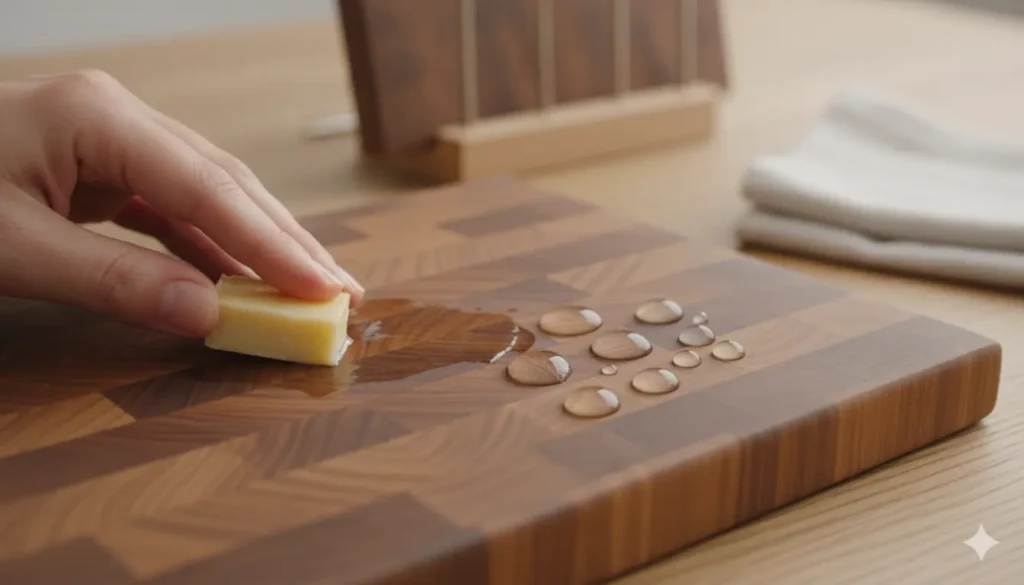
I’ve observed that mineral oil creates a hydrophobic barrier that fundamentally changes how wood interacts with water. The oil penetrates deep into the wood fibers, filling the microscopic spaces where water would otherwise accumulate. This doesn’t make the board waterproof, but it dramatically slows moisture absorption.
- Prevention of raised grain: Untreated boards develop a rough, fuzzy texture as fibers swell and break
- Reduced bacterial harboring: Smooth, sealed surfaces don’t trap food particles and moisture in damaged fibers
- Easier cleaning: Water beads on the surface rather than soaking in, making cleanup faster and more effective
- Stain resistance: Juices from beets, berries, and other pigmented foods wipe away instead of penetrating
In my experience, a well-oiled board maintains its smooth finish indefinitely. The wood stays tight and consistent, rather than developing that rough, splinter-prone surface that makes cutting uncomfortable and cleaning frustrating.
Preventing Cracks and Warping
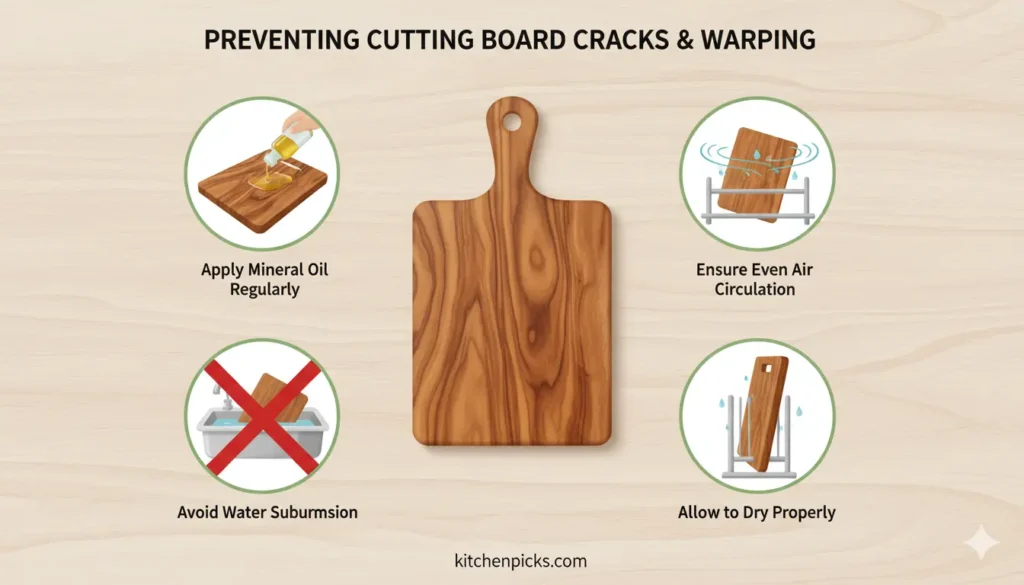
Wood is a dynamic material that responds to its environment. Changes in humidity cause wood to expand and contract across the grain. Without proper wood board oil treatment, these dimensional changes create internal stresses that manifest as visible damage.
I’ve seen countless boards develop problems that mineral oil would have prevented. Cracks typically start small—barely visible lines that appear near the edges or around knots. Over weeks and months, these cracks deepen and spread as moisture repeatedly enters and leaves the wood.
Warping presents a different but equally problematic issue. Boards that aren’t consistently oiled develop uneven moisture content between the top and bottom surfaces. The wetter side expands more than the drier side, causing the board to cup or bow. Once warping begins, it’s nearly impossible to reverse.
Regular mineral oil application addresses these issues by:
- Maintaining consistent moisture content throughout the board’s thickness
- Keeping wood fibers flexible and resilient rather than brittle
- Equalizing environmental stress across all surfaces
- Preventing the drying and shrinkage that opens cracks
The boards in my kitchen that receive monthly oil treatments have remained perfectly flat and crack-free for over a decade. Meanwhile, boards I’ve rescued from friends’ kitchens often show significant warping and splitting after just two or three years of neglect.
Extending Your Cutting Board’s Lifespan
Let’s talk about the economics of kitchen wood care. A quality cutting board represents a significant investment—anywhere from fifty to two hundred dollars for premium hardwoods or end-grain construction. A bottle of food-grade mineral oil costs about five dollars and lasts for dozens of applications.
I consider mineral oil treatment one of the highest-return maintenance practices in any kitchen. The math is compelling: spending thirty dollars on oil over ten years protects a hundred-dollar board investment. Without treatment, that same board might last only two to three years before damage renders it unusable.
The lifespan extension comes from cumulative protection. Each application reinforces the wood’s defenses against:
- Daily washing and exposure to moisture
- Knife cuts that would otherwise penetrate deeper into dry, brittle wood
- Temperature fluctuations that stress untreated boards
- Natural aging processes that dry out wood over time
My oldest cutting board has been in continuous use for twenty-three years. It still presents a smooth, even cutting surface with no cracks, warps, or rough patches. I’ve maintained it with nothing more than regular mineral oil applications—proof that simple, consistent care delivers extraordinary results.
The transformation is remarkable when you compare treated versus untreated boards side by side. Oiled boards develop a rich, warm patina that deepens their natural color. The wood feels substantial and solid in your hands. Untreated boards, by contrast, become progressively lighter, rougher, and more fragile.
Beyond the practical benefits, properly maintained boards simply perform better. The cutting surface remains kind to knife edges, reducing the dulling that occurs on rough or damaged wood. Food preparation becomes more enjoyable when you’re working on a smooth, stable surface that responds well to every cut.
How to Apply Mineral Oil to Your Cutting Board
I’ve found that applying mineral oil correctly makes all the difference in protecting your wooden cutting board. The process itself is straightforward, but following the right steps ensures maximum absorption and lasting protection. With just a little preparation and patience, you’ll transform a dry, thirsty board into a beautifully conditioned kitchen workhorse.
The mineral oil treatment process doesn’t require special tools or professional expertise. You simply need quality food-grade mineral oil, a clean cloth, and enough time to let the wood properly absorb the nourishment it needs.
Getting Your Board Ready for Treatment
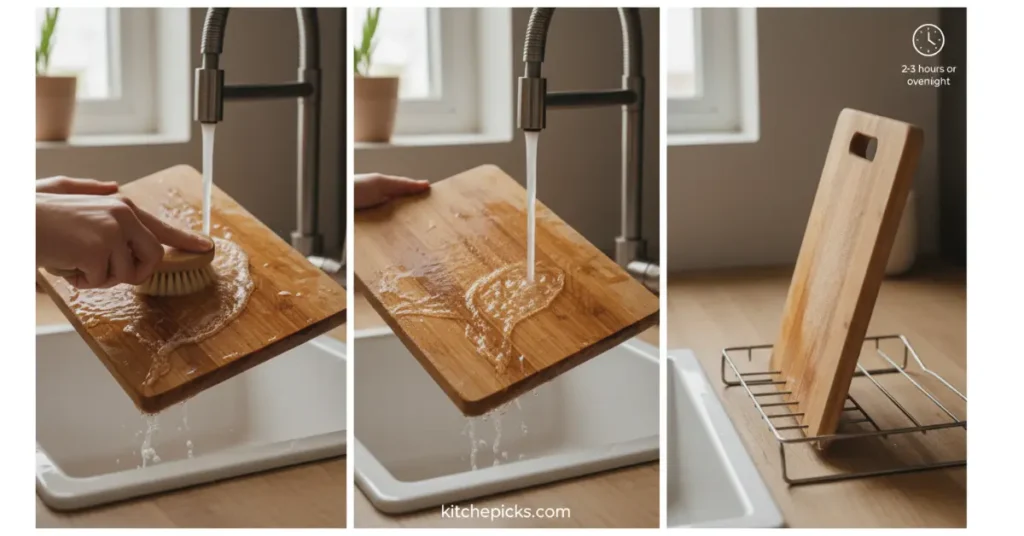
Before you apply any oil, proper preparation sets the foundation for success. I always start by thoroughly washing my cutting board with warm water and mild dish soap. This removes any food particles, stains, or residue that could interfere with oil absorption.
Use a scrub brush or sponge to clean all surfaces, paying extra attention to any grooves or knife marks where debris accumulates. Rinse the board completely under running water until no soap remains.
Here’s the crucial part that many people overlook: your board must be completely dry before oiling. I recommend letting it air-dry for at least 2-3 hours, though overnight is even better. If you apply oil to a damp board, you’ll actually trap moisture inside the wood, which defeats the entire purpose of treatment and can lead to warping or mold growth.
You can test dryness by touching the surface—it should feel room temperature and show no signs of dampness. The wood might look a bit parched and thirsty, which is exactly what you want before treatment.
The Complete Application Method
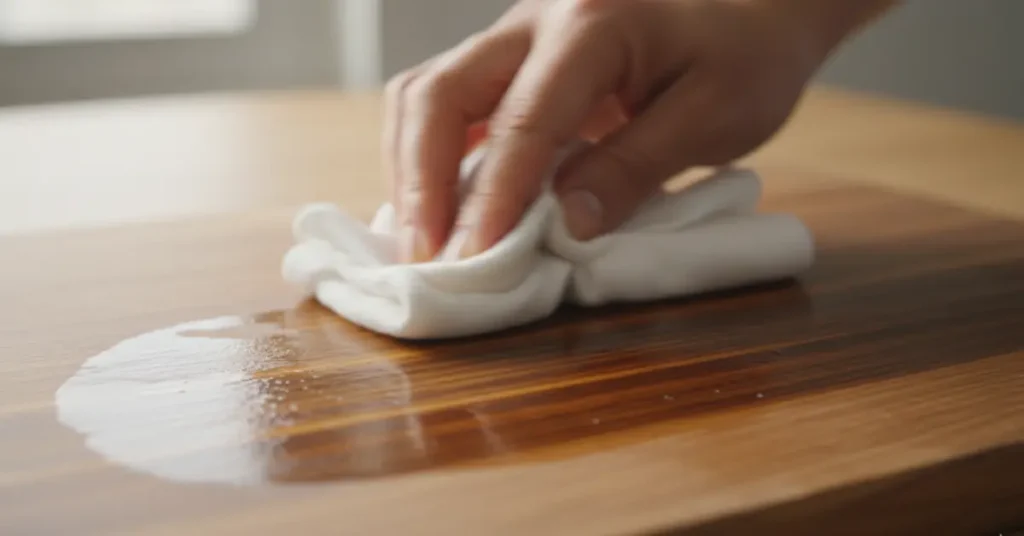
Now comes the satisfying part where you’ll see your board transform right before your eyes. Pour a generous amount of mineral oil for food cutting board directly onto the surface. Don’t be shy with the oil—most people use far too little and wonder why their boards still look dry.
| Board Size | Initial Oil Amount | Expected Coats |
|---|---|---|
| Small (under 12″) | 2-3 tablespoons | 2-3 coats |
| Medium (12-18″) | 4-5 tablespoons | 3-4 coats |
| Large (over 18″) | 6-8 tablespoons | 4-5 coats |
| Extra-Large Butcher Block | 1/2 to 3/4 cup | 5-6 coats |
Take a clean, lint-free cloth or paper towel and spread the oil evenly across the entire surface. Work it into the wood using circular motions, then follow the grain direction. The oil should create a thin, even layer that begins soaking in almost immediately.
Don’t forget these often-missed areas:
- All four edges of the board
- The corners where edges meet
- The bottom surface (flip and treat it too)
- Any handles or decorative details
Let the first coat soak in for 4-6 hours. The wood will drink it up like a plant absorbing water. When you return, check if the surface looks dry again. If it does, apply another coat using the same process.
Continue applying coats until the wood stops absorbing oil and a slight sheen remains on the surface. This tells you the wood fibers are fully saturated. Most boards need 3-4 coats during their first treatment, though very dry or neglected boards might require more.
Allowing Proper Cure Time
Patience during the curing phase ensures your mineral oil treatment delivers maximum protection. After applying each coat, I always wait at least 4-6 hours before adding another layer. This gives the oil time to penetrate deeply into the wood fibers rather than just sitting on the surface.
Once you’ve applied your final coat, the board needs a full 24-hour rest period before you use it for food preparation. During this time, the oil continues migrating through the wood and reaching its full protective potential.
You might notice the board feels slightly oily to the touch after treatment. This is completely normal and actually a good sign. The surface will gradually lose this oily feel over the next day or two as the mineral oil fully penetrates and excess oil evaporates.
If any oil pools on the surface after 24 hours, simply wipe it away with a clean cloth. Your cutting board is now properly conditioned and ready to provide years of reliable service in your kitchen.
Best Mineral Oil Products for Cutting Boards: My Top Picks
Choosing the best mineral oil for cutting boards can feel overwhelming with so many options available, but I’ve narrowed down my top three recommendations. After researching formulations, testing different brands, and comparing value propositions, I’ve identified products that deliver consistent results. Each option I’m sharing offers unique advantages depending on your specific needs and budget.
I’ve selected these three products based on several critical factors. Quality and purity matter most when you’re treating surfaces that contact food. Price-to-value ratio also plays an important role, especially if you maintain multiple boards or have large surfaces to treat.
My recommendations span different price points and bottle sizes. This variety ensures you’ll find the right match whether you’re a beginner treating your first board or an experienced woodworker maintaining a collection.
Howard Products Cutting Board Oil
I recommend Howard Products Cutting Board Oil as the ideal starting point for anyone new to cutting board maintenance. This product consistently delivers excellent results at a price point that won’t make you hesitate to apply it generously. The 12-ounce bottle typically costs less than most premium options while providing professional-grade protection.
The medium viscosity of Howard’s formula strikes the perfect balance. It penetrates deeply into wood fibers without being so thin that it drips everywhere during application. I appreciate how it absorbs within a reasonable timeframe, usually requiring just a few hours of drying time.
Howard has built a trusted reputation in wood care products over decades. Their cutting board oil uses pure, food-safe mineral oil without unnecessary additives. You’ll find this product at most hardware stores and online retailers, making it incredibly convenient to purchase.
The brand’s widespread availability means you won’t struggle to find it when you need to reorder. I’ve used Howard Products on everything from maple cutting boards to walnut serving platters. The consistency of quality across different wood types impressed me significantly.

- Cutting Board Oil is a deep penetrating 100% Pure USP Food Grade Mineral Oil that is tasteless, odorless, colorless, and…
- Cutting Board Oil rejuvenates dry wood, including: cutting boards, butcher blocks, countertops, wooden bowls and utensil…
- Deeply penetrates into wood pores, bringing out the rich natural wood color and helps prevent drying and cracking
John Boos Mystery Oil
John Boos Mystery Oil represents my top choice for serious home cooks willing to invest in premium board maintenance. This product comes from a company that’s manufactured commercial cutting boards since 1887, bringing unmatched expertise to their formulation. Their deep understanding of wood behavior translates directly into superior protection.
Mystery Oil actually contains a mineral oil and beeswax blend, which I’ll explore more thoroughly in the next section. This combination provides both deep conditioning and surface protection in one application. The beeswax component creates a subtle barrier that enhances moisture resistance without feeling waxy or sticky.
I consider this professional-grade treatment worth the slightly higher investment. The results speak for themselves through enhanced wood grain appearance and longer-lasting protection. Your boards will maintain their rich color and smooth texture with less frequent applications.
John Boos products undergo rigorous testing standards. The brand’s reputation in commercial kitchens means they can’t compromise on quality. I trust this product completely for my most valuable cutting boards and butcher blocks.

- Wood Cutting Board Oil: Pamper and prep the wood of your John Boos chopping blocks, cutting boards, or charcuterie board…
- Crafted for Your Home: Our Mystery Oil is designed to stop drying, splitting, and cracking of wooden surfaces between us…
- Made for Life: Mystery Oil’s natural white mineral oil and beeswax formula is safe for food surfaces.
Thirteen Chefs Food Grade Mineral Oil
Thirteen Chefs Food Grade Mineral Oil offers exceptional value for anyone maintaining multiple boards or large work surfaces. The brand provides generous bottle sizes, typically ranging from 16 to 32 ounces, at highly competitive prices. This option makes economic sense when you need to treat several boards regularly.
The pure USP-grade formulation meets pharmaceutical standards for purity and safety. I appreciate knowing that this mineral oil contains no additives or questionable ingredients. The USP designation guarantees you’re getting food-safe quality suitable for direct food contact.
Larger bottle sizes reduce packaging waste and save money over time. I calculate that a 32-ounce bottle of Thirteen Chefs costs roughly half the per-ounce price of smaller premium bottles. This significant savings adds up quickly if you maintain a collection of cutting boards.

- FOOD GRADE – This butcher block conditioner is lab tested to ensure that it meets food safety standards, and is also col…
- PROTECTION – Use this mineral oil for cutting board restoration and protection to prevent cracking and drying. It also m…
- EASY APPLICATION – This butcher block oil has a push-applicator cap and squeeze-bottle design that makes maintenance a b…
The viscosity falls in the medium range, similar to Howard Products. It spreads easily across board surfaces and penetrates efficiently. I’ve found it performs identically to more expensive options in side-by-side comparisons.
| Product | Best For | Key Advantage | Price Range |
|---|---|---|---|
| Howard Products | Beginners | Widely available, trusted brand | Budget-friendly |
| John Boos Mystery Oil | Premium users | Professional-grade blend with beeswax | Premium investment |
| Thirteen Chefs | Multiple boards | Excellent value in large sizes | Best per-ounce value |
Each of these products represents the best mineral oil for cutting boards in its respective category. Your choice depends primarily on your specific situation and priorities. Budget-conscious beginners should start with Howard Products, while those seeking ultimate performance will appreciate John Boos.
I encourage you to consider how many boards you maintain when making your selection. Single-board owners can justify premium options more easily. Those with multiple boards will appreciate the economy of larger Thirteen Chefs bottles.
Whichever product you choose, you’re selecting from proven formulations that protect wood effectively. These three options have earned my confidence through consistent performance and reliable results.
beeswax and mineral oil for cutting board
I’ve discovered that using beeswax and mineral oil for cutting board care creates a powerful duo that delivers results neither ingredient can achieve alone. This combination treatment has transformed how I maintain my wooden boards, giving them professional-level protection and a gorgeous finish.

- Superior Surface Sealing: Our cutting board gel combines food grade mineral oil for wood cutting boards and beeswax for …
- Advanced Cutting Board Wax Formula: This cutting board wax, enriched with beeswax for cutting board and mineral oil acts…
- Comprehensive Surface Nourishment: Our gel is formulated with cutting board oil and food grade beeswax, offering a dual-…
The oil-wax blend works like a two-step defense system for your wood. While pure mineral oil does an excellent job, adding beeswax takes the protection to another level entirely.
Think of it this way: mineral oil is your deep conditioner, while beeswax is your protective topcoat. Together, they create something truly special for your cutting boards.

The Power of Combining These Two Ingredients
Mineral oil penetrates deep into the wood fibers, conditioning from within and preventing dryness. Beeswax, on the other hand, creates a water-resistant surface seal that locks in that moisture and keeps contaminants out.
When I first applied an oil-wax blend to my walnut cutting board, I noticed an immediate difference. The surface developed a beautiful, subtle sheen that looked professionally maintained. It wasn’t glossy or artificial—just a natural luster that enhanced the wood grain.
The typical ratio I use is 4 parts mineral oil to 1 part beeswax. This proportion gives you the best of both worlds: deep conditioning from the oil and lasting surface protection from the wax.
Here’s what makes this combination so effective:
- Deeper moisture retention: The beeswax seals in the mineral oil, preventing it from evaporating too quickly
- Enhanced stain resistance: The wax barrier helps repel food particles and liquids before they can penetrate
- Extended protection: You’ll need fewer treatments because the combination lasts longer than oil alone
- Superior moisture defense: The dual-layer approach blocks water more effectively than either ingredient separately
The beeswax component slightly extends the time between treatments. With my own boards, I’ve found that monthly applications of oil-wax blends work perfectly, whereas pure mineral oil requires weekly attention for new boards.
I particularly love how the wax adds firmness to the surface without making it feel waxy or sticky. It creates a smooth, almost silky texture that makes cutting and chopping feel better. My chef’s knife glides across the surface with just the right amount of resistance.
How to Apply Oil-Wax Blends Successfully
Applying beeswax and mineral oil for cutting board treatment requires a slightly different approach than using pure oil. I’ve refined my technique over time, and these methods work consistently well.
First, warm the mixture slightly for easier application. I place my container of oil-wax blend in a bowl of warm water for about 10 minutes. This softens the beeswax just enough to make spreading effortless.
Never microwave the mixture—gentle, indirect heat is safer and more effective. The warm water bath method gives you perfect consistency every time.
Apply the warmed blend to your clean, dry board using a soft cloth. Work it into the wood with circular motions, paying extra attention to end-grain areas that absorb more product. You’ll need to massage it in more thoroughly than pure mineral oil.
Here’s my step-by-step process:
- Clean your board and let it dry completely
- Warm the oil-wax blend using the water bath method
- Apply a generous amount with a soft, lint-free cloth
- Work the mixture into the wood grain using firm, circular motions
- Let it absorb for 4-6 hours or overnight
- Buff the surface with a clean cloth to bring out the lustrous finish
The buffing step is crucial with oil-wax blends. After the mixture has absorbed, take a clean cloth and rub the surface vigorously. This removes any excess product and creates that beautiful, professional sheen I mentioned earlier.
Should you make your own blend or buy premade products? I’ve tried both approaches. Making your own costs less—you can create a large batch for just a few dollars. However, premade products like John Boos Mystery Oil offer convenience and consistent ratios.
For beginners, I recommend starting with a quality premade option. Once you understand how the mixture should look and feel, experimenting with homemade versions becomes easier and more rewarding.
The oil-wax combination represents an upgrade in cutting board care that’s absolutely worth considering. Your boards will look better, last longer, and resist damage more effectively than with oil-only treatments.
Alternatives to Mineral Oil for Cutting Boards
I’ve tested numerous alternatives to mineral oil over the years, and each brings its own set of benefits and drawbacks to the table. The market offers several legitimate options for cutting board care. Some work well in specific situations, while others fall short of expectations.
Understanding these alternatives helps you make informed decisions about your cutting board maintenance. I’ll walk you through the most popular options and explain when they might make sense for your kitchen.
Coconut Oil and Other Natural Options
Fractionated coconut oil stands out as the most viable natural alternative to mineral oil for cutting boards. Unlike regular coconut oil, the fractionated version has been processed to remove long-chain fatty acids. This process creates a product that resists rancidity much better than ordinary coconut oil.
Regular coconut oil solidifies at room temperature and can turn rancid within weeks when applied to wood. I don’t recommend it despite its popularity in natural living circles.

- PREMIUM FOOD GRADE CARE – CLARK’S fractionated coconut oil is an organic fractionated coconut oil made from pure MCT coc…
- DEEP WOOD NOURISHMENT – Our liquid coconut oil penetrates deeply into butcher blocks, cutting boards, bamboo boards, sal…
- PREVENTS DAMAGE: Regular use every 3–4 weeks with CLARK’S fractionated coconut oil organic helps prevent wood from dryin…
Walnut oil offers another plant-based option that many woodworkers appreciate. It penetrates wood fibers effectively and provides decent moisture protection. However, this oil requires reapplication every two to three weeks because it gradually oxidizes and loses effectiveness.
The major concern with walnut oil involves allergies. Anyone with tree nut sensitivities should never use walnut oil on cutting boards. Cross-contamination poses serious health risks in these situations.
Tung oil and linseed oil fall into the “drying oil” category. These oils polymerize when exposed to air, creating a harder finish. Food-grade versions exist, but I advise caution. Many commercial products contain metallic driers and chemical additives that aren’t food safe.
Pure, raw tung oil takes weeks to cure properly. The drying process makes your cutting board unusable during that time. Boiled linseed oil often contains petroleum-based additives, making it unsuitable for food contact surfaces.
Several commercial conditioning products use blended formulations with plant-derived ingredients. These products typically combine oils with waxes to create all-in-one treatments. Quality varies significantly among brands, and prices often run higher than simple mineral oil.
| Oil Type | Rancidity Risk | Application Frequency | Special Considerations |
|---|---|---|---|
| Fractionated Coconut Oil | Low | Every 3-4 weeks | Higher cost, pleasant scent |
| Walnut Oil | Moderate | Every 2-3 weeks | Allergy concerns, good penetration |
| Regular Coconut Oil | High | Weekly (if used) | Solidifies, goes rancid quickly |
| Mineral Oil | None | Monthly | Proven performance, hypoallergenic |
When to Choose Alternatives
Certain situations make alternatives more appealing than traditional mineral oil. Personal values and priorities play a significant role in product selection. I respect these considerations even though they differ from my approach.
People who prefer exclusively plant-based products in their homes might choose fractionated coconut oil. This choice aligns with their philosophical stance against petroleum-derived products. The performance difference matters less than the principle involved.
Some individuals prioritize “natural” labels and feel more comfortable with oils derived from plants. This preference reflects growing consumer interest in natural alternatives across all product categories. The cutting board care market has responded with numerous natural options.
Specialty woodworking applications sometimes benefit from specific oil properties. Artisans creating decorative boards might choose oils that enhance wood grain appearance. These boards serve display purposes rather than heavy food preparation use.
Gifting situations occasionally influence product selection. A cutting board package with coconut oil or walnut oil might appeal to recipients who value natural products. The presentation matters in these contexts.
Budget considerations rarely favor alternatives. Most natural options cost significantly more than mineral oil per ounce. However, some people willingly pay premium prices for products matching their values.
Why I Still Prefer Mineral Oil
After testing various alternatives extensively, I consistently return to mineral oil for my cutting boards. The practical advantages outweigh any theoretical benefits of natural alternatives. Chemical stability represents the most compelling reason to choose mineral oil.
Mineral oil never goes rancid. This property alone makes it superior for cutting board maintenance. You can apply it once and forget about oxidation, spoilage, or unpleasant odors developing over time.
The hypoallergenic nature of mineral oil provides another significant advantage. No one develops allergic reactions to properly refined, food-grade mineral oil. I can treat any cutting board without worrying about cross-contamination issues.
Storage convenience matters more than people realize. Mineral oil requires no refrigeration and maintains its properties indefinitely. Natural alternatives often need cool storage and have limited shelf lives.
Availability and affordability make mineral oil the practical choice. Every pharmacy and most grocery stores carry food-grade mineral oil. The cost remains remarkably low compared to specialty alternatives.
The proven track record speaks volumes. Commercial kitchens and professional butchers have relied on mineral oil for decades. This isn’t mere tradition—it’s evidence of superior performance in demanding environments.
Application frequency differences add up over time. Monthly mineral oil treatments versus weekly or biweekly applications of alternatives mean less maintenance work. Busy households appreciate this convenience.
I acknowledge that personal preferences vary. Some people genuinely prefer working with plant-based products regardless of performance metrics. That’s a valid choice. However, when someone asks me for the most effective alternative to mineral oil for cutting boards, I tell them honestly: stick with mineral oil.
The conventional wisdom exists for good reasons. Mineral oil’s dominance in cutting board care reflects genuine superiority for this specific application. Sometimes the traditional approach really is the best approach.
Special Considerations for Different Cutting Board Materials
Understanding your cutting board’s specific material characteristics transforms basic maintenance into precision care. I’ve learned through years of experience that one-size-fits-all approaches rarely deliver the best results when it comes to board conditioning. The type of material, wood grain orientation, and construction method all significantly impact how your board absorbs and retains protective treatments.
Tailoring your application technique to match your board’s unique properties ensures you’re not wasting product or missing crucial protection opportunities. Let me walk you through the essential differences that matter most for successful maintenance.
Treating Bamboo Boards with Mineral Oil
Many people assume bamboo boards don’t need the same care as traditional wooden surfaces, but this misconception leads to premature deterioration. Despite being technically a grass rather than hardwood, bamboo requires equally diligent mineral oil treatment to maintain its integrity. I recommend using mineral oil for bamboo cutting board maintenance with the same frequency you’d treat maple or walnut.

- BAMBOO CUTTING BOARD of 3 – Keechee bamboo cutting boards for kitchen include 3 practical sizes: 15×10 in, 12×8 in, and …
- UPGRADE BAMBOO CUTTING BOARDS – Our bamboo cutting boards undergo high-temperature carbonization at 500°F (260°C), reduc…
- STURDY CUTTING BOARDS -Each wood cutting board is made using a cross-laminated bamboo structure, where multiple layers a…
The key difference lies in bamboo’s incredibly dense cellular structure. This natural density means bamboo absorbs oil more slowly than most wood species. When I treat my bamboo boards, I always allow extra time for penetration—sometimes up to 8 hours between coats.
I’ve noticed that bamboo’s tight grain can fool you into thinking it’s adequately sealed when it actually needs more conditioning. The surface may look saturated while the deeper layers remain dry. My solution is to apply thinner coats more frequently rather than heavy applications that sit on the surface.

Without proper oiling, bamboo becomes just as susceptible to cracking, splitting, and moisture damage as any wooden board. The material’s reputation for durability only holds true when you maintain consistent protection. I’ve rescued several neglected bamboo boards by implementing a rigorous reconditioning schedule that brought them back to life.
Hardwood vs Softwood Treatment
The porosity of your board’s wood species directly determines how often you’ll need to reapply mineral oil. Dense hardwoods like maple, walnut, cherry, and teak absorb conditioning treatments relatively slowly but retain protection much longer than softer alternatives. I’ve found my maple boards can go 4-6 weeks between treatments with regular use.
Softwoods present different challenges entirely. Pine, cedar, and other softer species feature more open grain structures that drink up oil quickly. While this rapid absorption might seem beneficial, it actually means the protection dissipates faster as well.
My practical recommendation is to monitor how quickly your board’s surface returns to a dry, pale appearance after treatment. This visual cue tells you exactly when your specific board needs attention. Hardwood boards maintain their rich, oiled appearance longer, while softwood surfaces lighten up within days.
I prefer hardwood cutting boards specifically because they offer the best balance between maintenance requirements and durability. The investment in quality hardwood pays dividends through reduced treatment frequency and extended lifespan.
End-Grain vs Edge-Grain Boards
Board construction style dramatically affects your mineral oil application strategy. End-grain boards—where wood fibers face upward like a bundle of straws—are significantly more porous than edge-grain designs. This means end-grain surfaces absorb substantially more oil during each treatment cycle.
I always budget for 50-75% more mineral oil when conditioning end-grain boards compared to edge-grain equivalents. The vertical fiber orientation creates countless tiny channels that pull conditioning deep into the wood structure. This increased absorption capacity requires more generous initial applications to achieve proper saturation.
The trade-off for this extra maintenance is remarkable performance. End-grain boards are gentler on knife edges and feature self-healing properties where the wood fibers close back together after cutting. I consider the additional oil investment worthwhile for these premium benefits.
Edge-grain boards, where the wood’s long side faces up, create a smoother, less porous surface. These boards need less frequent treatment and consume less product per application. However, they show knife marks more readily and don’t offer the same blade-preserving qualities as end-grain construction.
My approach is to assess your board’s construction type first, then adjust both the quantity of oil applied and the frequency of treatments accordingly. End-grain boards in my kitchen receive attention every 2-3 weeks, while edge-grain boards comfortably stretch to monthly maintenance. Understanding these fundamental differences helps you provide precisely the care your specific cutting board needs to thrive for decades.


Cutting Board Maintenance Schedule and Best Practices
I’ve learned through years of experience that proper maintenance schedules make the difference between boards that last decades and those that fail within months. Creating a routine for your cutting board care doesn’t require complicated systems or constant attention. What it does require is understanding your board’s needs and responding to them consistently.
The beauty of wooden cutting board maintenance lies in its simplicity. Once you establish good habits, caring for your board becomes second nature. I’ll share my proven approach that has kept my boards in excellent condition for over twenty years.
Using food safe mineral oil for cutting board applications remains the foundation of any successful maintenance program. This single practice prevents the majority of problems that cause boards to deteriorate prematurely. When combined with proper cleaning and storage, your board will serve you reliably for generations.
Optimal Oiling Frequency
New cutting boards require intensive initial conditioning that many people skip, leading to disappointing results. I apply oil daily for the first week after purchasing a new board. This frequent treatment allows the wood fibers to become fully saturated with protective oil.
During the first month, I continue weekly applications. This establishes a protective barrier deep within the wood structure. After this conditioning period, the board holds moisture better and requires less frequent attention.
For regularly-used boards, monthly applications of food safe mineral oil for cutting board maintenance keep the wood properly nourished. If you use your board daily, this schedule prevents dryness without over-saturating the wood. Boards used occasionally need treatment quarterly, or whenever they show signs of dryness.
Usage intensity dramatically affects oiling needs. Boards that see heavy daily use require more frequent treatment than those used weekly. Washing frequency matters too—every wash strips away some protective oil, necessitating replacement.
Home humidity levels play a surprising role in maintenance schedules. Dry climates pull moisture from wood faster, requiring more frequent food safe mineral oil for wood cutting board applications. Humid environments allow boards to retain moisture longer, reducing treatment frequency.
| Board Age/Status | Treatment Frequency | Application Method | Expected Results |
|---|---|---|---|
| Brand New (First Week) | Daily applications | Heavy saturation coating | Deep wood conditioning and initial protection |
| New (First Month) | Weekly treatments | Moderate coating layers | Establishing protective barrier throughout wood |
| Regular Use (Daily) | Monthly maintenance | Standard application | Sustained moisture resistance and smooth surface |
| Occasional Use (Weekly) | Quarterly treatments | Light to moderate coating | Prevention of drying and cracking |
| Stored/Rarely Used | Every 4-6 months | Light maintenance coating | Basic protection against environmental damage |
Recognizing When Your Board Needs Attention
Your cutting board communicates its needs through visible and tactile changes. Learning to read these signs prevents damage before it becomes permanent. I check my boards regularly for these telltale indicators.
A dry, dull appearance signals that the wood has lost its protective oil layer. Well-maintained boards show a subtle, healthy sheen. When that glow disappears, the wood is asking for treatment with food safe mineral oil for cutting board restoration.
Water absorption patterns reveal board condition instantly. Drop water on a properly oiled board, and it beads on the surface. When water soaks in quickly instead, the protective barrier has weakened and needs replenishment.
The surface texture changes as boards dry out. Run your hand across the wood—it should feel smooth and slightly waxy. Rough, fuzzy textures indicate dried-out fibers that require immediate treatment with food safe mineral oil for wood cutting board applications.
Light gray patches appearing on darker woods show severely dried areas. These spots indicate wood that has lost significant moisture content. While alarming in appearance, they respond well to proper oiling within a few applications.
Practices for Lasting Board Performance
I’ve developed habits beyond regular oiling that extend cutting board lifespan dramatically. These practices address the complete care ecosystem your board needs. Implementing them transforms good maintenance into exceptional preservation.
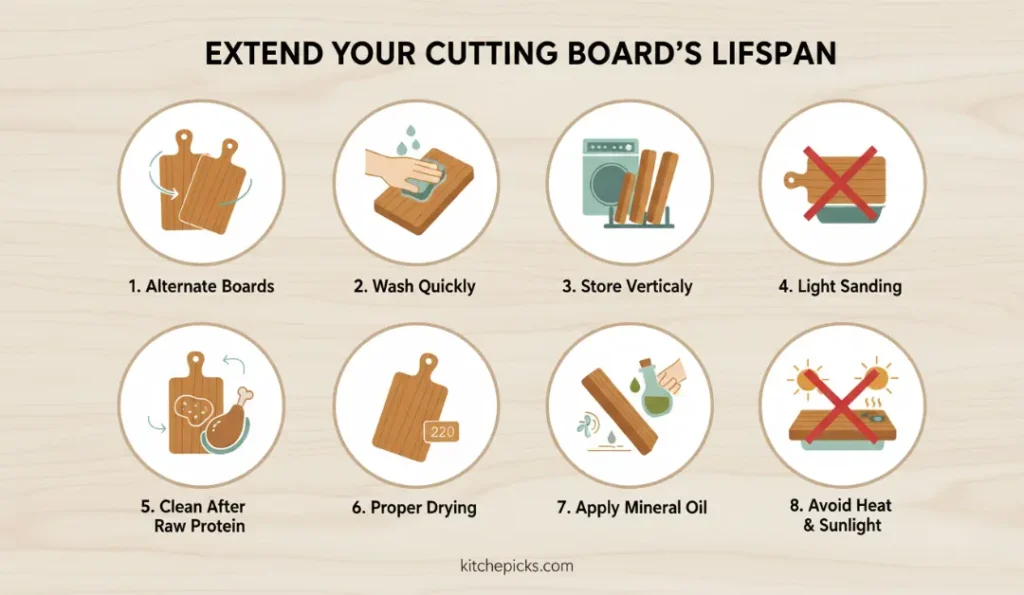
Alternating between two boards allows thorough drying between uses. This simple practice prevents moisture accumulation that leads to warping. I rotate my boards daily, giving each one full recovery time before the next use.
Never soak wooden boards in water or place them in dishwashers. These practices introduce excessive moisture that causes irreversible damage. Quick washing with mild soap and immediate drying protects the wood structure while maintaining hygiene standards.
Storage method matters more than most people realize. I store boards vertically rather than flat, promoting even air circulation around all surfaces. This prevents moisture concentration on contact surfaces and reduces warping risk.
Here are my essential long-term care practices:
- Sand periodically with fine-grit sandpaper (220-grit) to refresh surfaces and remove minor knife marks
- Clean immediately after cutting raw proteins to prevent bacterial growth and staining
- Dry thoroughly by standing boards on edge after washing, allowing complete air exposure
- Apply only food safe mineral oil for cutting board treatments to maintain kitchen safety standards
- Monitor environmental conditions and adjust oiling frequency based on seasonal humidity changes
Periodic light sanding removes the thin surface layer where most knife marks accumulate. This refreshes the cutting surface without removing significant wood material. After sanding, condition the board as if it were new, with several applications over the following week.
Temperature extremes stress wood fibers and accelerate deterioration. I never place hot pots on wooden boards or expose them to direct sunlight for extended periods. Maintaining moderate, consistent temperatures preserves wood integrity.
These practices, combined with regular applications of food safe mineral oil for wood cutting board maintenance, create conditions for exceptional longevity. I’ve watched boards maintained this way serve families for multiple generations. They become kitchen heirlooms rather than disposable tools, developing character and patina that tells the story of countless meals prepared.
The investment of time in proper maintenance pays dividends far beyond board preservation. It connects you to traditional craftsmanship and sustainable kitchen practices. Each application of oil becomes a moment of appreciation for quality tools that serve you faithfully when properly cared for.
Protecting Your Kitchen Investment
Your cutting board deserves the same care you give to your knives and cookware. I’ve seen countless boards last decades with simple monthly maintenance. The answer to is mineral oil safe for cutting boards is an absolute yes when you choose food-grade products.
The time investment is minimal. Ten minutes each month protects a board you use daily. The cost is even smaller. A single bottle of mineral oil for cutting board treatment lasts months and costs less than replacing a damaged board.
I encourage you to check your boards today. Run your fingers across the surface. Does it feel dry or rough? That’s your sign to act now. Order quality mineral oil if you don’t have it on hand. Your boards work hard for you, and they need this basic protection.
Proper maintenance means your cutting boards stay hygienic, beautiful, and functional for years. I’ve maintained my own boards this way since I started cooking seriously. The results speak for themselves. Boards that could have cracked or warped still look and perform like new.
Take pride in your kitchen tools. Start your maintenance routine this week. Your cutting boards will reward you with reliable service and lasting quality. This simple practice makes a real difference in your kitchen’s daily performance.
🪵 Mineral Oil for Cutting Boards
Everything you need to know about caring for your cutting board
Is mineral oil safe for cutting boards?
Yes—only food-grade/USP mineral oil is safe for food contact; avoid industrial oils or baby oil.
Difference between food-grade and regular mineral oil?
Food-grade is highly purified for safety; regular mineral oil may contain harmful impurities.
How often should I apply mineral oil?
Daily for a week, weekly for a month, then monthly—oil whenever the board looks dry.
Can I use mineral oil on bamboo boards?
Yes; bamboo also needs oiling, though it absorbs oil more slowly.
Best mineral oil for cutting boards?
Howard, John Boos Mystery Oil, and Thirteen Chefs are reliable food-safe choices.
Should I use beeswax + mineral oil?
Yes; mineral oil conditions while beeswax adds a protective, water-resistant seal.
Alternatives to mineral oil?
Fractionated coconut and walnut oil work, but can go rancid; mineral oil is more stable.
Is mineral oil good compared to other treatments?
Yes—it’s affordable, stable, odorless, and doesn’t go rancid.
How do I apply mineral oil?
Clean and dry the board, apply generously, let it soak, and repeat until saturated.
How can I tell if my board needs oil?
If it looks dull, feels dry, or water absorbs instead of beading, it needs oil.
Can mineral oil prevent cracking?
Yes; it stabilizes moisture levels and reduces stress that causes splits.
Do end-grain and edge-grain boards need different care?
End-grain absorbs more oil and needs more frequent treatments.