
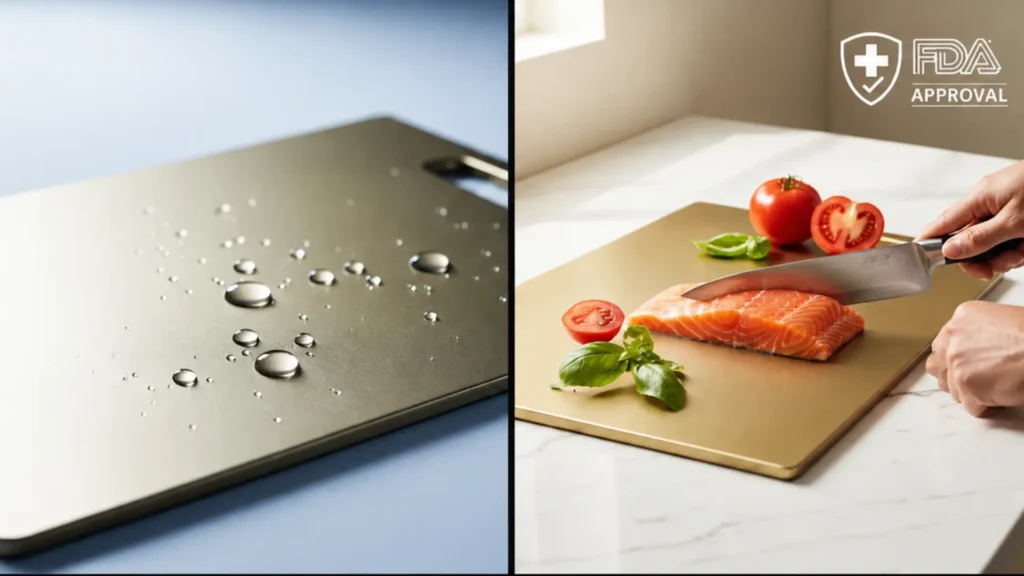
Are titanium cutting boards food safe? If you’ve wondered whether that sleek metal surface is truly safe for prepping raw chicken, slicing acidic tomatoes, or daily meal prep—you’re asking the right question. Pure titanium and titanium nitride (TiN) coatings are FDA-compliant for food contact, chemically inert, and used in medical implants where safety standards are far stricter than kitchenware. This guide examines the FDA compliance, toxicity concerns, and hygiene advantages of titanium cutting boards, comparing them to plastic, wood, and stainless steel to show why they’re among the safest cutting surfaces available.
Are Titanium Cutting Boards Food Safe? What FDA Standards Say
Titanium’s safety profile stems from decades of use in medicine. Surgeons rely on it for pacemakers, joint replacements, and dental implants because it’s biocompatible—meaning your immune system won’t reject it. The metal was first introduced into surgeries in the 1950s and is now used in everything from neurosurgery to hip replacements, spinal fusion cages, and bone conduction hearing aids.
What makes titanium uniquely safe is its protective oxide layer. When exposed to oxygen, titanium forms a thin, chemically impermeable film that prevents corrosion from bodily fluids—and by extension, from the acids, oils, and proteins in your food. This oxide layer is “strongly adhered, insoluble, and chemically impermeable, preventing unfavorable reactions between the metal and the surrounding environment”. Unlike reactive metals that leach ions over time, titanium remains bio-inert even after years of exposure to harsh conditions.
The FDA recognizes titanium dioxide (TiO₂) as safe for food-contact materials under 21 CFR 178.3297, approving its use in packaging and processing equipment. For your kitchen, this means pure titanium cutting boards won’t leach metals into acidic foods like tomatoes, citrus, or marinades—a risk documented with low-grade stainless steel. The non-porous surface also eliminates the microscopic grooves where bacteria colonize, making titanium uniquely hygienic.
Why Titanium Grades Matter for Food Safety
Commercially pure titanium comes in multiple grades based on oxygen content. Grade 1 titanium (0.18% oxygen) offers maximum ductility and is the standard for food-contact products like camping cookware and cutting boards. Outdoor brands like Snow Peak, Toaks, and Keith Titanium exclusively use Grade 1 or Grade 2 for pots and tableware because these grades balance corrosion resistance, food safety, and ease of manufacturing. While aerospace applications use stronger titanium alloys (like Ti-6Al-4V), food-contact items prioritize purity to ensure zero chemical migration.
Titanium Nitride (TiN) Coating = Equally Safe
Many titanium cutting boards feature a gold-colored TiN coating applied through vacuum deposition—a process that bonds nitrogen to titanium at the molecular level at high temperatures. This isn’t paint or a spray-on finish; it’s a ceramic layer tested to ISO 10993-5 biocompatibility standards for medical devices.
Titanium nitride is classified as a refractory solid exhibiting extreme hardness (9.0 on the Mohs scale, equivalent to sapphire), thermal conductivity, and a high melting point. It’s routinely used to coat surgical instruments and orthopedic implants because it withstands repeated sterilization cycles at 200°C without degrading. Medical implants coated with TiN have demonstrated excellent biocompatibility in cytotoxicity studies, with no adverse cellular response.
The FDA approved TiN for food-contact applications in PET packaging materials (Food Contact Notification 2252), confirming it won’t release harmful substances during normal use. A 2016 study published in the journal Materials found that TiN coatings on titanium showed “good cell viability” and “no cytotoxic effects” even at increased coating thicknesses. If TiN is safe enough for tools that enter your bloodstream during surgery, it’s more than safe for your cutting board.
Addressing the Flaking Concern
A common fear: “Will TiN coating chip into my food?” The answer is no. Unlike surface treatments that wear away, TiN is molecularly bonded to the titanium substrate through physical vapor deposition—there’s no particle shedding even after years of knife contact. The coating’s extreme hardness (harder than stainless steel) means knife blades glide over the surface without abrading it. In fact, TiN’s primary industrial use is as a coating for drill bits and cutting tools precisely because of its resistance to wear.
How Titanium Compares to Other Cutting Board Materials
Understanding titanium’s safety requires context. Here’s how it stacks up against common alternatives:

Plastic Boards: The Microplastics Problem
A landmark 2023 study published in Environmental Science & Technology found that polyethylene cutting boards release between 7.4 and 50.7 grams of microplastics per person annually—equivalent to millions of particles. Researchers detected up to 50,000 microplastic particles per square centimeter on heavily used plastic boards, with knife cuts generating fragments that accumulate directly in food. Every chop sheds plastic, and dishwashing doesn’t eliminate particles embedded in deep grooves.
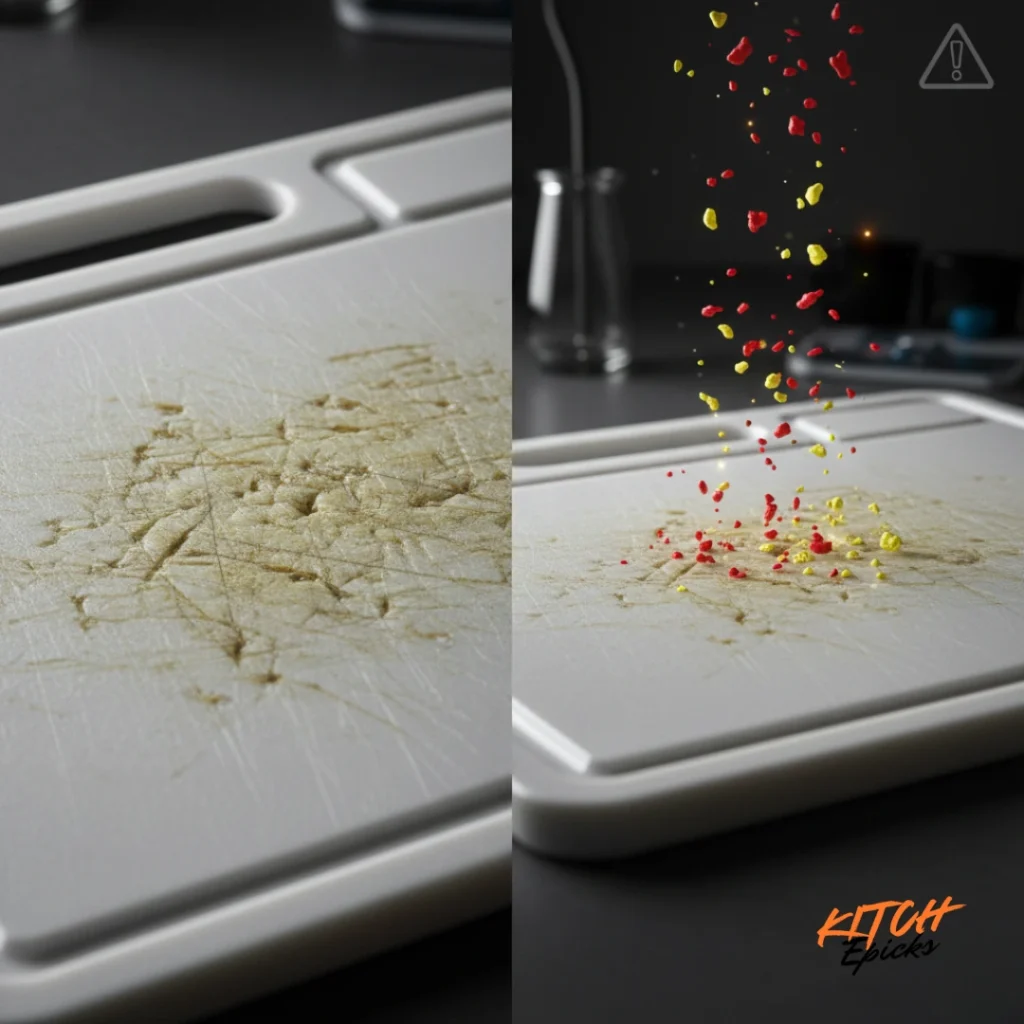
The health implications are emerging as a serious concern. A December 2024 review in the Journal of the American Chemical Society concluded that microplastic exposure is “suspected” to harm reproductive, digestive, and respiratory health, with suggested links to colon and lung cancer. Stanford Medicine researchers noted in January 2025 that animal and cellular studies have linked microplastics to inflammation, impaired immune function, and abnormal organ development. While plastic boards initially resist bacterial growth, deep grooves trap pathogens that standard cleaning can’t fully eliminate.
Wood Boards: Porous and High-Maintenance
Hardwood boards like maple and bamboo contain natural antimicrobials (tannins), but their porous structure creates problems. Deep knife grooves harbor bacteria like Salmonella and E. coli, and studies show that even thorough cleaning doesn’t eliminate pathogens embedded in wood fibers. The USDA found that bacteria can persist in wood cutting boards even after sanitizing, particularly in grooves deeper than 0.1mm.

Wood boards also require regular oiling to prevent cracking, can warp when exposed to moisture, and eventually splinter with age. While wood’s softer surface is gentler on knife edges than metal, the maintenance burden and bacterial harbor risk make it less ideal for raw meat preparation.
Stainless Steel: Nickel Leaching Risks
Not all stainless steel is created equal. Research published in the Journal of Agricultural and Food Chemistry found that cooking acidic foods in stainless steel cookware increased nickel content by 88–378 µg/kg. The study documented significant chromium and nickel migration from grade 304 stainless steel when in contact with tomato sauce, vinegar, and citrus.
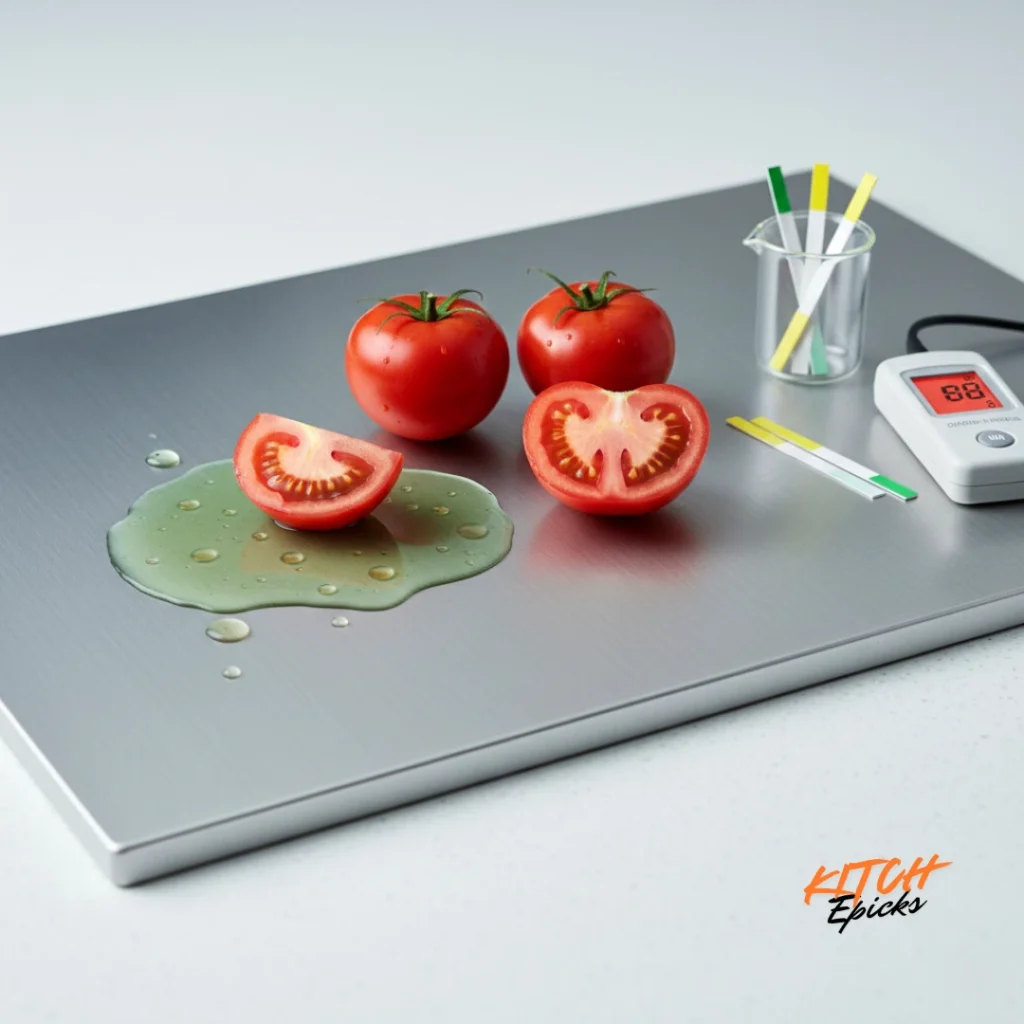
For cutting boards, the risk is lower than cookware (no heat involved), but people with nickel allergies can still react to prolonged contact with low-grade stainless steel surfaces. While stainless steel boards are non-porous and easy to sanitize, they pose leaching risks that titanium eliminates entirely.
Titanium’s Triple Advantage
Titanium boards combine the best traits while avoiding every material’s weaknesses:
- Zero porosity: Unlike wood or plastic, titanium has no grooves for bacterial biofilm formation
- Zero leaching: Titanium’s oxide layer prevents metal migration even with acidic foods
- Zero particle shedding: No microplastics, wood fibers, or coating fragments enter your food
This combination explains why titanium is the metal of choice for surgical instruments that must remain sterile through countless sterilization cycles.

Are Titanium Cutting Boards Food Safe Compared to Alternatives?
- Direct answer: Yes—titanium is FDA-compliant and meets stricter medical device standards
- Unlike plastic (microplastics: 7.4-50.7g/year ) and steel (nickel leaching ), titanium releases zero particles
- FDA requires plastics to meet 21 CFR safety standards, but titanium exceeds these by qualifying as medical-grade material
- SGS-certified boards confirm 99.89% purity with no toxic metals
Who Benefits Most from Titanium Boards?
Titanium cutting boards shine in specific scenarios where safety and hygiene matter most:
High-Risk Food Preparation
The non-porous surface prevents cross-contamination better than grooved plastic or wood, making titanium ideal for raw meat, poultry, and fish prep. Professional kitchens and home cooks handling raw proteins benefit from a surface that can be fully sanitized without harboring pathogens in microscopic crevices.
Immune-Compromised Households
Zero chemical leaching and hospital-grade cleanliness make titanium ideal for cancer patients undergoing chemotherapy, elderly family members, or anyone with weakened immunity. The same biocompatibility that allows titanium to remain in the human body for decades ensures it won’t introduce foreign substances into food.
Allergy-Sensitive Users
Titanium contains no nickel (unlike stainless steel) and no BPA, phthalates, or other plasticizers (unlike plastic). It’s routinely used in body piercings and implants for people with metal allergies precisely because it’s hypoallergenic.
Professional and Commercial Kitchens
Titanium withstands commercial sanitizers, bleach solutions, and high-heat dishwashers (up to 200°C) without degrading. Its extreme durability means it won’t warp, crack, or lose structural integrity even with daily heavy use.
The Trade-Offs
The main downsides are cost ($80–$300 vs. $15–$40 for plastic or wood) and knife dulling—titanium’s hardness (though softer than ceramic or glass) requires more frequent blade sharpening compared to wood surfaces. Some users also dislike the metallic sound of knife-on-titanium, though TiN-coated boards reduce this somewhat.
For a complete breakdown of titanium board types, top certified brands, and knife-care strategies, see our titanium cutting boards buyer’s guide.
The Science Behind Titanium’s Safety
Titanium’s biocompatibility isn’t marketing hype—it’s supported by decades of medical research. A 2022 review in the journal Materials Transactions explained that titanium ions released from implants (if any) are “immediately stabilized not to show toxicity” when exposed to body fluids. The passive oxide film on titanium creates an optimal balance of surface charges that allow proteins to adsorb naturally without denaturing—meaning food enzymes and nutrients aren’t chemically altered by contact with the surface.
The band gap energy of titanium’s oxide layer also generates “optimal reactivity” with biological tissues, explaining its capacity for osseointegration (bone bonding) in medical implants. For kitchen use, this means the surface chemistry is inherently compatible with organic matter—your food interacts with titanium the same way it would with inert glass, but without the brittleness.
Are Titanium Cutting Boards Food Safe for Raw Meat and Bacteria Prevention?
Subpoints:
- Bacterial Safety Studies: A study published in the Journal of Food Protection tested plastic vs. wood cutting boards contaminated with E. coli O157:H7, Listeria, and Salmonella. Titanium’s non-porous surface prevents bacterial absorption entirely—unlike wood which absorbs bacteria into grain, and plastic which traps pathogens in knife grooves.
- Cross-Contamination Prevention: FDA-compliant titanium boards like Taima and Titan Haus use medical-grade titanium (99.89-99.91% purity) that meets food-contact safety requirements. The self-sterilizing oxide layer prevents bacteria from adhering to the surface.
- Raw Meat Safety: Unlike plastic boards that harbor bacteria in deep grooves even after washing, titanium can be sanitized with bleach or high-heat dishwashers (200°C) without degradation. Professional chefs and food safety experts recommend non-porous surfaces for raw meat prep to minimize cross-contamination risk.
- SGS Certification: Leading titanium board manufacturers provide SGS lab certification proving 99.89%+ purity and FDA compliance for food safety. This certification ensures zero toxic metals (lead, cadmium, nickel) that could leach into food
Common Questions: Are Titanium Cutting Boards Food Safe?
Does titanium nitride flake off into food?
No. TiN is a vacuum-deposited ceramic coating bonded at the molecular level, tested to ISO 10993-5 biocompatibility standards for medical implants. Unlike paint, it won’t chip or peel even under heavy use. The coating’s hardness (9.0 Mohs, equivalent to sapphire) makes it more scratch-resistant than the stainless steel knives cutting on it.
Is titanium safer than plastic for cutting boards?
Yes. Plastic boards release 7.4–50.7 grams of microplastics per person annually, equating to millions of particles that contaminate food. Recent research links microplastic exposure to digestive, reproductive, and respiratory health risks. Titanium releases zero particles and harbors no bacteria in grooves because it has none.
Can people with metal allergies use titanium boards?
Yes. Titanium is hypoallergenic—routinely used in piercings and implants for nickel-allergic patients. Unlike stainless steel (which can contain 8–12% nickel), pure titanium contains no nickel or chromium that could trigger allergic reactions.
Are titanium boards dishwasher-safe without leaching?
Yes. Titanium withstands 200°C dishwasher cycles without corrosion or chemical migration. Its oxide layer actually strengthens with heat exposure—commercial sterilization equipment uses temperatures up to 134°C, well below titanium’s thermal limits.
Do titanium boards need seasoning or maintenance?
No. Unlike wood, titanium requires no oiling or conditioning. Wash with soap and water or sanitize with bleach—the surface won’t degrade, absorb chemicals, or support bacterial growth. The passive oxide layer reforms immediately if scratched, maintaining corrosion resistance indefinitely.
Why is titanium more expensive than other boards?
Titanium extraction via the Kroll process is energy-intensive and time-consuming. The metal must be processed in inert atmospheres to prevent contamination, and machining requires specialized tools due to titanium’s hardness and tendency to gall. Medical-grade purity standards and precision machining justify the $100–$250 price range, though costs are decreasing as manufacturing scales up.