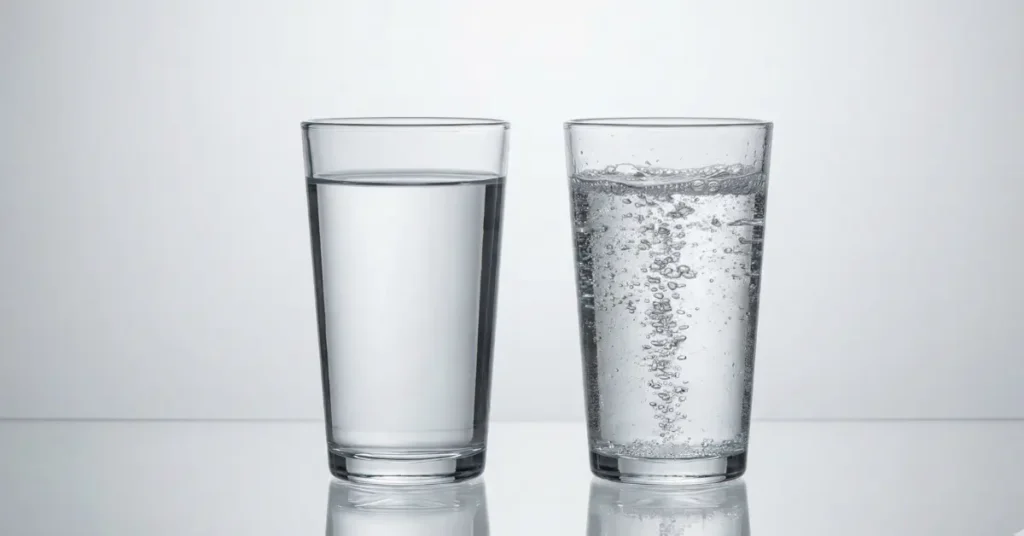
You’re scanning a restaurant menu or standing in the grocery aisle, and you see both mineral water and sparkling water listed as separate options. You’ve always assumed they’re the same thing. You’re not alone — this is one of the most common points of confusion in the beverage world.
The difference between mineral water and sparkling water is more significant than most people realize. It affects taste, health benefits, culinary use, and what you’re actually paying for.
Here’s the short version: mineral water and sparkling water are not the same thing. Mineral water is defined by where it comes from and what’s naturally in it. Sparkling water is defined by what’s been added to it — specifically, carbon dioxide (CO₂). This guide breaks down everything: the FDA definitions, the mineral content, the taste profiles, the health facts, and exactly which one to buy for different situations.
The Short Answer
Mineral water is sourced from a naturally protected underground spring and contains naturally occurring minerals like calcium, magnesium, and sodium — no minerals can be added after extraction. Sparkling water is plain filtered water that has been artificially carbonated with CO₂. The key difference: mineral water is about source and mineral content; sparkling water is about added carbonation. They are not the same thing — though sparkling mineral water is both.
So: no, mineral water and sparkling water are not the same — though sparkling mineral water (which combines both) does exist and adds to the confusion. Let’s break down each one fully.
What Is Mineral Water? The Full Story
Mineral water is one of the most tightly regulated water categories in the United States. The FDA defines mineral water under 21 CFR § 165.110 as water containing not less than 250 parts per million (ppm) of Total Dissolved Solids (TDS), sourced from a geologically and physically protected underground source.
That last part is critical: the minerals must come from the source itself. No minerals may be added to mineral water after extraction. This is what makes it legally and fundamentally different from every other water category.
Where Does Mineral Water Come From?
Mineral water originates from underground aquifers — deep geological formations where water has filtered slowly through layers of rock, limestone, and sediment over decades or centuries. As it moves through these formations, it absorbs naturally occurring minerals and trace elements.
This is why San Pellegrino (Italian Alps), Perrier (Vergèze, France), and Topo Chico (Monterrey, Mexico) all taste distinctly different from each other — each source has a unique geological fingerprint. The FDA requires that mineral water maintain a constant and stable mineral profile at the point of emergence.
What Minerals Are in Mineral Water?
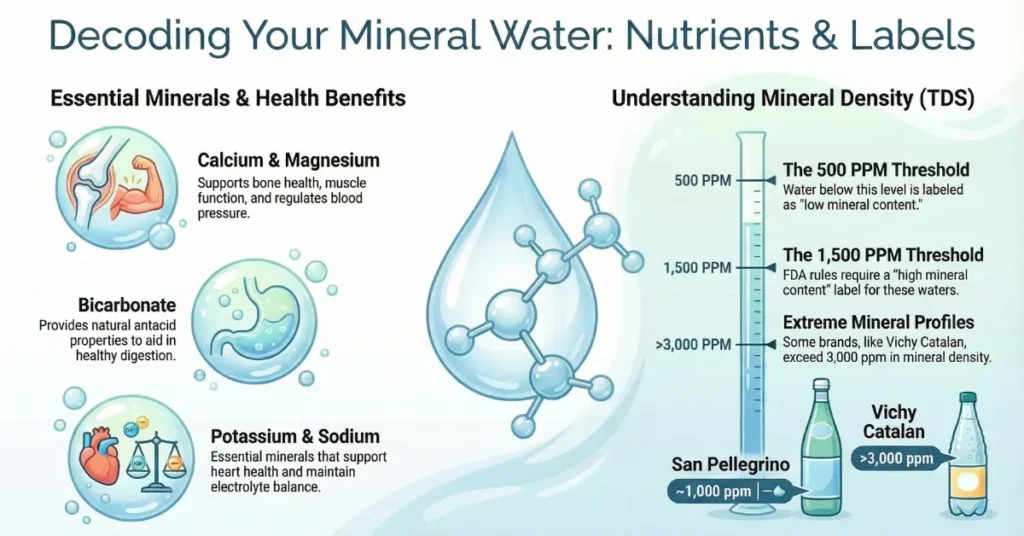
The exact mineral profile varies by brand and source. The most common minerals found in mineral water include:
- Calcium — supports bone health and muscle function
- Magnesium — helps regulate blood sugar and blood pressure
- Sodium — contributes to electrolyte balance (important note for low-sodium dieters)
- Potassium — supports heart health and fluid regulation
- Bicarbonate — natural antacid properties; aids digestion
- Silica — linked to skin and connective tissue health in some studies
The TDS level tells you how mineral-rich the water is. Under FDA labeling rules, mineral water below 500 ppm must be labeled “low mineral content,” and water above 1,500 ppm must be labeled “high mineral content.” San Pellegrino sits around 1,000 ppm; Vichy Catalan exceeds 3,000 ppm.
💡 Pro Tip: Look for the TDS value printed on the label of any mineral water bottle. It’s usually listed in mg/L. The higher the TDS, the more mineral-rich — and the more distinctive the taste.
What Is Sparkling Water? (And Is It the Same as Seltzer?)
Sparkling water — often called seltzer or carbonated water — is fundamentally different from mineral water. It starts as plain filtered water (often purified tap water) and is infused with carbon dioxide (CO₂) under pressure. That CO₂ creates the bubbles.
Here’s something most people don’t know: the FDA does not classify sparkling water as “bottled water.” Products labeled as carbonated water, seltzer water, or sparkling water are regulated merely as food items — not subject to the same strict quality standards applied to mineral water. That’s not a health alarm; it simply means there’s no minimum mineral content requirement.
LaCroix, Bubly, and a home SodaStream all produce sparkling water: plain water + CO₂, nothing more. This is precisely what gives sparkling water its signature clean, neutral taste.
✅ Quick Clarification: In everyday American usage, “sparkling water” and “seltzer” are interchangeable. Both are just water with added CO₂ and no naturally occurring minerals.
The Complete Water Spectrum: All 6 Types Explained
This is where most guides fall short. Mineral water and sparkling water don’t exist in isolation — they sit within a broader spectrum. Understanding the full spectrum eliminates confusion permanently.
| Water Type | Source | Carbonation | Mineral Content |
|---|---|---|---|
| Mineral Water | Underground aquifer (protected) | Natural (some) or CO₂ added | High — ≥250 ppm TDS, naturally occurring |
| Sparkling Water / Seltzer | Filtered tap water | Always added CO₂ | None — plain H₂O + CO₂ |
| Club Soda | Filtered tap water | Added CO₂ | Added: potassium sulfate, sodium bicarbonate |
| Tonic Water | Tap water | Added CO₂ | Quinine + sugar ⚠️ treat like a soft drink |
| Spring Water | Natural spring (surface) | Usually still; may be sparkling | Minimal; variable — may not meet 250 ppm TDS |
| Sparkling Mineral Water | Underground mineral spring | Natural or added CO₂ | High — same as mineral water (Perrier, San Pellegrino) |
⚠️ Tonic Water Warning: Tonic water contains quinine and added sugar — a 12 oz can can have as much sugar as a typical soda. It is not a healthy alternative to sparkling water.
Full Comparison Table
Here’s a comprehensive breakdown of the difference between mineral water and sparkling water across every dimension that matters:
| Feature | Mineral Water | Sparkling Water (Seltzer) |
|---|---|---|
| Source | Geologically protected underground spring | Filtered tap water |
| Mineral Content | ✅ High — naturally occurring, cannot be added | ❌ None — plain H₂O + CO₂ |
| Carbonation | Natural (some springs) or CO₂ added at bottling | Always added CO₂ under pressure |
| Flavor Profile | Distinct mineral taste; salty, earthy, or crisp | Clean and neutral; closest to plain water |
| FDA Status | Strictly regulated as bottled water; ≥250 ppm TDS | Regulated as a food product, not bottled water |
| TDS (ppm) | Minimum 250 ppm; up to 3,000+ ppm (premium brands) | Typically 0–50 ppm |
| Best Used For | Sipping plain; food pairing; electrolyte boost | Cocktail mixing; cooking; everyday hydration |
| Popular Brands | San Pellegrino, Perrier, Topo Chico, Gerolsteiner | LaCroix, Bubly, Spindrift, SodaStream |
| Price Point | Higher (imported; source-protected) | Budget to mid-range; home carbonation cheapest |
| Eco Footprint | Glass bottles common; higher transport emissions | Home carbonation systems most sustainable |
Top Mineral Water Picks
These are the best sparkling mineral waters available on Amazon right now. Replace YOUR-ASSOCIATE-TAG in each link with your Amazon Associate ID.
Best Overall — S.Pellegrino Sparkling Natural Mineral Water (Pack of 12)

- Includes twelve 33.8 fl oz (1 L) plastic bottles of S.Pellegrino Sparkling Natural Mineral Water SNAP and EBT Eligible i…
- This bottled sparkling water offers unmistakable taste and gentle bubbles
- S.Pellegrino sparkling mineral water is low in sodium and contains zero calories with no artificial colors, flavors or s…
⭐⭐⭐⭐⭐ 4.7/5
Sourced from the Italian Alps with a 30-year underground journey. TDS: ~915 mg/L. Zero calories, low sodium, no artificial ingredients. The gold standard for sparkling mineral water — a favorite of chefs and food lovers worldwide.
✅ Pros:
- Genuine underground mineral source
- Rich in calcium & magnesium
- Excellent food and wine pairing
- Available in glass or plastic
❌ Cons:
- Pricier than seltzer
- Plastic bottles can lose fizz faster than glass
Best for Cocktails — Perrier Sparkling Mineral Water, 11.15 fl oz Cans (Pack of 24)

- Includes one pack of 24 cans, 11.15 fl oz each, of Perrier Carbonated Mineral Sparkling Water SNAP and EBT Eligible item
- Perrier is the natural mineral water captured at the source in the South of France
- Carbonated water with invigorating bubbles and naturally occurring minerals for a unique thirst-quenching taste
⭐⭐⭐⭐ 4.5/5
Originating in Vergèze, France since 1863. Bolder, more aggressive bubbles than San Pellegrino — makes it the top pick for cocktail mixing and aperitif moments. CO₂ is sourced from the same spring as the water itself.
✅ Pros:
- Bold, invigorating carbonation
- Cans stay fizzy longer than bottles once opened
- Zero calories, zero sweeteners
- Great cocktail and highball mixer
❌ Cons:
- More pronounced mineral taste — not for everyone
- Less ideal for plain everyday sipping if you prefer neutral
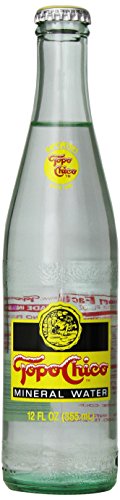
Best Carbonation — Topo Chico Mineral Water, 11.5 oz (Pack of 24)
⭐⭐⭐⭐⭐ 4.6/5
Bottled at source in Monterrey, Mexico since 1895. Famous for its extreme, aggressive carbonation — often called the most fizzy mineral water available. Contains sodium, magnesium, and manganese. A cult favorite among chefs, bartenders, and mixologists.
✅ Pros:
- Most intense carbonation of any mainstream mineral water
- Authentic Mexican mineral source
- Glass bottles preserve mineral integrity
- Iconic status in the food world
❌ Cons:
- Higher sodium than most alternatives
- Glass bottles are heavier and more fragile to ship
Best High-Mineral Content — Gerolsteiner Sparkling Mineral Water, 16.9 oz (Pack of 24)

⭐⭐⭐⭐⭐ 4.7/5
German volcanic rock-filtered water with one of the highest TDS levels of any mainstream mineral water (~2,500 mg/L). Exceptionally rich in calcium, magnesium, and bicarbonate. Perfect for those looking for maximum mineral benefit per sip.
✅ Pros:
- The highest mineral content on this list
- Outstanding digestion support from high bicarbonate content
- Pleasant, balanced mineral flavor
- Excellent for health-focused drinkers
❌ Cons:
- Less widely available in physical stores
- High TDS mineral taste is intense — not for everyone
Top Sparkling Water Picks
These are the best plain sparkling waters for everyday drinking, cocktail mixing, and cooking — clean, neutral, and consistently available.
Best Everyday Seltzer — LaCroix Sparkling Water Pure (Unflavored), 12 fl oz, 8-Pack

- Pure – Pure-ly Perfect The classic unflavored sparkling water is crisp, clean and thirst-quenching
- LaCroix Sparkling Waters are Gluten Free, Vegetarian, Kosher and non-GMO Project Verified, Whole 30 approved & environme…
- All LaCroix flavors are derived from natural essences, which give each LaCroix flavor its unique aroma, taste, and senso…
⭐⭐⭐⭐ 4.4/5
The original American sparkling water icon. Zero calories, zero sweeteners, zero sodium — just water and CO₂. The pure unflavored version is as clean and neutral as it gets. BPA-free recyclable cans. Gluten-free, non-GMO, Whole30 approved.
✅ Pros:
- Purest, most neutral taste available
- Perfect cocktail mixer and cooking base
- Eco-friendly recyclable cans
- Zero everything — ideal for calorie counting
❌ Cons:
- No minerals at all
- Lighter carbonation than mineral water
Best Flavored Sparkling Water — LaCroix Sparkling Water, Lime, 12 fl oz, 8-Pack

- Lime – Classic Crowd Pleaser! A refreshing citrus zest – a fresh lime, just picked from the tree.
- LaCroix Sparkling Waters are Gluten Free, Vegetarian, Kosher and non-GMO Project Verified, Whole 30 approved & environme…
- All LaCroix flavors are derived from natural essences, which give each LaCroix flavor its unique aroma, taste, and senso…
⭐⭐⭐⭐ 4.4/5
For those who want a hint of flavor without sugar or calories. The Lime flavor uses natural essence oils — no sweeteners, no artificial ingredients. One of LaCroix’s bestselling flavors and a go-to for mocktails and light mixing.
✅ Pros:
- Natural lime essence — no sugar or artificial flavors
- Great for mocktails and gin-based cocktails
- Widely available and very affordable
❌ Cons:
- Faint flavor — not suitable as a cocktail mixer if you want neutrality
- Contains no minerals
Health Benefits: What the Research Actually Shows
Both mineral water and sparkling water are genuinely healthy choices — especially compared to sugary sodas and juices. But they offer different kinds of value.
On Hydration
Both are equally effective. According to registered dietitians at the Cleveland Clinic, sparkling water hydrates just as well as still water. The carbonation does not reduce absorption or cause dehydration.
On Minerals and Electrolytes
Mineral water has a clear advantage here. Calcium and magnesium in liquid form are absorbed efficiently through the GI tract. For people who struggle to meet daily mineral requirements through food alone, high-quality mineral water (especially Gerolsteiner or Vichy Catalan) can be a meaningful supplement.
On Digestion
The carbonation itself — in both mineral water and sparkling water — may improve swallowing function and increase feelings of fullness after meals, according to research cited by Healthline. The bicarbonate in mineral water specifically has well-documented antacid properties that can help with mild indigestion and acid reflux.
Clearing Up the Health Myths
✅ Bone Health — MYTH BUSTED: There is a persistent myth that carbonated water weakens bones. This is false. According to the National Osteoporosis Foundation, sparkling mineral water containing calcium and magnesium may actually support bone health. The bone-loss concern is specific to dark colas containing phosphoric acid — not water.
✅ Tooth Enamel — MOSTLY MYTH: Plain sparkling water is mildly acidic due to carbonic acid, but the acidity is far below that of sodas, juice, or coffee. Plain seltzer has not been shown to have a significant effect on tooth enamel. The risk increases with flavored sparkling waters that list citric acid as an ingredient.
When to Use Caution
- Low-sodium diets: Some mineral waters (Vichy Catalan, St. Yorre) are very high in sodium. Always check the label.
- IBS or sensitive digestion: Carbonation can aggravate bloating in some individuals. Still, mineral water is a better choice.
- Existing tooth sensitivity: Minimize flavored sparkling waters containing citric acid; prefer plain seltzer or still water.
Which One Should You Choose?
The honest answer: both are excellent choices, and neither is universally “better.” The right pick depends entirely on what you need it for.
For Everyday Drinking If you want something clean and neutral, go with sparkling water (seltzer). If you want hydration with added minerals and don’t mind a more complex taste, go with mineral water.
For Cocktails and Mixing Sparkling water wins here. Its neutral flavor won’t compete with spirits, syrups, or citrus. Mineral water’s mineral notes can clash with delicate cocktail profiles.
For Cooking Always use plain sparkling water. It creates lightness in batters (tempura, pancakes, crepes) without introducing mineral flavor into your dishes.
For Health Goals Choose high-TDS mineral water (Gerolsteiner, San Pellegrino) for calcium and magnesium. For replacing soda — either works perfectly. For low-sodium diets — choose plain seltzer or check the mineral water label carefully.
How to Read a Water Bottle Label (And Spot the Difference Instantly)
Once you know what to look for on a label, you’ll never be confused again.
- “Mineral Water” — Look for TDS on the label (in mg/L or ppm). Over 500 ppm = richly mineralised. Under 500 ppm = “low mineral content.” If TDS isn’t listed, it’s likely not true mineral water.
- “Naturally Carbonated” — The CO₂ comes directly from the same underground source as the water. Rare and usually more expensive. Gerolsteiner Naturell is one example.
- “Carbonated” or “Sparkling” — CO₂ was added at the bottling stage. This applies to most sparkling waters AND most commercially bottled sparkling mineral waters (including San Pellegrino and Perrier).
- “Spring Water” — Comes from a natural spring but doesn’t necessarily meet the 250 ppm TDS threshold for “mineral water.” Composition may vary.
- “Seltzer” or “Sparkling Water” (no other qualifiers) — Plain filtered water + CO₂. No minerals unless specifically added. This is what LaCroix, Bubly, and store brands are.
- “Club Soda” — Like seltzer, but with added minerals (potassium sulfate, sodium bicarbonate) to mimic natural mineral water taste. Very different from true mineral water despite the similar mouthfeel.
💡 Bottom Line: If the label says “mineral water,” the minerals are natural and regulated. If it says anything else with “sparkling” or “carbonated,” check the ingredient list — if it only says “carbonated water,” that’s plain seltzer with no minerals.
Frequently Asked Questions
Is mineral water and sparkling water the same thing?
No. Mineral water is defined by its natural mineral content (minimum 250 ppm TDS per FDA rules) sourced from a protected underground spring. Sparkling water is plain filtered water with added CO₂ and no naturally occurring minerals. While sparkling mineral water is both carbonated and mineral-rich, plain sparkling water contains no naturally occurring minerals.
What’s the difference between soda water and sparkling mineral water?
Soda water (club soda) is filtered tap water with added CO₂ and minerals like potassium sulfate and sodium bicarbonate. Sparkling mineral water is sourced from a natural underground spring — its minerals are naturally occurring, not artificially added. The mineral composition, taste, regulatory status, and sourcing are completely different.
Does sparkling water damage your teeth?
Plain sparkling water has minimal impact on tooth enamel. It is mildly acidic due to carbonic acid, but far less so than soda, juice, or coffee. The risk increases with flavored sparkling waters that contain citric acid as an ingredient. Alternating with still water and maintaining good oral hygiene effectively manages any marginal risk.
Is mineral water healthier than sparkling water?
For hydration, they are equal. For minerals and electrolytes: mineral water wins — it naturally contains calcium, magnesium, and potassium that sparkling water lacks. If choosing for general health, high-quality mineral water (Gerolsteiner, San Pellegrino) offers more nutritional value. Both are excellent replacements for sugary drinks.
Is Perrier a mineral water or sparkling water?
Perrier is a sparkling mineral water — it’s both. It is sourced from a spring in Vergèze, France, and naturally contains minerals including calcium, magnesium, and sulfates. The CO₂ used to carbonate Perrier is captured from the same source and recombined with the water at bottling. It fully meets the FDA regulatory definition of mineral water.
Can I make mineral water at home with a SodaStream?
No — a SodaStream produces sparkling water (filtered water + CO₂), not mineral water. The result is carbonated but contains no naturally occurring minerals. You cannot replicate the mineral profile of a natural spring at home. Home carbonation is an excellent, eco-friendly option for plain sparkling water, but it remains fundamentally different from true mineral water.
Is LaCroix a mineral water?
No. LaCroix is sparkling water (seltzer). It uses locally-sourced municipal water that is filtered and purified, then carbonated with CO₂. It contains zero naturally occurring minerals. LaCroix is a high-quality, clean sparkling water — but it is not mineral water and should not be used as a substitute when mineral content matters.
The Bottom Line
Mineral water and sparkling water both deserve a place in your life — but for different reasons, and in different contexts.
Mineral water is defined by nature: protected underground sources, a naturally stable mineral profile, and strict FDA regulation. It has a complex, distinctive taste and provides genuine nutritional value from its calcium, magnesium, and bicarbonate content.
Sparkling water is defined by simplicity: clean, neutral, and satisfying. It’s the go-to for cocktails, cooking, and everyday hydration without flavor interference. And it’s equally effective at keeping you hydrated.
The confusion often comes down to sparkling mineral water — the category that bridges both. Brands like Perrier, San Pellegrino, and Topo Chico are simultaneously mineral water (by source) and sparkling water (by carbonation). Now you know exactly where they fit.
The best way to settle this for yourself? Try a high-TDS mineral water (Gerolsteiner or San Pellegrino) and a plain seltzer (LaCroix Pure) side by side. The difference in taste, mouthfeel, and complexity will become immediately and unmistakably clear.
Affiliate Disclosure: KitchePicks is a participant in the Amazon Services LLC Associates Program. As an Amazon Associate, we earn from qualifying purchases. Product links on this page are Amazon affiliate links — clicking and purchasing through them supports our site at no extra cost to you. All product recommendations are based on independent research and editorial judgment; no brand paid for placement.
Health Disclaimer: This article is for general educational purposes only. Consult a registered dietitian or healthcare professional for specific dietary or medical advice.