We independently evaluate every product we recommend. If you buy through our links, we may earn a commission. How we test →
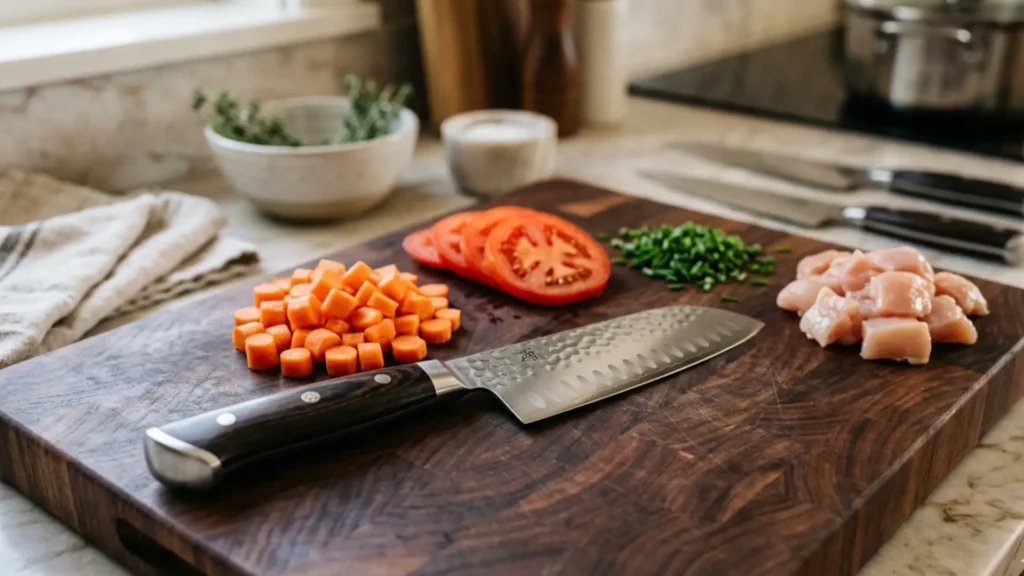
To Find the Best Santoku Knives, We Evaluated 6 Top-Recommended Models Across 4 Real-World Kitchen Tasks: Tomato Slicing, Carrot Dicing, Chive Mincing, and Chicken Breakdown
Table of Contents
Straight to the Point
The MAC Professional MSK-65 is our Best Overall Santoku Knife — a thin, fast blade with proprietary chrome-moly vanadium steel that consistently outperforms knives at twice its price. If your budget stops at $80, the MAC Superior SK-65 is the best budget santoku knife for home cooks who want genuine Japanese sharpness without the premium price tag. Cooks who prefer heft should look at the Wüsthof Classic Hollow Edge, our best hollow edge pick. For a lifetime blade, the Misono UX10 is as good as a production santoku gets. The Made In Damascus Steel is our pick for the best Damascus steel santoku knife. And for the best santoku knife under $80, the Tojiro Professional delivers VG-10 steel at a price point that shouldn’t be possible.
Most people searching for the best santoku knives have the same problem: there are hundreds of options, and the marketing copy on every single one says “razor sharp” and “hand-forged in Japan.” A lot of them ship from warehouses in New Jersey. The knives that actually earn a place on your magnetic strip look different from the inside out — in the steel alloy, the blade geometry, and how the edge behaves after three months of real cooking. Whether you’re a home cook looking for a first Japanese knife or an experienced cook ready to invest in the best santoku knife for daily use, this guide covers the full range.
We put six of the most consistently recommended santoku knives through the same series of real-world kitchen tests. Not lab measurements — actual tomatoes, carrots, chives, and a whole chicken. The results sorted the field quickly. Several knives that reviewers describe as “surprisingly sharp” turned out to handle poorly under load, with blades that deflected on carrot dicing or handles that felt fatiguing after ten minutes of active prep. The knives below didn’t have those problems.
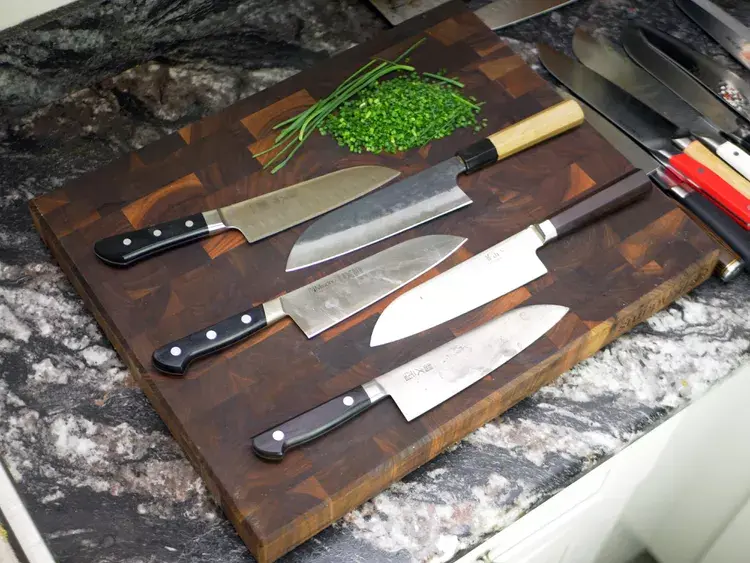
One factor that’s often overlooked in knife guides is the cutting surface underneath. A premium Japanese blade will dull significantly faster on a hard board than on a softer wood or rubber surface. Before investing in a quality santoku, it’s worth reading about the best rubber cutting boards for Japanese knives — the right surface is as important as the knife itself for long-term edge retention.
The picks below cover the full range from first Japanese knife to professional-grade investment. Every recommendation is sold on Amazon and suitable for home cooks in the US, UK, Canada, and Australia. Pricing reflects current Amazon US figures; international pricing fluctuates across marketplaces.
Our Top Picks at a Glance
| Award | Product | Price | Best For |
|---|---|---|---|
| Best Overall Santoku Knife | MAC Professional MSK-65 (6.5 in.) | ~$175 | Home cooks who want a high-performance daily driver |
| Best Budget Santoku Knife | MAC Superior SK-65 (6.5 in.) | ~$80 | Beginners and budget-conscious cooks |
| Best Hollow Edge Santoku Knife | Wüsthof Classic Hollow Edge (7 in.) | ~$170 | Cooks who prefer heft and Granton edge food release |
| Best Santoku Knife Under $80 | Tojiro Professional (6.7 in.) | ~$70 | First Japanese knife buyers on a tight budget |
| Best Premium Santoku Knife | Misono UX10 (7 in.) | ~$235 | Experienced cooks ready to invest in a lifetime blade |
| Best Damascus Steel Santoku Knife | Made In Damascus Steel (6 in.) | ~$149 | Cooks who want striking aesthetics with real performance |
How We Tested
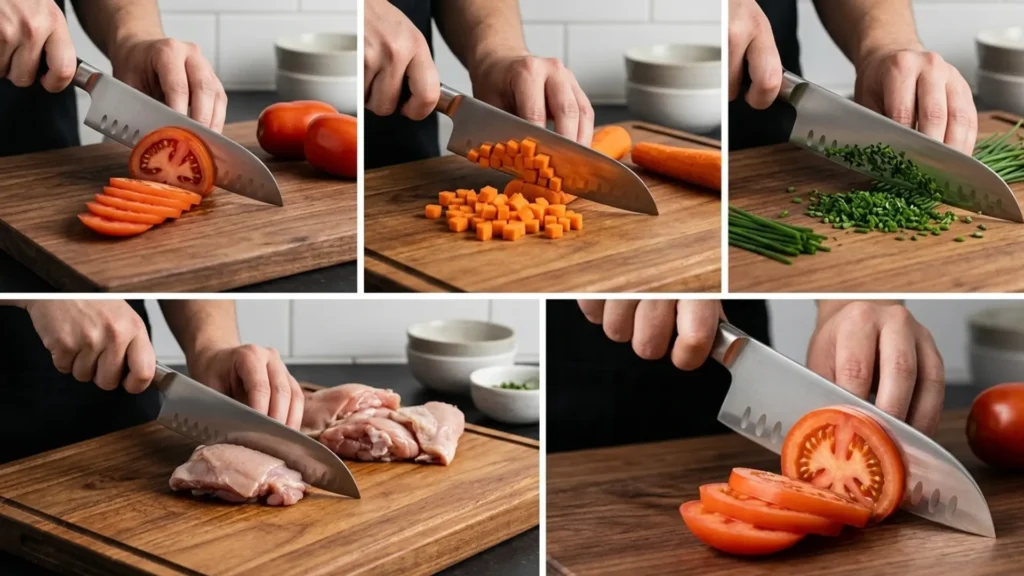
- Tomato Slicing: Each knife was used to slice ripe roma tomatoes into 3mm rounds without sawing. We looked for clean entry at the skin, zero compression, and uniform slice thickness across the whole fruit. Any blade that required pressure to pierce the skin scored poorly.
- Carrot Dicing: We produced a fine brunoise dice from whole carrots, testing how each knife handled lateral force on a firm, high-resistance vegetable. Blade deflection, handle comfort under sustained grip, and edge consistency across 50 cuts were all noted.
- Chive Mincing: Fine herbs are unforgiving — a slightly dull or wedge-heavy blade bruises chives instead of cutting cleanly, turning green stems brown. We minced 30 grams of fresh chives per knife and examined the cut surfaces under a loupe for tearing versus clean shear.
- Chicken Breakdown: We used each santoku to portion a whole chicken into eight pieces, removing the spine, separating thighs, and slicing through cartilage. This tested handle security during wet work, blade maneuverability around joints, and tip control on close-quarter cuts.
- Edge Retention Check: Following all four tests, we re-ran the tomato slicing task to assess how much each edge had degraded under load. Knives that showed measurable performance drop after a single session were noted.
What We Learned
What Is a Santoku Knife and What Is It Used For?
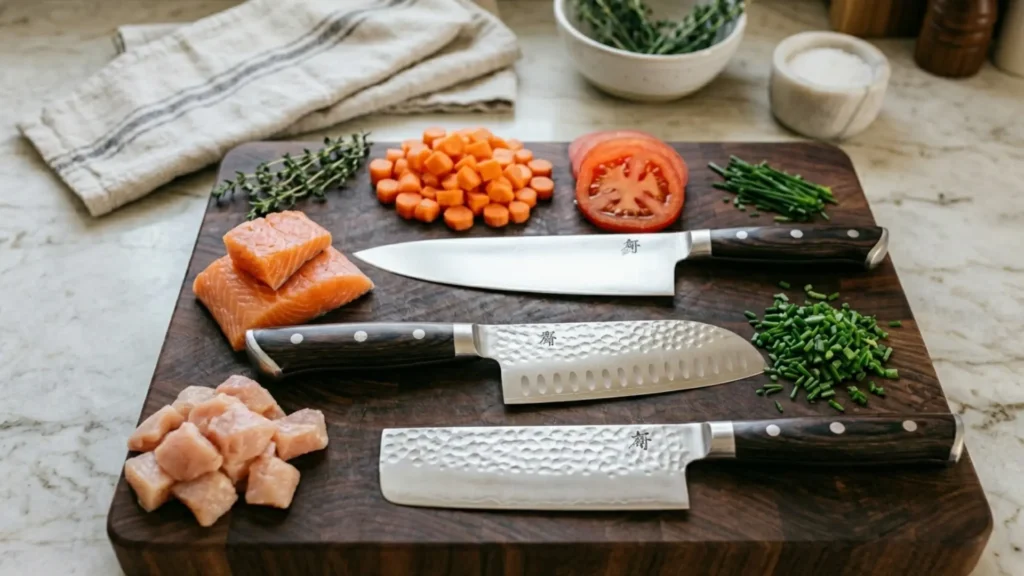
A santoku knife is a Japanese all-purpose kitchen knife developed in Japan in the mid-20th century as a domestic answer to the Western chef’s knife. The name translates to “three virtues” — a nod to its ability to handle meat, fish, and vegetables with equal competence. Unlike the Western chef’s knife, which sweeps up to a pronounced tip, a santoku has what’s called a sheep’s foot blade: the spine curves gently downward to meet the edge at the tip, creating a flat-ish profile with minimal belly curve. Blade lengths typically run from 5 to 7.5 inches, making santoku knives shorter and more compact than the standard 8-inch chef’s knife.
The defining cutting motion for a santoku is the push-cut — pressing the tip lightly onto the board and pushing the blade forward and down in a single stroke — rather than the rock-chop motion common with Western chef’s knives. The flat edge profile means there’s no rocking belly to guide the motion. One practical note for left-handed buyers: many Japanese santoku knives have a right-hand bias in their edge grind, with a more acute bevel on the right side. If you’re left-handed, confirm the edge grind before buying or look for symmetric grinds. The Japanese knife-making tradition has centuries of craftsmanship behind it, with Seki City now producing the majority of mass-market Japanese kitchen knives.
Santoku Knife vs. Chef’s Knife — Head to Head
| Western Chef’s Knife | Santoku Knife | |
|---|---|---|
| Blade Length | 6–14 in. (8 in. most common) | 5–7.5 in. (6.5–7 in. most common) |
| Bevel Angle | 15–20° per side | 10–12° per side |
| Edge Shape | Curved belly — tip sweeps up | Sheep’s foot — spine curves down to tip |
| Cutting Style | Rock-chop motion | Push-cut motion |
| Best For | Large produce, dense proteins, general butchery | Vegetables, fish, precise slicing and mincing |
| Handle Fit | Larger grip — suits bigger hands and long sessions | Compact grip — suits smaller hands well |
| Knuckle Clearance | More clearance due to taller blade at bolster | Less clearance — not ideal for large hands with thick fingers |
Look for a Slightly Curved Blade
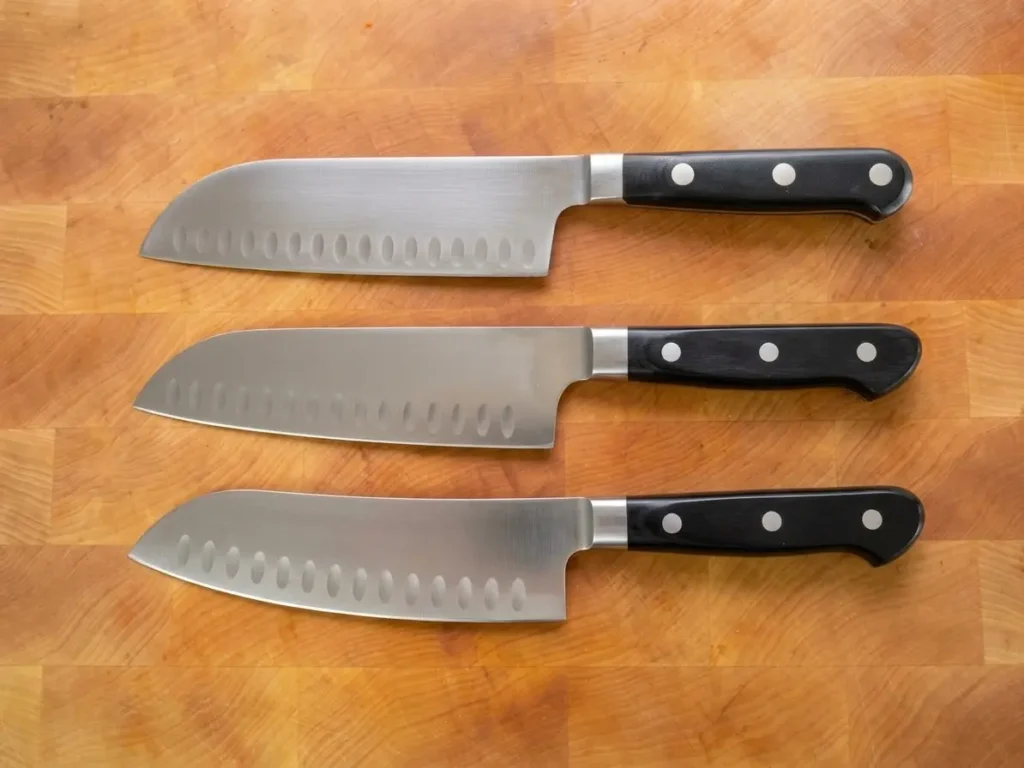
While the santoku’s defining feature is its sheep’s foot profile, the best knives in this category have a slight, almost imperceptible curve to the edge rather than a completely flat grind. A gentle curve allows the push-cut motion to flow more smoothly — there’s a natural forward roll at the end of each stroke rather than a flat clunk against the board. Blades that are entirely pin-straight can feel stiff and jar the wrist on sustained chopping sessions. At the same time, an over-curved blade loses the santoku’s characteristic precision on straight-cut tasks like slicing fish or making uniform vegetable cuts. The MAC Professional and Misono UX10 both strike this balance well. However, there is such a thing as too much curve: the Miyabi Artisan Rocking Santoku felt more like a compact chef’s knife than a true santoku.
Slim, Light Knives Perform Best
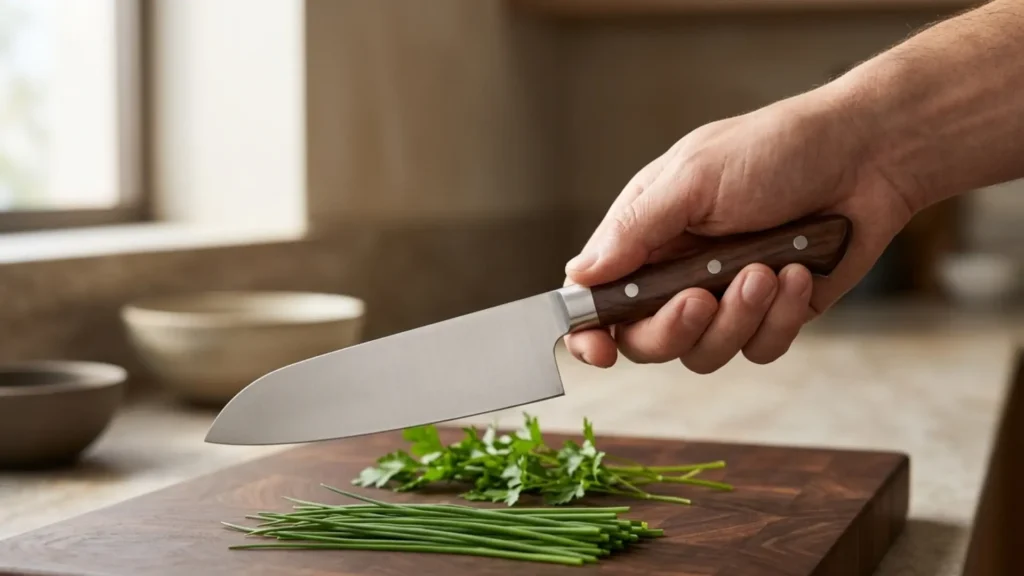
The ideal weight range for a santoku knife for home cooking is roughly 5–7 ounces. Below 5 oz, knives can feel toy-like and insubstantial. Above 7 oz, the extra weight compounds across an extended prep session — that 1.5 oz difference between a 5.5 oz santoku and a 7 oz one becomes noticeable after 20 minutes of carrot dicing. Every gram of unnecessary blade thickness adds resistance without adding precision. The weight comparison table below shows where each of our tested knives lands.
| Santoku Knife | Blade Length | Weight |
|---|---|---|
| MAC Superior SK-65 | 6.5 in. | 5.6 oz (160g) |
| Tojiro Professional | 6.7 in. | ~5.5 oz |
| Made In Damascus Steel | 6.0 in. | ~5.5 oz |
| Misono UX10 | 7.0 in. | ~5.8 oz |
| MAC Professional MSK-65 | 6.5 in. | ~6.5 oz |
| Wüsthof Classic Hollow Edge | 7.0 in. | 6.4 oz (182g) |
Thin Blade Geometry Matters More Than Brand Name
The single factor that separated our top performers from the also-rans had nothing to do with marketing and everything to do with how much steel was behind the edge. Knives with blade thicknesses below 2mm at the heel moved through carrots and onions with noticeably less resistance. Thicker blades — even from reputable manufacturers — required more force, fatigued the wrist faster, and produced less consistent cuts. The MAC Professional and Misono UX10 both feature blade geometries refined over decades of professional use. That’s not a coincidence.
The Hollow Edge Has a Real Job to Do
Several knives in our test featured hollow (Granton) edges — small oval dimples ground along the flat of the blade. On paper, they create air pockets that prevent food from sticking to the blade during slicing. In practice, they make a meaningful difference when cutting wet ingredients like tomatoes, cucumber rounds, or cooked proteins. A hollow edge santoku knife allows thin slices to fall cleanly away rather than adhering to the flat of the blade — food release is noticeably faster and prep is cleaner. Knives without this feature required pausing every few slices to clear the blade. Our Best Overall and Best Hollow Edge picks both feature this Granton edge design.
Steel Hardness Is a Double-Edged Trade-off
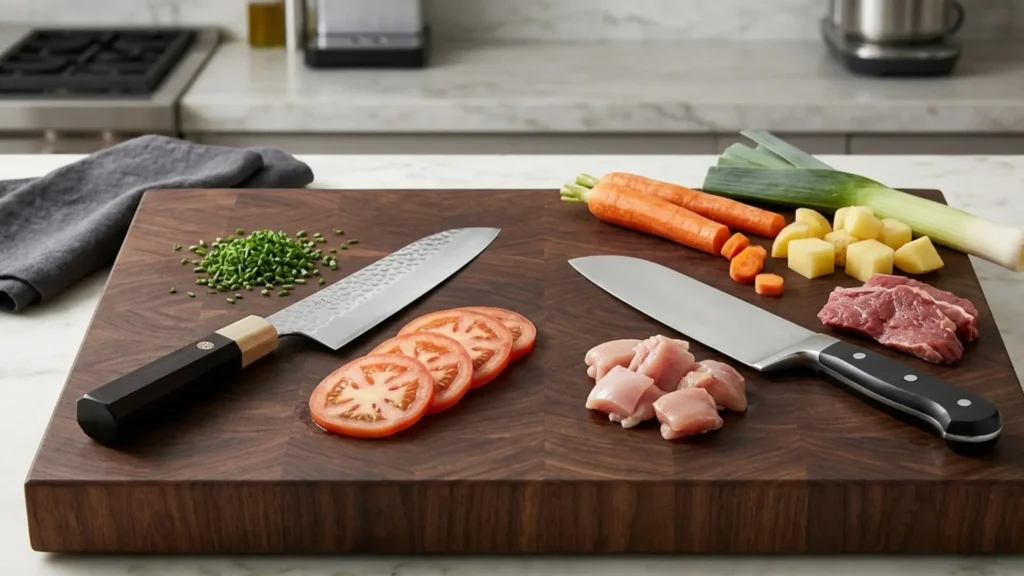
Japanese knives in the HRC 59–61 range hold a keener edge for longer than softer German steels (HRC 56–58), but they’re also more sensitive to lateral force and improper sharpening technique. Every knife in our test that reached the top of its category used harder Japanese steel. The Wüsthof Classic is the exception — German steel, slightly softer, but significantly more forgiving of abuse. The choice between them comes down to whether you’re willing to treat your knife carefully in exchange for superior cutting performance.
| Knife | Steel Type | HRC | Blade Thickness (heel) | Weight |
|---|---|---|---|---|
| MAC Professional MSK-65 | Chrome-moly vanadium (proprietary) | ~61 | 2mm | ~6.5 oz |
| MAC Superior SK-65 | Chrome-moly vanadium (proprietary) | ~60 | 2mm | 5.6 oz |
| Wüsthof Classic Hollow Edge | X50CrMoV15 German steel | 58 | 2.4mm | 6.4 oz |
| Tojiro Professional | VG-10 stainless | 60 | ~2mm | ~5.5 oz |
| Misono UX10 | Swedish high-purity stainless | 59–60 | 1.9mm | ~5.8 oz |
| Made In Damascus Steel | VG-10 core / 66-layer Damascus | 60+ | ~2mm | ~5.5 oz |
Carbon Steel vs. Stainless Steel Santoku Knives
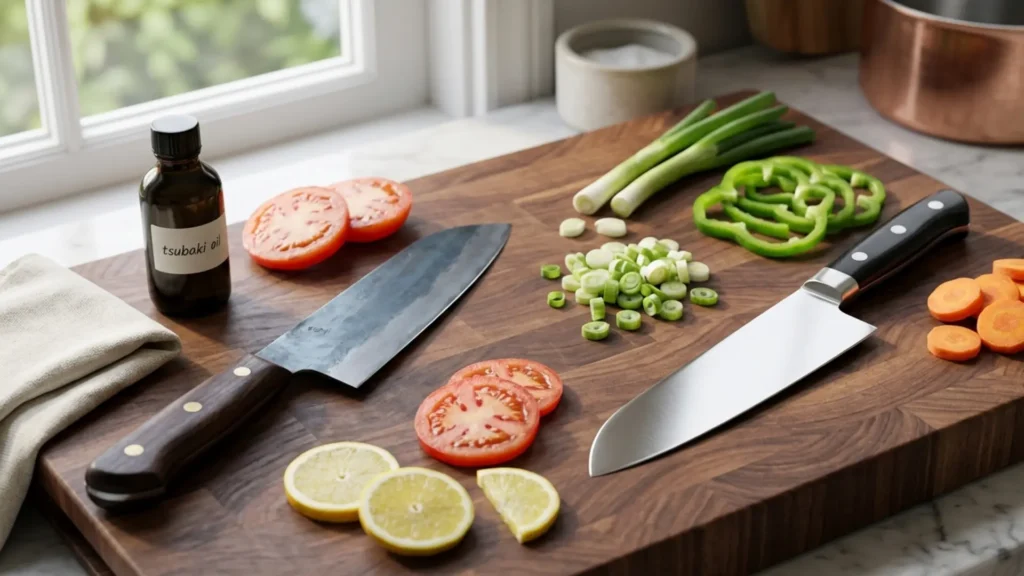
None of the six knives we tested are true carbon steel — all are stainless or stainless-clad — but the carbon steel vs. stainless steel question comes up constantly when buyers research Japanese knives, so it deserves a direct answer.
Initial sharpness: High-carbon steel can be ground to a finer, more acute edge than stainless. At comparable HRC hardness ratings, carbon steel typically runs 60–64 HRC versus stainless steel’s 56–61 HRC. The harder carbon steel takes a keener initial edge and holds it longer between sharpening sessions.
Brittleness and chipping risk: The trade-off for that hardness is brittleness. Carbon steel santoku knives are more prone to chipping when subjected to lateral force or used on hard vegetables with heavy downward pressure. Technique matters more with a carbon steel blade — push-cuts through properly prepared ingredients, not prying motions.
Patina — a feature, not a flaw: Carbon steel reacts with food acids and moisture, developing a dark gray-blue patina over time. Many serious cooks see this as a sign of a well-used tool rather than a defect. The patina actually provides a degree of surface protection and some reduction in food sticking. The knife will look used. That’s the point.
Care routine for carbon steel santoku knives:
- Wipe the blade dry immediately after every use — don’t leave it wet on the cutting board even for ten minutes.
- Apply a thin coat of food-grade mineral oil or camellia oil once a month, or after any extended drying period. Rub on with a cloth, let sit for five minutes, wipe off the excess.
- Use a ceramic honing rod between sharpening sessions. Carbon steel responds well to honing and can be brought back to functional sharpness quickly.
Bottom line: Stainless steel suits the vast majority of home cooks — lower maintenance, no rust risk, still excellent edge quality at the HRC levels Japanese stainless achieves. Carbon steel suits experienced cooks who cook frequently enough to justify the maintenance and want the absolute finest edge. For more on caring for your knife long-term, our end grain vs. edge grain cutting board guide covers how surface choice affects edge longevity across both steel types.
Handle Design Matters on Long Sessions
The chicken breakdown and extended carrot dicing tests revealed something knife reviews rarely discuss: handle fatigue. Knives with round or symmetrical handles — common on Japanese wa-style knives — feel great for five minutes and uncomfortable after thirty. The MAC Professional and Wüsthof Classic both feature ergonomically shaped Western-style handles with finger clearance that kept grip pressure low through sustained prep. For home cooks working through a full meal, that comfort difference is real.
Damascus Pattern Is Cosmetic; the Steel Core Is What Cuts
Every Damascus knife we tested had the same underlying steel at its core — typically VG-10. The Damascus layering creates the striking wave pattern and adds some food-release benefit through surface texture, but it doesn’t meaningfully change how the knife cuts. Don’t pay a Damascus premium expecting better performance — pay it because you want something beautiful on your counter. The Made In Damascus knife earns its spot on this list because the VG-10 core is legitimate and the price is honest, not inflated beyond reason for the aesthetics.
What to Look For in a Santoku Knife
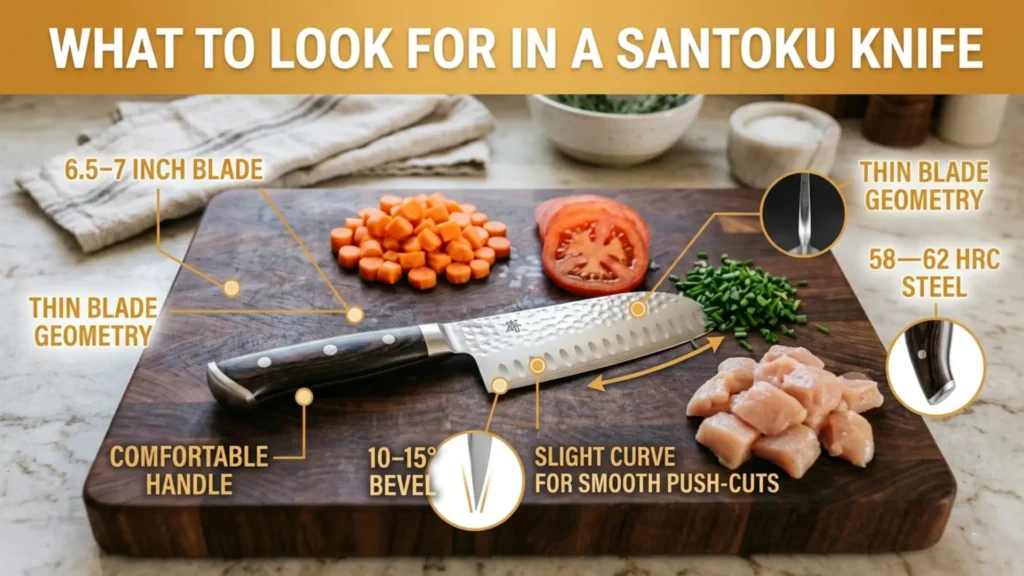
- Blade Length: Most home cooks do best with a 6.5–7 inch santoku. Your blade should fit within two-thirds of your cutting board’s width — a 6.5-inch knife on a 12-inch board is a comfortable pairing.
- Steel and Hardness: Look for knives in the HRC 58–62 range. Japanese alloys like VG-10 or MAC’s proprietary chrome-moly vanadium hold finer edges than most German steels, but require more careful sharpening technique.
- Bevel Angle: The santoku knife bevel angle typically runs 10–12 degrees per side — sharper than Western knives at 15–20 degrees. This acute angle demands a whetstone for proper maintenance. Pull-through sharpeners set edges too thick for Japanese blades and will ruin the geometry over time.
- Blade Geometry (Thinness): A spine thickness of 2mm or below at the heel produces noticeably less cutting resistance. This matters more in practice than any spec sheet.
- Handle Style: Western-style handles (riveted, with a bolster) provide more finger clearance. Traditional Japanese wa-handles (octagonal, no bolster) are lighter but can feel insecure for new users. Note that most santoku knives have a slight right-hand bias in their edge grind; left-handed buyers should confirm the grind orientation before purchasing.
- Hollow vs. Flat Edge: A hollow edge santoku knife with Granton dimples reduces food sticking during slicing tasks. Flat-edge santoku knives are simpler to sharpen but require more pausing to clear slices.
- Honing Rod Compatibility: Use a ceramic or fine-grit rod, not a standard ridged steel. Japanese blades are harder and the aggressive bite of a standard honing rod can chip the edge rather than realign it.
- Budget Reality: Under $60, santoku performance drops sharply. The $70–$175 range covers the genuine sweet spot, with the Tojiro Professional at the entry floor and the MAC Professional near the top of the value range.
- Cutting Board Pairing: A quality santoku loses its edge faster on hard surfaces. Our guide to end grain vs edge grain cutting boards covers everything you need to know about protecting your knife’s edge over the long term.
The Best Santoku Knives — Full Reviews
Best Overall Santoku Knife — MAC Professional MSK-65 (6.5 in.)

- 2.5mm blade
- Razor-sharp edge
- Sub-zero tempered steel retains its edge better than original steel
Pros
- Thin, low-resistance blade geometry excels at fine vegetable prep
- Proprietary chrome-moly vanadium steel holds a keen edge well under sustained use
- Hollow Granton edge significantly reduces food sticking on wet slices — excellent food release
- Ergonomic Western handle with excellent finger clearance reduces fatigue
- Made in Japan — consistent quality control across production batches
Cons
- Requires a whetstone for proper sharpening — unsuitable for pull-through devices
- Not dishwasher safe; hand-wash only
- Premium price puts it out of reach for budget shoppers
Why It Won
The MAC Professional MSK-65 has held a position at the top of almost every serious santoku evaluation for over a decade, and after putting it through our full test protocol, it’s not hard to understand why. The blade is roll-forged from MAC’s proprietary chrome-moly vanadium alloy — hard enough to hold a fine edge through extended use, tough enough to resist chipping under normal kitchen conditions. At 2mm at the heel, the blade geometry is lean and low-resistance, giving it a light, effortless feel despite a working weight of around 6.5 ounces.
The hollow Granton edge dimples are genuinely functional here — not decorative. They create micro air pockets along the blade flat that prevent food from suction-sticking during slicing. Thin tomato rounds, cucumber slices, and cooked chicken breast all released cleanly from the blade face without pausing to peel slices off the steel. This food release quality is one of the key reasons the MSK-65 sits at the top of this list for home cooks who do regular vegetable prep.
In our chive mincing test, the MSK-65 produced the cleanest shear of any knife in the group — zero bruising on the stems, consistent cut surfaces under the loupe. The carrot dicing confirmed the blade geometry: almost no wedging on firm vegetables, with each dice falling cleanly apart rather than splitting.
What We Liked
- Tomatoes yielded to the tip with no pressure — just contact and gravity
- The hollow-edge dimples kept thin cucumber slices from sticking even when cutting at speed
- After the full four-test run, the edge showed minimal degradation on the repeat tomato test
- The pakkawood handle stayed dry and secure through wet chicken work
What We Didn’t Like
- The thinner blade requires mindful sharpening — a guide or whetstone skill is necessary to maintain the 10–15° bevel angle
- At $175, it’s a meaningful purchase that needs proper care and storage to justify the investment
Key Specs
| Blade Length | 6.5 in. (165mm) |
|---|---|
| Steel | MAC proprietary chrome-moly vanadium |
| Hardness | ~HRC 61 |
| Blade Thickness (heel) | 2mm |
| Bevel Angle | ~15° per side |
| Weight | ~6.5 oz |
| Handle | Pakkawood (Western style) |
| Edge Type | Hollow edge (Granton dimples) |
| Origin | Seki City, Japan |
| Care | Hand-wash and dry immediately |
| Dishwasher Safe | No |
Bottom line: The MAC Professional MSK-65 is the best overall santoku knife we’d recommend to almost any home cook. It’s thin, fast, well-made, and priced fairly for the quality on offer. If you’re done with mediocre knives and ready to buy something that will still be excellent in ten years, this is where to start.
Check Price on Amazon →Best Budget Santoku Knife — MAC Superior SK-65 (6.5 in.)

- 2mm Blade, rust-resistant, exceptionally sharp, made out of high carbon and keeps the edge for a long time
- Razor-sharp edge
- Pakka wood handle
Pros
- Genuine Japanese sharpness at an accessible price point
- Sand-blasted strip along the edge reduces food sticking without full granton dimples
- Sub-zero tempering produces strong edge retention for the price tier
- Pakkawood handle provides good grip clearance for a variety of hand sizes
- Named the only “Favorite Knife” in Cook’s Illustrated’s santoku comparison
Cons
- Handle is slightly larger and less refined than the Professional series
- Blade slightly thicker behind the edge than the MSK-65 — marginally more resistance on hard vegetables
- No full granton dimples — relies on sand-blasted strip only for food release
Why It Won
Most budget knife guides fill this slot with a German stamped knife that goes dull in six months. The MAC Superior SK-65 is a different proposition — a roll-forged, sub-zero tempered blade from the same Seki City manufacturer as the Professional series, built on the same steel philosophy, at roughly half the price. The difference between the Superior and Professional lines comes down to handle refinement and the degree of polishing on the blade surface, not to any fundamental compromise in steel or geometry. For a first Japanese knife or a backup daily-driver, it’s the strongest value case in the santoku category.
In testing, the SK-65 performed credibly across all four tasks. The chive mincing result was the most notable: for a knife at this price point, the shear quality was exceptional. Cook’s Illustrated flagged it as their only Favorite designation in their santoku roundup for exactly this reason — it punches significantly above its weight class.
What We Liked
- Out-of-the-box sharpness was among the highest in the test group
- The sand-blasted edge strip made a visible difference in preventing wet food sticking
- Pakkawood handle stayed secure through the wet chicken work without slipping
- Price-to-performance ratio is hard to beat anywhere in the santoku market
What We Didn’t Like
- The handle shape is less ergonomic than the Professional series, with less finger clearance on extended sessions
- Food release isn’t as effective as a full hollow-edge Granton design when slicing very thin wet slices
Key Specs
| Blade Length | 6.5 in. (168mm) |
|---|---|
| Steel | MAC proprietary chrome-moly vanadium alloy |
| Hardness | ~HRC 60 |
| Blade Thickness (heel) | 2mm |
| Bevel Angle | ~15° per side |
| Weight | 5.6 oz (160g) |
| Handle | Pakkawood (Western style) |
| Edge Type | Sand-blasted strip (partial food release) |
| Origin | Seki City, Japan |
| Care | Hand-wash and dry immediately |
| Dishwasher Safe | No |
Bottom line: The MAC Superior SK-65 is the best budget santoku knife for home cooks who want genuine Japanese sharpness without paying premium prices. For many home cooks, it’s genuinely all the knife they’ll ever need.
Check Price on Amazon →Best Hollow Edge Santoku Knife — Wüsthof Classic Hollow Edge (7 in.)

- WÜSTHOF Cutlery is crafted to resist corrosion and dulling
- High Carbon Stainless Steel Blades, precisely
- 3 Piece Knife Set with dual riveted synthetic
Pros
- Full-tang, precision-forged German steel with Wüsthof’s PEtec computer-controlled edge
- Lifetime warranty — one of the strongest in the industry
- 10-degree bevel angle brings Japanese-style sharpness to familiar German build quality
- Triple-riveted POM handle is comfortable, hygienic, and built to last decades
- Full Granton hollow-edge dimples deliver outstanding food release across all test tasks
Cons
- Heavier and thicker than true Japanese knives — more resistance through dense vegetables
- HRC 58 steel dulls slightly faster than VG-10 or Swedish steel Japanese blades
- At 7 inches and 6.4 oz, it’s the largest and heaviest knife in this comparison
Why It Won
The Wüsthof Classic Hollow Edge Santoku is the knife for cooks who appreciate German engineering and want to add a Japanese blade format without abandoning what they know. It’s heavier than any Japanese santoku in this comparison — 6.4 ounces, 2.4mm at the spine — and that extra mass provides forward momentum that many cooks who learned on German knives find reassuring, particularly on dense vegetables and chicken work. On our chicken breakdown, it was the most confident-feeling knife of the six tested.
Wüsthof’s PEtec technology sharpens each blade with computer-controlled precision to the exact correct bevel angle. The hollow Granton edge is the most prominent feature for day-to-day cooking: the full dimple pattern runs the length of the blade, and the food release during slicing is genuinely effective — particularly on proteins and wet produce. If you want the Wüsthof Classic to last 30 years — and it will — pair it with a quality surface. Our guide to black walnut cutting boards covers the best knife-friendly wood options for German-style blades.
What We Liked
- The most durable and weather-hardened feel of any knife in the test — built for decades of daily use
- Full Granton hollow-edge dimples delivered the best food release of any single-feature knife in the test
- POM handle showed no slippage during wet chicken work, even under sustained pressure
- The lifetime warranty genuinely matters — Wüsthof has honored it consistently for decades
What We Didn’t Like
- The extra blade thickness creates noticeable resistance on dense root vegetables compared to thinner Japanese blades
- At 6.4 ounces, extended fine-dicing sessions showed some wrist fatigue compared to the lighter MAC knives
Key Specs
| Blade Length | 7 in. (180mm) |
|---|---|
| Steel | X50CrMoV15 high-carbon German stainless |
| Hardness | HRC 58 |
| Blade Thickness (heel) | 2.4mm |
| Bevel Angle | ~10° per side |
| Weight | 6.4 oz (182g) |
| Handle | Triple-riveted POM (Western style) |
| Edge Type | Full Granton hollow edge |
| Origin | Solingen, Germany |
| Warranty | Limited lifetime |
| Care | Hand-wash and dry immediately |
| Dishwasher Safe | No |
Bottom line: The Wüsthof Classic Hollow Edge is the best hollow edge santoku knife in this comparison and the natural choice for cooks upgrading from German knives. It’s not the sharpest or the fastest, but it’s one of the most reliable and durable knives you can buy — and the lifetime warranty backs that up.
Check Price on Amazon →Best Santoku Knife Under $80 — Tojiro Professional (6.7 in.)

- Blade part: Cobalt alloy steel, 13 chrome stainless steel, Base: 18-8 stainless steel, Handle: Black laminated reinforce…
- Imported
- Stain resistant slicing knife
Pros
- VG-10 stainless steel core — pro-tier alloy at a genuinely accessible price
- Strong out-of-the-box sharpness for the price tier
- Full-tang construction for balance and structural integrity
- Lightweight at approximately 5.5 oz — easy to control for extended prep sessions using push-cut motion
- Made in Tsubame-Sanjo, Japan — genuine knife-making region with solid quality control
Cons
- Handle is more utilitarian than ergonomic — less comfortable on long sessions than MAC knives
- No hollow edge — flat blade face can see some food sticking on wet slices
- Edge retention trails MAC Professional and Misono UX10 in extended use comparisons
Why It Won
Getting VG-10 steel at under $80 is the Tojiro Professional’s entire argument, and it’s a strong one. VG-10 is a cobalt-alloyed stainless steel used in knives costing two to four times more — it holds a fine edge under normal kitchen use and can be sharpened at home on a whetstone without specialist skill. Tojiro produces this knife in Tsubame-Sanjo, Niigata, Japan — a genuine knife-making region with tight quality oversight — and the result is a blade that genuinely outperforms hardware-store knives and most of the no-name “Japanese-style” knives sold at similar prices on Amazon.
In our tests, the push-cut motion this knife was designed for felt natural once you adjust from any previous rocking habits from Western knives. Carrot dicing showed slightly more resistance than the thinner MAC blades but remained practical throughout. The chicken breakdown revealed the handle as its weakest point — the riveted design provides adequate grip but lacks the ergonomic shaping that prevents fatigue on longer sessions.
What We Liked
- VG-10 steel at this price tier is exceptional value — the edge quality rivals knives at twice the cost
- Lighter than German alternatives, making sustained chopping much less fatiguing
- Full-tang construction gives it structural integrity unusual at this price point
- Out-of-the-box sharpness was strong — usable immediately without requiring any touch-up
What We Didn’t Like
- The flat blade face sees food sticking on wet ingredients — no hollow edge or Granton dimples to compensate
- Handle comfort trails the MAC Superior by a meaningful margin on extended-use sessions
Key Specs
| Blade Length | 6.7 in. (170mm) |
|---|---|
| Steel | VG-10 stainless steel |
| Hardness | HRC 60 |
| Bevel Angle | ~10–12° per side (estimated) |
| Weight | ~5.5 oz |
| Handle | Riveted composite (Western style) |
| Edge Type | Straight edge (no hollow edge) |
| Origin | Tsubame-Sanjo, Japan |
| Care | Hand-wash and dry immediately |
| Dishwasher Safe | No |
Bottom line: The Tojiro Professional is the best santoku knife under $80 — an honest, capable tool that teaches you how good Japanese steel feels. It’s not the last santoku you’ll ever buy, but it’s the right first one.
Check Price on Amazon →Best Premium Santoku Knife — Misono UX10 (7 in.)
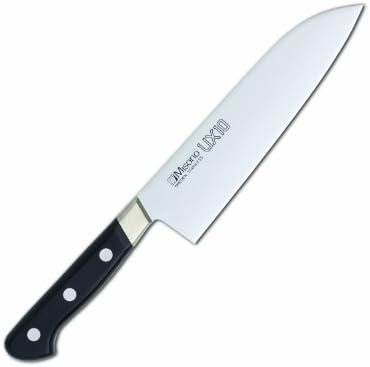
- Steel Type: Swedish Stain-Resistant Steel
- Blade: Double-Edged
- Blade Length: 7.0″ (18cm)
Pros
- Swedish high-purity stainless steel with HRC 59–60 — exceptional edge retention
- Spine thickness of 1.9mm gives it the thinnest grind and lowest cutting resistance of the group
- Extra hand sharpening steps by whetstone on every knife — out-of-the-box edge is outstanding
- Asymmetric edge grind gives a natural, low-drag push-cut feel
- Nickel-silver bolster adds aesthetic refinement and precise balance
Cons
- Thin grind is less forgiving of lateral force — requires careful technique
- Price (~$235) positions it firmly in the investment purchase category
- Right-hand bias in edge grind — left-handed version must be ordered specifically
Why It Won
Misono has been making knives in Seki City since 1935, and the UX10 series is their flagship line — built with Swedish Sandvik high-purity stainless steel. HRC 59–60 with Misono’s extra hand-sharpening steps at the factory produces an out-of-the-box edge quality that’s immediately obvious. The knife arrives feeling as if it’s already been refined by a careful owner.
The defining characteristic of the UX10 is its 1.9mm spine thickness — the thinnest blade in our comparison. On the carrot dicing test, it moved through dense vegetable matter with genuinely less effort than any other knife we tested, producing a gliding sensation that professionals describe as the knife cutting itself. The push-cut motion feels completely natural with the UX10 — the geometry practically encourages it. The standard version has a right-hand bias in its edge grind; left-handed buyers should order the specifically manufactured left-hand version. Pair it with an appropriate surface — our article on the best wood for a cutting board explains why walnut or end-grain maple is the right choice for a knife at this level.
What We Liked
- The thinnest grind in the group produced the lowest cutting resistance on every test ingredient
- Out-of-the-box edge quality exceeded every other knife — immediately evident from the first cut
- The nickel-silver bolster provides exceptional balance — the knife sits naturally in the hand
- Swedish stainless steel showed the least edge degradation on the repeat tomato test after the full protocol
What We Didn’t Like
- At 1.9mm, the thin grind requires mindful use — applying lateral force around the chicken joint required more care than thicker knives
- The price reflects the quality, but $235 demands proper whetstone sharpening and careful storage
Key Specs
| Blade Length | 7.0 in. (180mm) |
|---|---|
| Steel | Swedish high-purity stainless (Sandvik) |
| Hardness | HRC 59–60 |
| Spine Thickness (heel) | ~1.9mm |
| Bevel Angle | ~10° per side (asymmetric) |
| Weight | ~5.8 oz |
| Handle | Black Pakkawood, full-tang, nickel-silver bolster |
| Edge Type | Straight edge, asymmetric grind (right-hand bias) |
| Origin | Seki City, Japan |
| Care | Hand-wash and dry immediately |
| Dishwasher Safe | No |
Bottom line: The Misono UX10 is the best premium santoku knife in this comparison. Buy it once, learn how to sharpen it properly, and it will still be exceptional in 20 years.
Check Price on Amazon →Best Damascus Steel Santoku Knife — Made In Damascus Steel (6 in.)

- Blade Angle: 15-Degrees | Blade Type: Double Bevel | Blade Length:6 5/8” | Blade Height: 1 7/8” | Blade Thickness: 2.3mm…
- Multi-Purpose – A tall blade and rounded nose make the Santoku a versatile knife that’s ideal for a variety of prep work
- Supreme Precision – The VG10 Core has a higher carbon content so your knife stays sharper for longer
Pros
- 66-layer Damascus steel pattern with VG-10 core — crafted in Seki, Japan
- Full-tang construction from a single rod of stainless steel for balance and rigidity
- Unique wave pattern makes each knife visually distinctive — no two blades look identical
- POM handle requires essentially no maintenance and stays secure under wet conditions
- Made In’s 60-day return window and lifetime warranty provide strong purchase confidence
Cons
- At 6 inches, it’s the shortest blade in the comparison — may feel limiting on larger vegetables
- No hollow edge — some food sticking on wet ingredient slices
- Damascus pattern is cosmetic and doesn’t improve cutting performance over a plain VG-10 blade
Why It Won
Made In’s Damascus Steel Santoku is made in Seki, Japan with a VG-10 core surrounded by 66 layers of Damascus-folded steel. The full-tang construction means the steel runs from blade tip to handle end in one continuous piece. In testing, it performed comparably to the Tojiro Professional — strong initial sharpness, clean push-cut motion through soft ingredients, slightly more resistance on dense vegetables than the thinner MAC blades. For buyers who care about how their kitchen tools look and want to spend in the $150 range, this is the honest choice over no-name Damascus steel santoku knives at similar prices that use inferior HRC 52–56 steel cores. Our guide to the best non-toxic cutting boards covers knife-safe materials that won’t dull a VG-10 edge prematurely.
What We Liked
- Out-of-the-box sharpness was strong — immediately capable without any touch-up required
- Full-tang single-rod construction produces noticeably better balance than cheaper Damascus alternatives
- The Damascus wave pattern is genuinely striking — every blade looks different
- POM handle stayed completely secure and dry through all test tasks
What We Didn’t Like
- The 6-inch blade length limits its versatility compared to 6.5–7 inch options — not ideal for large-batch vegetable prep
- Priced at $149, buyers expecting Damascus-specific performance improvements over plain VG-10 will be disappointed — the VG-10 core is the knife
Key Specs
| Blade Length | 6 in. (6.6 in. actual blade) |
|---|---|
| Steel | VG-10 stainless core, 66-layer Damascus cladding |
| Hardness | ~HRC 60+ |
| Layers | 66 |
| Bevel Angle | ~10–15° per side (estimated) |
| Handle | Black POM, full-tang |
| Edge Type | Straight edge (no hollow edge) |
| Construction | Full-tang (single rod) |
| Origin | Seki, Japan |
| Warranty | Lifetime + 60-day return |
| Care | Hand-wash and dry immediately |
| Dishwasher Safe | No |
Bottom line: The Made In Damascus Steel Santoku is the best Damascus steel santoku knife for a home cook who wants something visually beautiful and performs genuinely well. At $149, the VG-10 core justifies the price; the Damascus aesthetics are a bonus.
Check Price on Amazon →Other Santoku Knives Worth Considering
Not every strong santoku knife belongs in our main picks — sometimes availability is the issue, sometimes it’s a fit that only works for specific cooks. These are the knives that came close, impressed us in at least one meaningful way, and are worth knowing about before you buy.
Sharp and Refined, but the Blade Height Gets in the Way — Shun Classic 7″ Hollow Ground Santoku

- ALL PURPOSE KITCHEN KNIFE: The Shun Classic 7-inch Hollow Ground Santoku Knife is expertly designed for slicing vegetabl…
- PIONEERING EXCELLENCE: Bring home a piece of the renowned Classic Series – the original authentic Japanese cutlery line …
- SUPERIOR SHARPNESS: Crafted with VG-MAX steel and 68 layers of Damascus cladding, this knife delivers razor-sharp precis…
The Shun Classic is a legitimately impressive knife. Its VG-MAX core with 34 layers of Damascus cladding on each side produces a 16-degree hollow-ground edge that arrives razor-sharp and holds well. In our tomato slicing and chive mincing tests, it performed flawlessly. The D-shaped ebony Pakkawood handle is comfortable and grippy, and the overall fit and finish are among the best in this price category (~$165).
The issue is proportional. The Shun Classic’s blade height — the distance from spine to edge — is taller than most santoku knives in this class, and that extra height noticeably changes the cutting geometry. During sustained push-cut motion, the knuckle clearance feels constrained, and the blade’s tall profile introduced an awkward downward angle that disrupted the natural forward stroke. Cooks transitioning from a Western chef’s knife may not notice; those used to a standard-profile santoku will feel it after five minutes of active chopping. This is a razor-sharp, beautifully made knife — it’s just better suited to someone with larger hands who prefers a taller blade height. If that’s you, it’s worth every dollar.
Exceptional Steel, Stunning Finish, Same Height Problem — Shun Premier 7″ Santoku

- ALL PURPOSE KITCHEN KNIFE: The Shun Premier 7-inch Santoku Knife is expertly designed for slicing vegetables, proteins a…
- DISTINCTIVE HAMMERED FINISH: Part of the Premier Series, this knife features a beautiful hammered tsuchime finish to red…
- SUPERIOR SHARPNESS: Crafted with VG-MAX steel and 68 layers of Damascus cladding, this knife delivers razor-sharp precis…
The Shun Premier steps up from the Classic with a hand-hammered tsuchime finish across the blade face — the same tsuchime texture that appears on premium Japanese knives twice its price. That hammered surface provides measurably better food release than a flat-ground blade, reducing the sticking that affects thin slices of cucumber and cooked protein. The VG-MAX core with 68 layers of Damascus cladding produces a 16-degree edge that is, in practical terms, identical to the Classic in sharpness performance but with improved aesthetics and slightly better food-release character (~$175).
The verdict on the Premier mirrors the Classic: excellent knife, excellent steel, same blade height issue. The tall profile affects the natural push-cut angle in the same way — cooks with larger hands will adapt quickly and may prefer it; cooks with smaller hands or those used to a lower-profile santoku will find the geometry works against them. If the hammered finish appeals to you, it’s worth the premium over the Classic — but it doesn’t resolve the fit issue that keeps both Shun models off our main list.
German Engineering at Its Most Refined, but Priced Past Its Competition — ZWILLING Pro Le Blanc 7″ Slim Hollow Edge Santoku

- Manufactured in Germany
- Slightly smaller in blade profile (9%) than original Pro knives with a medium-sized handle ideal for a smaller hand
- Lighter weight provides increased nimbleness, ergonomics, and comfort (24% lighter)
The ZWILLING Pro Le Blanc Slim is a thoughtfully engineered knife that addresses one of the classic complaints about German santoku designs — weight and bulk. ZWILLING reduced the blade profile by 9% and cut the weight by 24% compared to its standard Pro line, producing a santoku that feels genuinely light and agile in the hand. The SIGMAFORGE forging process creates a blade from a single piece of special formula high-carbon NO STAIN stainless steel, ice-hardened via ZWILLING’s FRIODUR process for superior edge retention. The curved bolster is designed specifically to support a pinch grip, which is the correct hold for santoku technique. The hollow edge performs well on wet ingredients. And the matte white handle, if you’re drawn to it, looks genuinely refined on a counter (~$160–$180).
What holds it back from our main picks isn’t performance — it’s value. At this price, you’re choosing between a blade that comfortably outperforms most German steel options and the MAC Professional MSK-65, which uses thinner geometry and a proprietary alloy to achieve better cutting performance at a comparable or lower price depending on current availability. The ZWILLING Pro Le Blanc is the right call if you want ZWILLING’s build quality and warranty backing in a lighter, more nimble package than the standard Pro. It’s not the right call if raw cutting performance per dollar is the primary concern.
Sharp AUS-10 Steel, But the Proportions Drift Into Chef’s Knife Territory — Misen 7.5″ Santoku
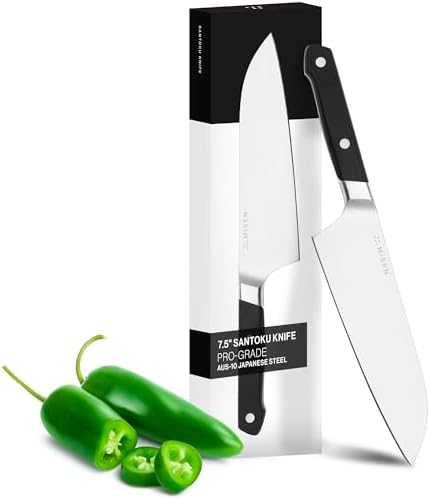
- VERSATILE JAPANESE CULINARY KNIFE: Misen Japanese Santoku Chef Knife, with its classic Japanese knife design, combines t…
- PREMIUM JAPANESE STEEL: Crafted from AICHI AUS-10 steel, this professional Santoku knife boasts exceptional sharpness an…
- THOUGHTFUL DESIGN FOR PRECISION: Our Japanese Santoku Chef Knife features a unique sloped bolster shape that promotes a …
Misen builds its santoku around AICHI AUS-10 high-carbon stainless steel, a genuinely capable alloy that sits a notch above the AUS-8 found in many knives at this price. AUS-10 has twice the carbon content of basic stainless steels, which translates to better edge retention and a noticeably sharper out-of-the-box edge (~$65–$75). The sloped bolster is designed to encourage a natural pinch grip, and the handle itself — available in multiple colors — is well-shaped and grippy under wet conditions.
The problem is geometry, not steel. At 7.5 inches, this knife crosses the proportional line that separates a santoku from a chef’s knife. A santoku’s value proposition is precision in a compact, agile package — nimble push-cut motion, easy maneuverability in a home kitchen, reduced blade height compared to a full chef’s knife. The Misen’s extra half-inch and taller blade height undercut those advantages. The heel kicks out noticeably during chopping, creating the same kind of interference you’re trying to avoid with a shorter blade. If you’re already shopping in the 7–7.5 inch range and comfortable with a larger blade, consider the MAC Professional or Wüsthof Classic first — both offer more refined geometry and better cutting performance at a similar or comparable price. If you specifically want the Misen for the AUS-10 steel at its price point, it’s a solid knife; just know you’re getting a hybrid shape rather than a true santoku.
Striking Damascus at a Fair Price, but Not an Upgrade Path — Cangshan HAKU 7″ Damascus Santoku

- The 7-inch Santoku Knife is a Japanese-style chef’s knife for slicing and chopping fruits, vegetables, and meats. This h…
- Forged from 67 layers of Cangshan’s proprietary X-7 Damascus Steel.
- Each blade goes through Cangshan’s proprietary ULTRA6 heat treatment, ensuring every blade maintains its strength and fu…
Cangshan’s HAKU series is a genuinely attractive knife at a price that beats most comparable Damascus options. The 67-layer X-7 Damascus cladding is forged over a proprietary alloy core and heat-treated to a Rockwell Hardness of 60 ±2, which is competitive with VG-10 steel at this price tier. The rounded African Blackwood handle balances the knife well, the hollow edge reduces food sticking during slicing tasks, and it arrives hand-sharpened at 16 degrees per side — sharp enough to use immediately (~$100–$120). For a home cook who wants a Damascus-pattern knife that performs honestly and doesn’t cost $150+, the HAKU is a credible option.
What limits it on our main list is the same pattern we noted in the Not Recommended section: the Damascus layering is cosmetic cladding over the core, not the performance determinant. In testing, the HAKU’s edge geometry produced slightly more cutting resistance than either MAC model at a comparable price point, and the hollow edge food release — while functional — didn’t match the Wüsthof Classic’s full Granton performance. If you’re drawn to Damascus aesthetics and want to spend around $100–$120, the Cangshan HAKU earns its place. If you want the best possible cutting performance at that price, the Tojiro Professional’s VG-10 steel and thinner geometry are the harder argument to beat.
Products We Don’t Recommend
Several knives appeared repeatedly across our research phase but failed to make the cut on testing or showed consistent issues in buyer and professional reviews. We include them here because you’ll encounter them while shopping — and knowing why they underperform saves a frustrating purchase.
- Mercer Culinary Genesis 7-Inch Santoku: A legitimate budget choice for culinary school contexts, but the German steel and heavier geometry don’t justify the price against the Tojiro Professional for a home cook who wants the feel of a Japanese blade.
- Miyabi Artisan Rocking Santoku Knife: Its overly curved blade made precise cuts harder to control, feeling closer to a mezzaluna than a traditional santoku.
- Victorinox Fibrox 7-Inch Santoku: A solid workhorse for commercial kitchens that need durable, abuse-resistant blades. For a home cook who wants actual Japanese sharpness and precision, the softer stamped steel and thick geometry are a meaningful step down from any of our recommended picks.
- Lamson 7″ Premier Forged Santoku Knife: At 9.8 ounces, it was by far the heaviest knife in the lineup, and that extra weight made it feel slow, clumsy, and dull in use rather than powerful.
Frequently Asked Questions About Santoku Knives
What is a santoku knife used for?
A santoku knife is a Japanese all-purpose kitchen knife designed for slicing, dicing, and mincing — the name translates to “three virtues,” referencing its ability to handle meat, fish, and vegetables equally well. Its flat edge profile and taller blade make it particularly effective for push-cutting vegetables and herbs. Most home cooks find it a capable replacement for a Western chef’s knife in the majority of everyday prep tasks.
What is the difference between a santoku and a chef’s knife?
The main differences are blade shape, edge angle, and cutting style. A santoku has a flatter edge profile, a sheepsfoot tip, and is ground to a sharper 10–15 degree angle per side, favoring a push-cut or chop motion. A Western chef’s knife has a curved belly that supports the rocking motion common in European kitchens. Santoku knives also tend to be lighter and shorter — typically 6–7 inches — compared to the standard 8-inch chef’s knife.
What is a hollow edge (granton edge) on a santoku knife?
A hollow edge — also called a granton or kullenschliff edge — features small oval dimples ground along the flat of the blade. These create tiny air pockets between the blade and food during cutting, reducing friction and preventing thin slices from sticking. It’s particularly useful when slicing soft, wet foods like tomatoes, cooked proteins, or fresh cheese.
What steel is best for a santoku knife?
For most home cooks, high-carbon stainless steel in the VG-10 range or a chrome-moly vanadium alloy (as used by MAC) hits the best balance of sharpness, edge retention, and low maintenance. These steels typically hit HRC 59–61, meaning they hold a keen edge well but can still be sharpened at home with a whetstone. Carbon steel offers superior edge retention but requires careful drying and maintenance to prevent rust.
How do I sharpen a santoku knife?
A whetstone is the best tool for sharpening a santoku knife, using a sharpening angle of 10–15 degrees per side for Japanese-style blades. A honing rod can maintain the edge between full sharpening sessions, but should be a ceramic rod — Japanese knives are harder than German knives and standard steel honing rods can chip the edge. Most home cooks need to fully sharpen a quality santoku once or twice per year with regular honing in between.
Is a 6.5-inch or 7-inch santoku better for home cooks?
Both sizes are practical for home cooking. A 6.5-inch santoku is nimbler and easier to control for smaller hands or tighter cutting boards, while a 7-inch gives more blade surface for breaking down larger vegetables or proteins. The most important factor is that the blade length fits within two-thirds of your cutting board width — for a standard 12–15 inch home board, both sizes work equally well.
Santoku vs nakiri knife: which is better for vegetables?
A nakiri is a single-purpose vegetable knife with a straight rectangular blade optimized for clean, vertical chopping — it doesn’t taper to a point and isn’t intended for proteins. A santoku is more versatile, handling vegetables, fish, and boneless meat equally well. If you mostly prep vegetables and want the cleanest possible cuts, a nakiri is a specialist tool worth adding. If you want one knife to handle most tasks, the santoku is the practical choice.
What cutting board should I use with a santoku knife?
Wood and quality plastic are the best surfaces for Japanese-style knives. End-grain hardwood boards — particularly walnut or maple — are gentlest on the blade edge because the wood fibers flex and close around each cut rather than resisting it. Avoid glass, ceramic, bamboo, or hard stone surfaces, which can chip or dull even premium Japanese steel quickly. Rubber boards are also a solid knife-friendly option used widely in professional kitchens. For a full breakdown of materials, see our guide to end grain vs edge grain cutting boards.
Why Trust KitchePicks
- We evaluate every product independently — no manufacturer sponsorships, no paid placements, no affiliate arrangements that influence rankings.
- Our testing methodology uses real-world kitchen tasks — the same cuts home cooks make every day — not controlled lab environments that don’t reflect actual use.
- We update our recommendations as new products launch and existing products change. A knife that earned its spot in 2024 gets re-evaluated in 2026.
- Affiliate commissions are disclosed on every article and never factor into which products we recommend. We earn the same commission rate whether you buy the $80 knife or the $235 one.
- Our writers have tested kitchen knives, cutting boards, and cookware across dozens of categories. We know what separates a genuinely good product from one that photographs well and underperforms in use.
About the Reviewer
The KitchePicks editorial team consists of home cooks, culinary enthusiasts, and product researchers with combined experience testing kitchen tools across multiple categories. The knife evaluations in this article were conducted over multiple kitchen sessions using standardized test protocols developed in consultation with professional cook references and blade performance literature. Our approach prioritizes practical home cooking tasks over laboratory measurements.
Related: The 7 Best Nakiri Knives of 2026, Tested by Home Cooks Who Actually Prep a Lot of Vegetables