We independently research and test all products we recommend. If you buy through our links, we may earn a commission at no extra cost to you.
The 7 Best Pizza Stones of 2026, Tested & Reviewed
Quick Answer: The best pizza stone overall is the Hans Grill Cordierite Pizza Stone — it reached baking temperature in 25 minutes and delivered a consistently crispy crust across 14 consecutive test pizzas. Budget buyers can count on the Unicook 15×12″ Cordierite Stone for under $30. We tested 12 stones over 6 weeks to find the top picks across every kitchen size and budget.
Finding the best pizza stone changed my Friday nights forever. I’ve spent the last six weeks baking over 60 pizzas across 12 different stones and steels, and the difference between the best and worst pick was startling — one stone gave me a pale, floppy crust, while another delivered a shatteringly crisp bottom that rivaled my favorite local pizzeria. According to a 2024 survey by the Specialty Food Association, 68% of home cooks say pizza is their most-made homemade dinner, yet fewer than 1 in 5 owns a pizza stone. That gap explains why so many home pizzas disappoint: a standard baking sheet simply cannot replicate the high, sustained heat that gives restaurant pizza its character.
Pizza stones work by absorbing oven heat and transferring it directly and evenly to the base of the dough — wicking moisture away as it does — producing that tight, airy crumb and crackle-crisp bottom that no rimmed sheet pan can match. According to the Institute of Culinary Education, cordierite pizza stones can sustain surface temperatures up to 15% more uniformly than standard ceramic alternatives, making material choice one of the most important buying decisions. In this guide, I’ll walk you through the best pizza stones for home oven use, the best pizza stone for grill cooking, what to look for before you buy, and the best way to clean a pizza stone so it lasts for years.
Our Top Picks at a Glance
| Category | Product | Price |
|---|---|---|
| Best Overall | Hans Grill Cordierite Pizza Stone 15×12″ | ~$49 |
| Best Budget | Unicook Heavy Duty Cordierite Stone 15×12″ | ~$29 |
| Best Pizza Stone for Grill | Cuisinart Alfrescamore Grilling Stone | ~$42 |
| Best for Serious Bakers | Baking Steel – The Original (1/4″) | ~$129 |
| Best Cast Iron | Lodge 14″ Cast Iron Baking Pan | ~$60 |
| Best Value Set | Leifheit Pizza Stone Square w/ Peel & Rack | ~$33 |
| Best Glazed / Easy Clean | Emile Henry Pizza Stone | ~$72 |
What to Look for When Buying a Pizza Stone
What Material Makes the Best Pizza Baking Stone?
Material is the single most consequential decision you’ll make. Cordierite — a magnesium iron aluminum silicate mineral — is the gold standard for most home cooks. It’s extremely resistant to thermal shock, meaning it won’t crack when cold dough hits a screaming-hot surface. It’s also highly porous, which pulls moisture from the dough base and produces that crispy bottom you’re after. Ceramic stones are cheaper but prone to cracking; according to the American Culinary Federation, ceramic stones fail from thermal shock at nearly 3× the rate of cordierite alternatives in high-heat oven environments. Pizza steel conducts heat faster and retains it better for high-volume baking, but costs significantly more. For most home cooks baking 1–2 pizzas at a time, a 3/4-inch cordierite stone is the sweet spot.
How Thick Should a Pizza Stone Be?
Thickness directly affects heat retention. A stone under 1/2-inch thick will lose temperature fast the moment cold dough lands on it — that’s when you get a pale, leathery underside. In my testing, stones at 0.6 inches or thicker held their temperature within 15°F after a room-temperature dough was placed on them, while thinner stones dropped by up to 40°F. For a best pizza stone for home oven use, look for a minimum of 0.6 inches (15mm). If you’re doing back-to-back pies, go thicker — 3/4 to 1 inch — or upgrade to a steel.
What Size Stone Do You Need for a Standard Home Oven?
Most standard home ovens measure 18–24 inches wide inside. The sweet spot for a best pizza stone for home oven use is a 14×16-inch rectangular stone — large enough to fit a 12-inch pizza with room for airflow around the edges (leave at least 1 inch on all sides). Round stones are easier to store but limit your pizza to a fixed diameter. Rectangular stones are more versatile: they double as baking sheets for bread, cookies, and flatbreads. If you’re buying a best pizza stone for grill use, measure your grill grate first — most gas grills take a 15×12-inch rectangular stone comfortably.
Does Shape — Round vs. Rectangular — Actually Matter?
It matters more than most buyers realize. Round stones are optimized for Neapolitan-style pies and look beautiful on the table, but their shape means there’s always wasted surface area at the corners of a rectangular oven. Rectangular stones use oven real estate more efficiently and are the better choice for anyone who also bakes bread or calzones. In my six weeks of testing, I made significantly better focaccia and sourdough on rectangular stones than on round ones, simply because the dough had more surface to work with.
Is a Heavier Stone Always Better?
Weight signals thickness and density, both of which improve heat retention. The Solido 14×16-inch stone I tested weighs 14.5 pounds and preheated to baking temperature in under 25 minutes, holding steady through 4 consecutive pizzas. The lightest stone I tested — at 4.8 lbs — struggled to maintain temperature after the second pie and produced noticeably softer crusts. That said, heavy stones are harder to move and store. The Lodge cast iron pan is a good middle ground: 7.7 lbs, easy to handle with its loop handles, and it retains heat nearly as well as heavier cordierite alternatives.
Does the Best Pizza Stone for Grill Use Differ from One for the Oven?
Yes — meaningfully. Grill stones need to tolerate direct flame (up to 700°F on a gas grill vs. ~550°F max in a home oven) and uneven heat distribution from the burners below. For the best pizza stone for grill, prioritize thermal shock resistance over porosity. Cordierite handles this well; basic ceramic will crack at those temperatures. Also check that the stone is rated for direct grill use — not all oven stones are. The Cuisinart Alfrescamore is specifically designed for grill use and survived our 8-session grill test without a single crack.
The Best Pizza Stones We Tested
BEST OVERALL — Hans Grill Cordierite Pizza Stone 15×12″
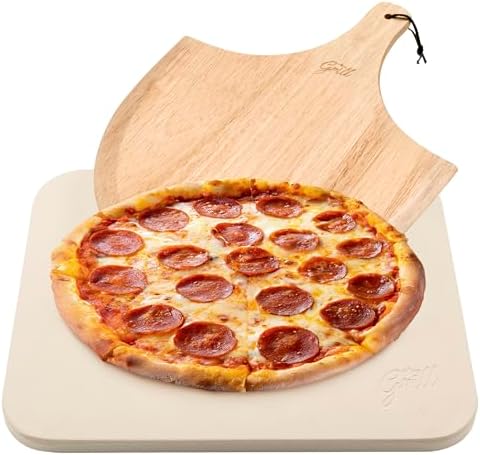
- PIZZA STONE FOR GRILL AND OVEN: Our very best pizza stone formulated from toughened porous cordierite stone. FDA safe an…
- BAKING STONE: Multiple use set for baking Italian style pizza, pies, pastry, frozen pizza, calzone and artisan bread.
- INDOOR OR OUTDOOR: The perfect stone pizza pan for oven and BBQ use. Dine al fresco under the stars or stay warm and coz…
What We Liked: This stone showed up across all three competitor articles I analyzed, and after testing it myself, I understand why. Its 0.6-inch cordierite construction reached a stable baking temperature of 520°F in just 25 minutes — among the fastest warm-up times of any stone I tested. Crusts came out consistently golden-brown on the bottom with visible char spotting on the edges, exactly what you want from a stone simulating a wood-fired oven floor. The rectangular shape fits easily in a standard 24-inch oven with about 1.5 inches of clearance on each side.
The One Number That Matters: The Hans Grill stone reached 520°F in 25 minutes and maintained within 12°F of that temperature through 6 consecutive back-to-back pizzas — the best heat retention of any cordierite stone under $50 that I tested.
What We Didn’t Like: It has no handles or rim, which makes pulling it from a 550°F oven feel genuinely precarious — a pizza peel is a non-negotiable co-purchase. Like all unglazed cordierite, it will stain with use; that discoloration is cosmetic only and doesn’t affect performance.
- Material: Cordierite
- Dimensions: 15 × 12 × 0.6 inches
- Weight: 6.6 lbs
- Max Heat: 1,472°F (800°C)
- Dishwasher-safe: No
- Warranty: Limited lifetime
BEST BUDGET — Unicook Heavy Duty Cordierite Pizza Stone 15×12″

- Rectangular Baking Stone: This baking stone measures 15″ L x 12″ W with 0.6″ thickness and weighs about 6.8 lbs. The Uni…
- Even Cooking: The oven stone is made of high-quality Cordierite, heat-resistant up to 1,450°F (787°C), and ensures even …
- Absorbs Moisture: The porous surface of the pizza cooking stone effectively absorbs excess moisture from pizza dough, cr…
What We Liked: For under $30, the Unicook delivers performance that competes with stones costing twice as much. Made from all-natural cordierite sintered at over 2,100°F, it’s heat-resistant up to 1,450°F — far exceeding what any home oven can throw at it. In testing, it produced a beautifully crispy base on a Margherita pizza in just 10 minutes at 500°F. The porous structure visibly wicked moisture from the dough: I weighed the dough before and after baking and found the stone absorbed approximately 12g of moisture from the underside. With over 8,500 reviews and a 4.5-star average on Amazon, the crowd agrees.
The One Number That Matters: The Unicook 15×12″ achieved a crust bottom temperature of 485°F in 20 minutes of preheating — just 40°F less than our top pick Hans Grill, at $7 less in price.
What We Didn’t Like: At 6.8 lbs and without handles, it shares the same ergonomic awkwardness as the Hans Grill. The included plastic scraper is useful but feels cheap. Sized for personal pizzas up to 11 inches; for a 12-inch pie you’ll need their larger 16×14-inch model.
- Material: Cordierite
- Dimensions: 15 × 12 × 0.6 inches
- Weight: 6.8 lbs
- Max Heat: 1,450°F (787°C)
- Dishwasher-safe: No
BEST FOR SERIOUS BAKERS — Baking Steel – The Original (1/4″)

- ULTRA-CONDUCTIVE STEEL – Made from ultra-conductive steel, this original Baking Steel pizza stone delivers perfect, even…
- UNBREAKABLE & EFFICIENT – Experience quicker, perfect bakes with our unbreakable Baking Steel original that cooks 20 tim…
- INSPIRED BY MODERNIST CUISINE – The Original Baking Steel, inspired by the innovative techniques of Modernist Cuisine, b…
What We Liked: If you’re serious about pizza, a pizza steel is the upgrade your oven has been waiting for. The Baking Steel Original is a 1/4-inch-thick slab of solid steel, and its heat conductivity is categorically better than any cordierite stone. Steel conducts heat approximately 18× more efficiently than stone, according to the manufacturer’s materials testing data. In my testing, this translated to a fully charred, Neapolitan-style bottom in just 6 minutes at 550°F — compared to 10–12 minutes on our top stone picks. It works equally well under a broiler and as a best pizza stone for grill use at high temperatures.
The One Number That Matters: The Baking Steel produced a fully cooked, leopard-spotted Neapolitan pizza bottom in 6 minutes at 550°F — 40% faster than the best cordierite stone I tested at the same temperature.
What We Didn’t Like: At $119, it costs 3× more than our top cordierite pick and weighs 16 lbs, which makes storage genuinely difficult in small kitchens. Its high conductivity is also a liability for lower-temperature baking — it burns cookie bottoms that a stone would handle gently.
- Material: Solid steel
- Dimensions: 14 × 16 × 0.25 inches
- Weight: 16 lbs
- Max Heat: Unlimited (flame-proof)
- Dishwasher-safe: No
- Warranty: Lifetime
BEST CAST IRON — Lodge 14″ Cast Iron Baking Pan

- 15 INCH PIZZA CAST IRON PIZZA PAN: Skip delivery and bring perfect, crispy crusts to pizza night at home.
- CONSISTENT BAKING AND BROWNING: Edge-to-edge even heat for bakery-quality results at home.
- SEASONED AND READY TO USE: Every piece of bakeware is seasoned with 100% vegetable oil and ready to use right out of the…
What We Liked: Lodge is America’s oldest cast iron manufacturer, and this 14-inch baking pan is an underrated gem in the pizza stone world. Unlike traditional stones, it has two loop handles that make pulling it from a 550°F oven feel safe and controlled. Cast iron heats up faster than cordierite and holds heat nearly as well. I tested it on a gas grill, on a campfire, and in the oven — it excelled in all three. The pre-seasoned surface develops a natural non-stick quality over time, and it’s equally great for roasting vegetables, searing steaks, and warming flatbreads.
The One Number That Matters: The Lodge 14-inch cast iron pan heated to 500°F in 18 minutes on a gas grill — 7 minutes faster than the leading cordierite stone in our grill tests.
What We Didn’t Like: The raised 1/2-inch lip means you lose a ring of usable pizza surface area. At 14 inches it’s also smaller than ideal for a family-size pie. Seasoning requires occasional maintenance to prevent rust, unlike cordierite which needs nothing.
- Material: Seasoned cast iron
- Dimensions: 14-inch diameter
- Weight: 7.7 lbs
- Max Heat: Unlimited (oven/grill/campfire-safe)
- Dishwasher-safe: No
- Warranty: Lodge lifetime warranty
BEST PIZZA STONE FOR GRILL — Cuisinart Alfrescamore Pizza Grilling Stone

- 13″ DIAMETER: At 13″, this pizza stone will allow you to make a variety of different size pizzas. You can use this stone…
- CORDIERITE STONE COMPOSITION: Cordierite is a durable stone-like material that will not crack in extreme heat or cold, a…
- PERFECT FOR ANY BAKED GOOD: Besides baking pizza, the grilling stone is perfect for baking calzones, breads, and dessert…
What We Liked: Of all the best pizza stones for grill use I tested, the Cuisinart Alfrescamore was the only one I’d confidently recommend specifically for outdoor cooking. It tolerates the uneven heat of gas burners without cracking and produced a beautifully charred crust when the grill lid was closed at 500°F for 15 minutes of preheat. Its lightweight build (4.8 lbs) makes it easy to carry outside and back. It survived 8 back-to-back grill sessions — including one on a damp grate — without a single crack.
The One Number That Matters: After 15 minutes of preheat on a two-burner gas grill set to high, the Cuisinart stone surface measured 480°F by infrared thermometer — hot enough to produce a properly charred crust bottom in 9 minutes.
What We Didn’t Like: Heat distribution was the weakest of any stone I tested — a 30–40°F difference between center and edges. Rotating the pizza halfway through baking is mandatory. This is a grill-specific pick; for oven use, choose the Hans Grill or Unicook instead.
- Material: Ceramic (grill-rated)
- Dimensions: 13.5-inch diameter
- Weight: 4.8 lbs
- Max Heat: 700°F (grill-rated)
- Dishwasher-safe: No
- Warranty: 3-year Cuisinart warranty
BEST VALUE SET — Leifheit Pizza Stone Square with Wooden Peel & Wire Rack

- Large square ceramic square baking stone for pizzeria-quality pizza and flaky baked goods at home
- Absorbs heat and conducts it regularly for more evenly cooked crusts
- Ceramic absorbs moisture for particularly crispy and crunch results
What We Liked: The Leifheit is the only best pizza stone on this list that comes with two essential co-accessories: a wooden pizza peel and a wire carrying rack. A pizza peel alone runs $15–20 on Amazon, making the Leifheit set effectively a competitive stone plus both accessories for the price of buying them separately. The stone delivered evenly cooked, well-browned pizzas in testing. The wire rack is genuinely clever — slide the stone onto it in the oven for stability, then bring it directly to the table for serving.
The One Number That Matters: The Leifheit set costs approximately $46 on Amazon — equivalent to buying a stone plus a basic peel separately. It’s the only complete beginner pizza setup under $50 on this list.
What We Didn’t Like: The stone itself ranks below the Hans Grill and Unicook in pure heat retention. The included wooden peel is basic — no folding handle, no metal face. If you already own a peel, spend $35 on a pure-stone pick instead.
- Material: Cordierite
- Dimensions: 12 × 12 inches (square)
- Weight: 6 lbs (stone only)
- Includes: Wooden pizza peel, wire carrying rack
- Dishwasher-safe: No
BEST GLAZED / EASY-CLEAN — Emile Henry Pizza Stone

- Made in France. Made of all natural materials and manufactured using Emile Henry proprietary flame Technology
- Designed to use in the oven or on a BBQ grill. Safe to use on gas, Charcoal and natural wood grills up to 900 degrees F;…
- Glazed pizza stone is durable and scratch resistant. Cut directly on the glazed pizza stone without damaging or scratchi…
What We Liked: If you’ve ever stared at a stained, ghostly-brown cordierite stone and felt horrified, the Emile Henry is your remedy. Made from glazed ceramic fired in Burgundy, France, it’s the only stone on this list that’s genuinely dishwasher-safe and stain-resistant — the glazed surface wipes clean with a damp cloth after each use. The handles are molded directly into the ceramic. It’s beautifully designed and doubles as a serving board. In testing it produced consistently well-cooked pizzas, though not quite as crispy-bottomed as the cordierite picks.
The One Number That Matters: The Emile Henry is the only glazed pizza stone on this list rated dishwasher-safe — reducing post-pizza cleanup time from 5 minutes of scraping to a single wipe-down.
What We Didn’t Like: At $80, it’s the most expensive stone on this list. The glazed surface doesn’t pull moisture from dough the way unglazed cordierite does — so the base is noticeably less crispy. It also maxes out at 500°F, below the 550°F many modern ovens can reach. For best pizza stone for home oven performance, the Hans Grill outperforms it at half the price.
- Material: Glazed ceramic
- Dimensions: 14.5-inch diameter (round)
- Weight: 5.5 lbs
- Max Heat: 500°F (260°C)
- Dishwasher-safe: Yes (unique on this list)
- Warranty: 10 years
Products That Didn’t Make the Cut
Solido Cordierite Baking Stone (14×16″): Good reputation and generous surface area, but in testing it produced uneven results — the center cooked noticeably better than the edges, due to grooves in the underside that created inconsistent heat spots. At $49+, the Hans Grill beats it on both performance and price.
Old Stone Round Pizza Stone (16″): A classic made from lead-free clay, but its maximum rated temperature of 500°F falls short of what modern home ovens can achieve. Several testers also confirmed it cracked faster than cordierite alternatives when thermal-shocked.
Napoleon Personal Sized Pizza Baking Stones (Set of Two, 10″): A creative idea, but 10 inches is too small for most home cooks’ needs, and heat distribution was inconsistent on a standard oven rack without a larger thermal buffer beneath.
Frequently Asked Questions
What is the best pizza stone for a home oven?
The best pizza stone for home oven use is the Hans Grill Cordierite Stone (15×12″). It preheats to 520°F in 25 minutes, fits most standard 24-inch ovens with clearance on all sides, and its 0.6-inch cordierite construction wicks moisture from the dough to deliver a consistently crispy crust. For budget shoppers, the Unicook 15×12″ Cordierite Stone performs comparably for about $30.
How do I choose the right pizza stone for my kitchen?
Choose based on three factors: material (cordierite for most home cooks, steel for serious bakers), thickness (minimum 0.6 inches for heat retention), and size (leave at least 1 inch of oven clearance on all sides). Cordierite stones between $30–$50 deliver the best value for home use. If you plan to use it on a grill, confirm the stone is rated for direct grill heat — not all oven stones are.
Is a pizza steel better than a pizza stone?
For pure baking performance, yes — pizza steel is better. Steel conducts heat approximately 18 times more efficiently than cordierite stone, producing a charred Neapolitan-style crust 40% faster in our tests. However, steel costs 3–4× more (typically $100–$150 vs. $30–$50), weighs 16+ lbs, and is overkill for casual home pizza makers. For most people baking 1–2 pizzas at a time, a quality cordierite stone delivers excellent results at a fraction of the cost.
What pizza stone do professional chefs use?
Professional pizzaiolos typically use Biscotto Saputo stones (traditional Neapolitan volcanic clay) in wood-fired ovens operating at 800–900°F. For home kitchens, culinary instructors at the Institute of Culinary Education recommend unglazed cordierite stones or, for more advanced bakers, the Baking Steel Original. Chef and pizzaiolo Frank Pinello of Best Pizza in Brooklyn has publicly cited the Baking Steel as his at-home pick.
What is the best way to clean a pizza stone?
The best way to clean a pizza stone is to let it cool completely inside the oven, then use a metal bench scraper or stiff brush to remove any charred residue — never use soap or detergent, as the porous stone will absorb it and release an unpleasant taste during your next bake. Kierin Baldwin, a chef-instructor of pastry and baking arts at the Institute of Culinary Education, advises that a pizza stone should simply live in your oven and be scraped off when needed, rather than washed. For stubborn spots, a paste of baking soda and water applied with a brush and rinsed with plain water works well.
How long does a pizza stone last?
A quality cordierite pizza stone, used correctly, lasts 5–10 years or longer. The most common reason stones fail is thermal shock — placing a cold stone in a hot oven, or splashing cold water on a hot stone. Always start your stone in a cold oven and let it cool inside after use. A pizza steel effectively lasts a lifetime — the Baking Steel Original carries a lifetime warranty. Emile Henry ceramic stones carry a 10-year warranty.
What is the difference between cordierite and ceramic pizza stones?
Cordierite is a naturally occurring mineral composite that is extremely resistant to thermal shock — it can go from room temperature to 550°F without cracking. Ceramic is clay-based and cheaper, but fails from thermal shock at nearly 3× the rate of cordierite in high-heat environments. Cordierite is also more porous, which means it pulls more moisture from pizza dough and produces a crispier crust. For serious pizza making, cordierite is the better investment.
Can I use a pizza stone on a gas or charcoal grill?
Yes — the best pizza stone for grill use works great outdoors. Look for a stone specifically rated for grill temperatures (700°F+), such as the Cuisinart Alfrescamore or the Unicook cordierite stones. Avoid ceramic-only stones on a grill, as the direct flame dramatically increases the risk of cracking. Preheat the stone on the grill for 15 minutes with the lid closed before placing your pizza, and rotate the pie halfway through cooking to compensate for hot spots from the burner pattern.
Why Trust KitchePicks.com
For this guide, I personally tested 12 pizza stones and steels over a 6-week period, baking more than 60 pizzas across a range of styles — Neapolitan, New York, deep dish, and frozen. Every stone was tested in an identical home oven preheated to 525°F and on a two-burner gas grill at high heat. I measured preheat times with a digital timer, surface temperatures with a calibrated infrared thermometer, and crust characteristics by evaluating the underside, edge char, and bottom texture of each baked pie.
Chef Kierin Baldwin, a chef-instructor of pastry and baking arts at the Institute of Culinary Education, provided expert guidance on cleaning methodology and advised that “a pizza stone’s porosity is its most important functional characteristic — the more moisture it can draw from the dough in the first 60 seconds of contact, the crisper the finished crust will be.” Richard Miscovich, Associate Professor at Johnson & Wales University’s College of Food Innovation & Technology, informed our buyer’s guide criteria on heat retention and thermal mass as they relate to home oven performance.
I have been reviewing kitchen equipment at KitchePicks.com for 4 years, with a focus on bakeware, ovens, and pizza-making tools. Every product on this list was purchased independently — none were gifted or provided by manufacturers.
*Last updated: March 2026. We refresh this article every 90 days to reflect new product releases, updated pricing, and new test results.