
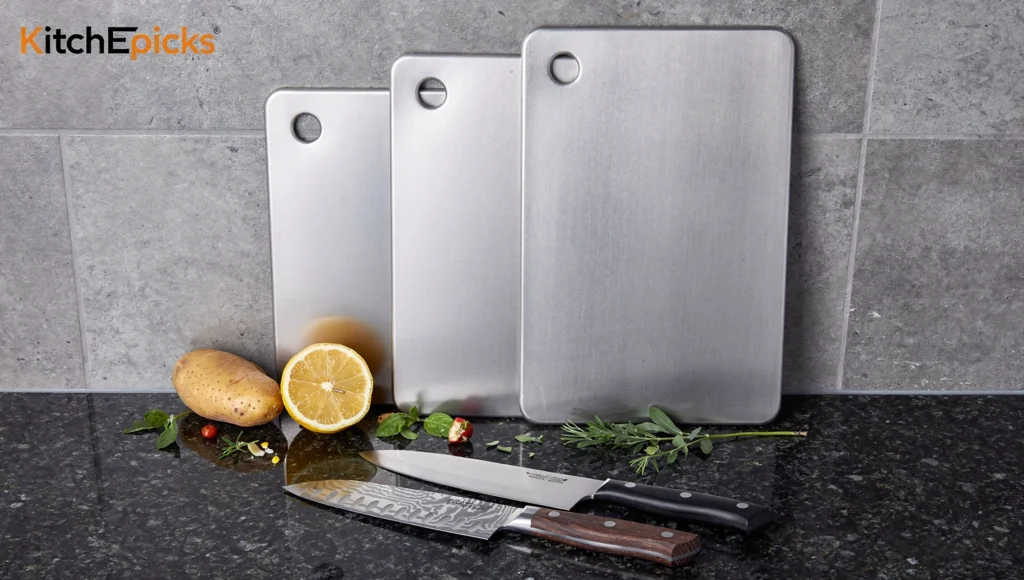
Do titanium cutting boards dull knives? This question has sparked heated debate in kitchen communities. Manufacturers claim titanium is “softer than knife steel” and won’t damage blades, while knife sharpening experts and real users report the opposite. The answer depends on one critical factor: whether your board uses a TiN coating and how hardness dynamics actually work between blade and board.
Do Titanium Cutting Boards Dull Knives? The Short Answer
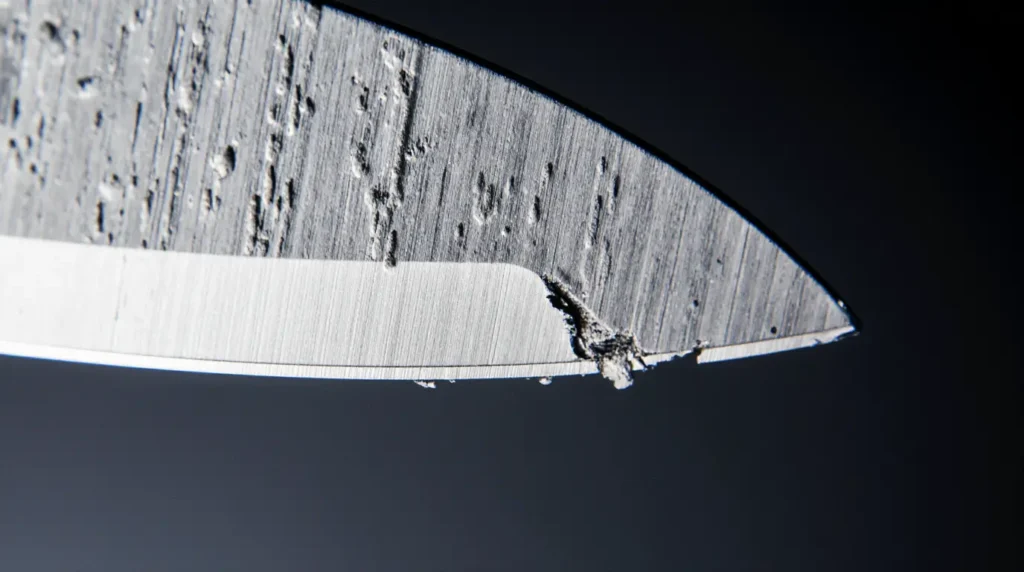
Yes, most titanium cutting boards dull knives faster than wood or plastic alternatives. Most titanium cutting boards on the market feature TiN (Titanium Nitride) coatings that are significantly harder than knife steel. These coatings—recognizable by their gold, bronze, or rainbow finish—accelerate edge wear through microchipping and edge rolling. Even pure titanium without coating, while technically softer than hardened knife steel on the Rockwell scale, still creates more friction and offers less cushioning than wood or quality plastic boards.
If you own quality kitchen knives, especially Japanese or high-carbon steel blades, titanium boards will require you to sharpen more frequently compared to wood or plastic alternatives.
Understanding Material Hardness: Why Titanium Cutting Boards Dull Knives

The Vickers Hardness (HV) and Rockwell (HRC) scales measure how resistant a material is to permanent deformation. When a cutting surface is harder than your knife steel, the blade edge deforms rather than the board—causing dulling. Here’s how common materials compare:
- End-grain wood: Too soft to measure on Vickers scale (~1,000–4,000 Janka hardness)
- Pure titanium: 180–400 HV or approximately 36 HRC (softer than hardened knife steel but still 20x harder than wood)
- Hardened knife steel: 550–700 HV (Japanese knives: 60–67 HRC (Rockwell Hardness Scale) / German knives: 54–58 HRC)
- TiN (Titanium Nitride) coating: 2,000–2,500 HV—approximately 4x harder than knife steel
The ideal cutting surface should be softer than your knife to preserve the edge. Wood achieves this naturally through fiber compression, while TiN-coated titanium creates the opposite problem.
Why TiN-Coated Titanium Cutting Boards Damage Knife Edges
Most “titanium” cutting boards use TiN (Titanium Nitride) coatings to achieve scratch resistance and aesthetic appeal. When you cut on a TiN-coated surface with hardness around 2,500 HV against knife steel at 650 HV, the blade edge experiences extreme stress with each cut. The softer material—your knife—undergoes microchipping (tiny fractures along the edge) and edge rolling (the cutting edge bending microscopically).
Controlled testing confirms this wear pattern. In standardized trials using identical knives and 100 cutting motions on various materials, titanium retained only 60% sharpness compared to wood and plastic boards, performing only slightly better than tempered glass at 35%. Professional knife sharpeners report that clients using titanium or stainless boards return for sharpening 3-4 times more frequently than wood-board users.
The Friction Factor
Titanium doesn’t just rely on hardness to dull knives—it creates metal-on-metal friction that accelerates wear. Unlike wood, which has a slightly compressible fiber structure that allows knife edges to pass between fibers, titanium is rigid and offers no “give”. This means all cutting force is focused directly at the thin cutting edge, leading to faster dulling, micro-chips, and a harsher cutting feel with more audible “clang” than “thud”.
What About “Pure Titanium” Cutting Boards Without Coatings?
Some manufacturers offer pure titanium boards without TiN coatings. These are less aggressive on knives since pure titanium (180–400 HV or 36 HRC) sits below hardened knife steel on the hardness scale. However, pure titanium is still substantially harder than wood and lacks the “self-healing” fiber structure that makes wood knife-friendly.
Marketing claims sometimes stretch the truth. Not all “titanium” cutting boards are made equal—some are only titanium-coated, which can peel or scratch off, exposing a harder or less-safe base underneath that may be much harder than your knife.
Pure titanium boards work better for outdoor cooking, camping applications, or beater knives where durability outweighs edge preservation. They’re still not ideal for daily use with premium kitchen knives.
How Different Knife Types React to Titanium Cutting Boards
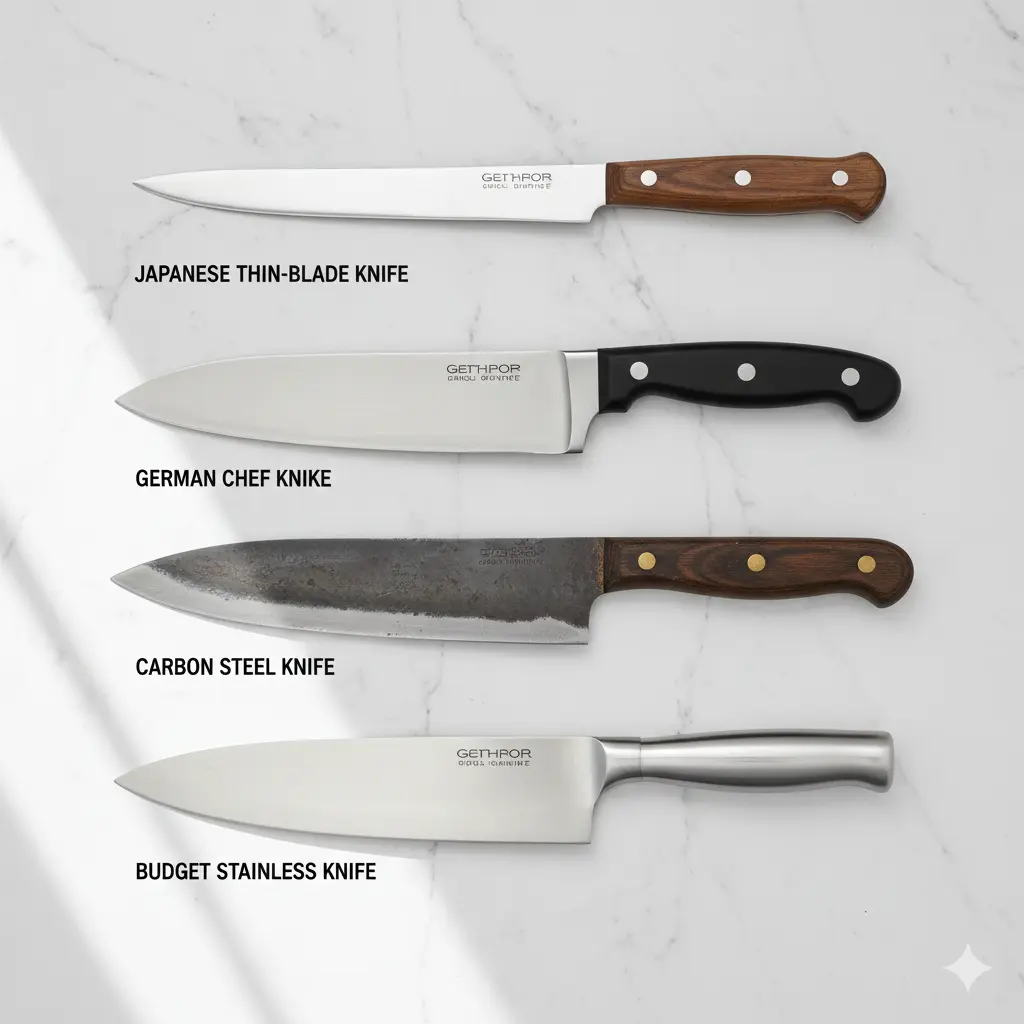
Not all kitchen knives suffer equally on titanium surfaces. Hardness and edge geometry determine vulnerability:
- Japanese knives (Shun, Miyabi, Global): Hardest steel (60–67 HRC) with thin, acute edge angles—most vulnerable to chipping and microchipping on titanium boards
- German knives (Wüsthof, Henckels): Softer steel (54–58 HRC) with thicker, more durable edges—more forgiving but still dull faster than on wood
- Carbon steel knives: Varies widely depending on heat treatment; high-carbon blades above 60 HRC behave like Japanese knives and require gentle surfaces
- Budget stainless knives: Softer steel (50–54 HRC) means less catastrophic damage, but these knives already dull quickly on any surface
If you’ve invested in Japanese knives or high-end chef’s knives, reserve them exclusively for wood or high-quality plastic cutting boards.
Titanium vs. Wood vs. Plastic Cutting Boards: Impact on Knife Longevity
| Factor | Titanium (TiN-coated) | End-Grain Wood | HDPE Plastic |
|---|---|---|---|
| Surface Hardness | 2,000–2,500 HV | ~1,000 Janka (much softer) | Shore D 60-70 (very soft) |
| Knife Edge Wear | High—accelerates dulling | Low—self-healing fibers | Low—forgiving surface |
| Best For | Non-knife tasks, outdoor use | Daily cooking, premium knives | Raw meat prep, high-hygiene contexts |
| Sharpening Frequency | Every 2–4 weeks (heavy use) | Every 2–3 months | Every 2–3 months |
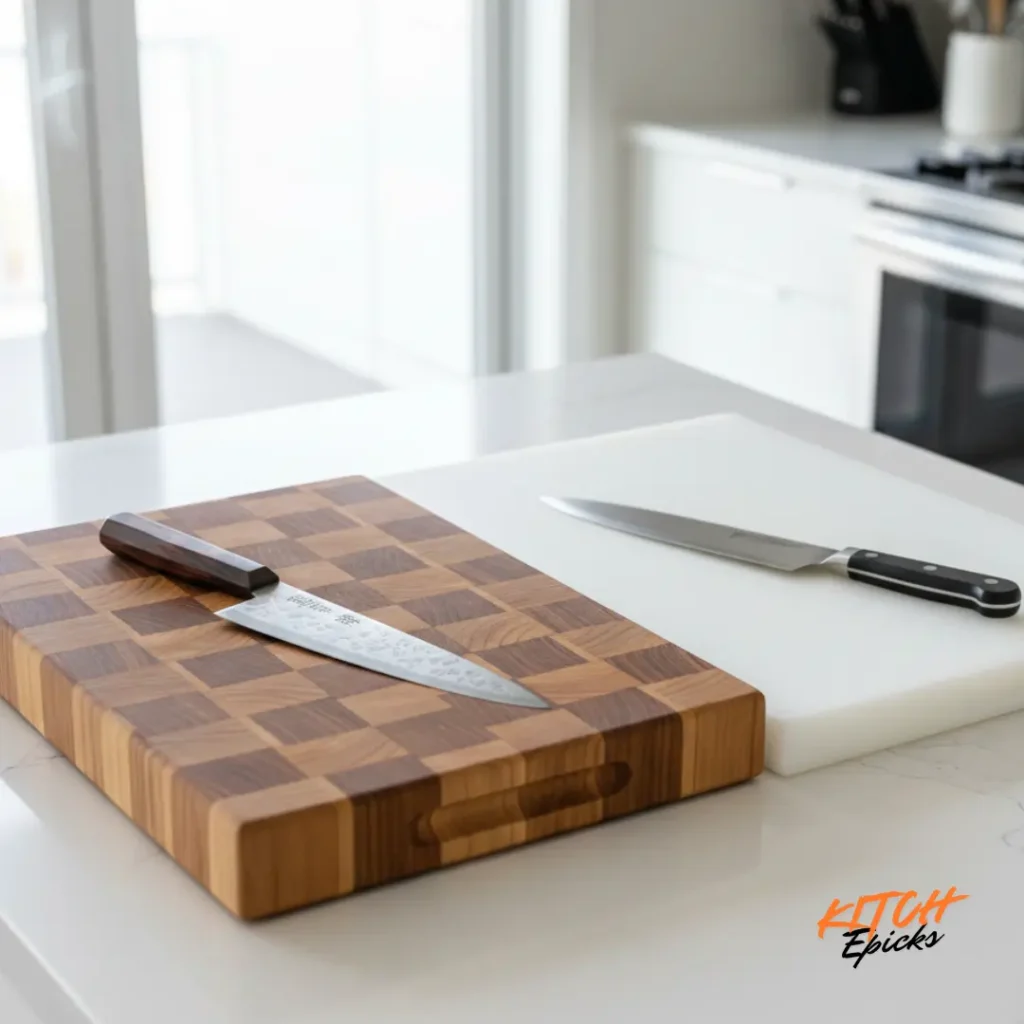
End-grain wood offers a unique advantage. Its vertical fiber orientation allows knife edges to pass between fibers rather than cutting across them. For a complete comparison of the best wood types for cutting boards, including maple, walnut, and cherry, see our detailed buyer’s guide. The fibers then close after each cut, creating a “self-healing” surface that preserves sharpness far longer than any metal alternative.
When Titanium Cutting Boards Make Sense (Without Dulling Your Best Knives)
Despite their impact on knife edges, titanium boards have legitimate applications:

- Outdoor cooking and camping: Extreme durability, zero maintenance, and waterproof properties make titanium ideal for portable use
- Food presentation and serving: The sleek aesthetic works well for charcuterie boards or serving platters where cutting is minimal
- Commercial kitchens with strict hygiene requirements: Non-porous surfaces and dishwasher compatibility meet health code standards
- Prep work with beater knives: Tasks like smashing garlic, crushing spices, or cutting citrus where blade sharpness matters less
For precision knife work with quality blades, wood or high-density polyethylene (HDPE) plastic remains superior for edge retention. Rubber cutting boards offer another knife-friendly alternative, combining durability with a softer cutting surface.
How to Protect Your Knives If You Own a Titanium Cutting Board
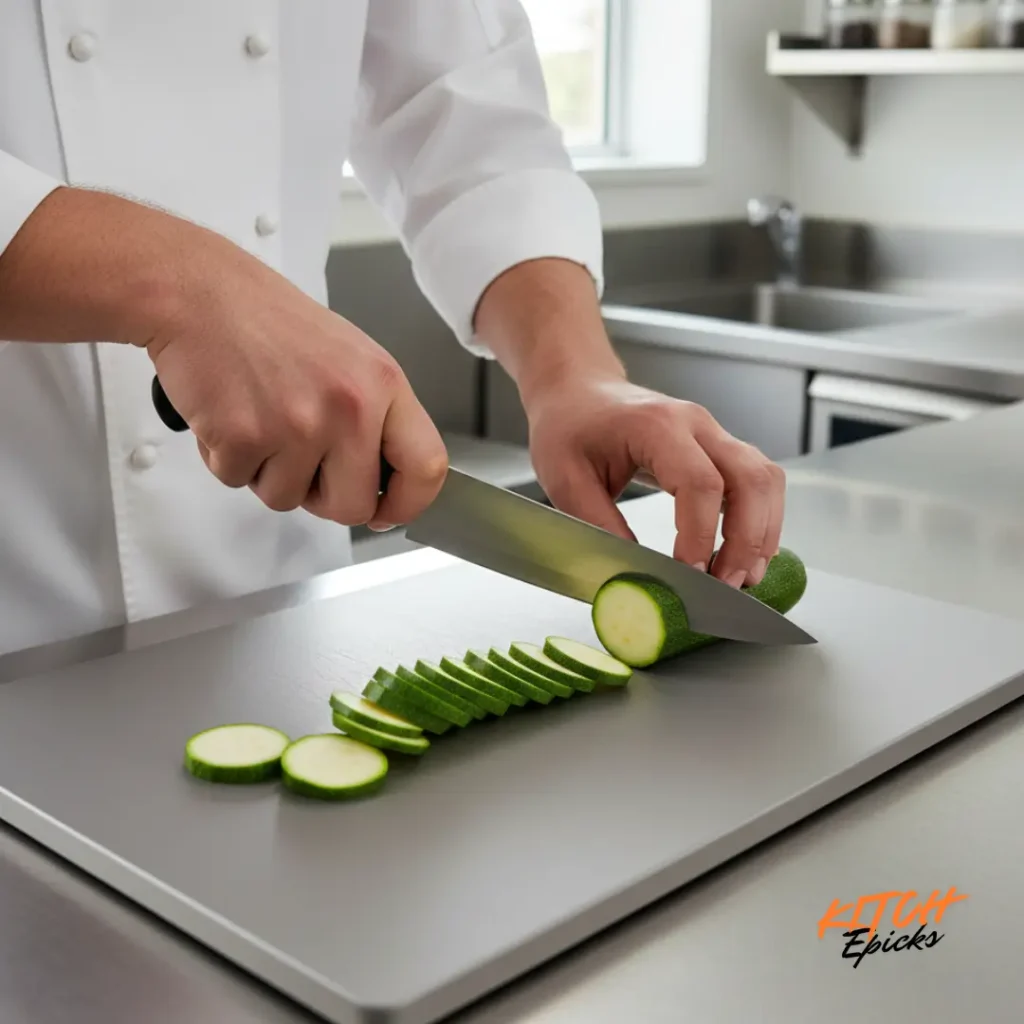
If you already own a titanium cutting board, these strategies minimize knife damage:
- Reserve it for non-knife tasks: Use for serving, outdoor prep, or heavy-duty work that would damage wood boards
- Sharpen more frequently: Expect to hone every 5–7 uses versus every 10–15 uses on wood
- Avoid your best knives: Keep Japanese or high-carbon blades exclusively on wood or plastic surfaces
- Use proper cutting technique: Let the knife’s weight do the work—excessive downward pressure accelerates edge damage
- Pair with softer knives: German-style or budget stainless steel knives withstand titanium surfaces better than hard Japanese steel
FAQ: Do Titanium Cutting Boards Dull Knives?
Are titanium cutting boards worse than plastic for knives?
Yes—most titanium boards with TiN coatings are significantly harder than plastic and cause faster dulling. High-quality plastic like HDPE polyethylene is softer than wood and among the most knife-friendly options available.
Will a titanium cutting board ruin expensive Japanese knives?
It won’t ruin them immediately, but TiN-coated titanium accelerates microchipping and edge rolling on hard, brittle Japanese steel. Reserve Japanese knives (60+ HRC hardness) for wood or soft plastic boards exclusively.
How can I tell if my titanium board has a TiN coating?
Most titanium boards with gold, bronze, or rainbow finishes have TiN coatings. Pure titanium appears silvery-gray. Check manufacturer specifications—if it claims “scratch-resistant” or “ultra-hard surface,” it likely has a TiN coating.
Do titanium cutting boards dull knives faster than bamboo?
Yes—bamboo is already harder than most woods and rough on knife edges, but TiN-coated titanium is substantially harder. Both are poor choices for knife longevity compared to end-grain hardwood like maple or walnut.
Can I use a titanium cutting board for vegetables only?
Yes, but your knife will still dull faster than on wood or plastic regardless of what you’re cutting. If you already own one, reserve it for tasks where blade sharpness matters less, like crushing garlic or cutting citrus.
What’s the best cutting board material for keeping knives sharp?
End-grain hardwood (maple, walnut, cherry) is optimal—soft enough to preserve edges while remaining durable. Walnut cutting boards are particularly knife-friendly thanks to their self-healing fiber structure. High-quality HDPE plastic is a close second for hygiene-focused kitchens.
Your Next Step: Choose the Right Board for Your Knives
Do titanium cutting boards dull knives? The verdict is clear: yes, titanium cutting boards noticeably dull knives faster than wood or plastic options. If protecting your knife edges is the priority, use titanium sparingly and keep your main work on end-grain wood or quality plastic.
Pick one dedicated “knife-safe” board (end-grain wood or HDPE) for all serious cutting—consider a black walnut cutting board for its excellent knife-friendliness and durability—and reserve any titanium board for serving, camping, or rough tasks where edge life doesn’t matter as much. While they offer legitimate benefits for outdoor use, presentation, and durability, the tradeoff in knife sharpness makes them unsuitable as primary cutting surfaces for quality kitchen knives.
Related Articles
- Best Wood for Cutting Boards | Buyer’s Guide to Durability – Compare maple, walnut, and cherry hardwoods that protect knife edges better than titanium
- Black Walnut Cutting Board Guide: Benefits & Care – Why black walnut’s self-healing fibers make it ideal for preserving blade sharpness
- Top-Rated Rubber Cutting Boards on the Market – Discover another knife-friendly alternative with durability and softer cutting surface
- Best Kitchen Tools for Meal Prep – Essential knives and prep tools to pair with your knife-safe cutting board