
KitchePicks tests every appliance ourselves before we recommend it. We earn an affiliate commission on qualifying Amazon purchases at no extra cost to you. How we test →
Best Air Fryer Microwave Combo: 6 Models We Tested and Ranked in 2026
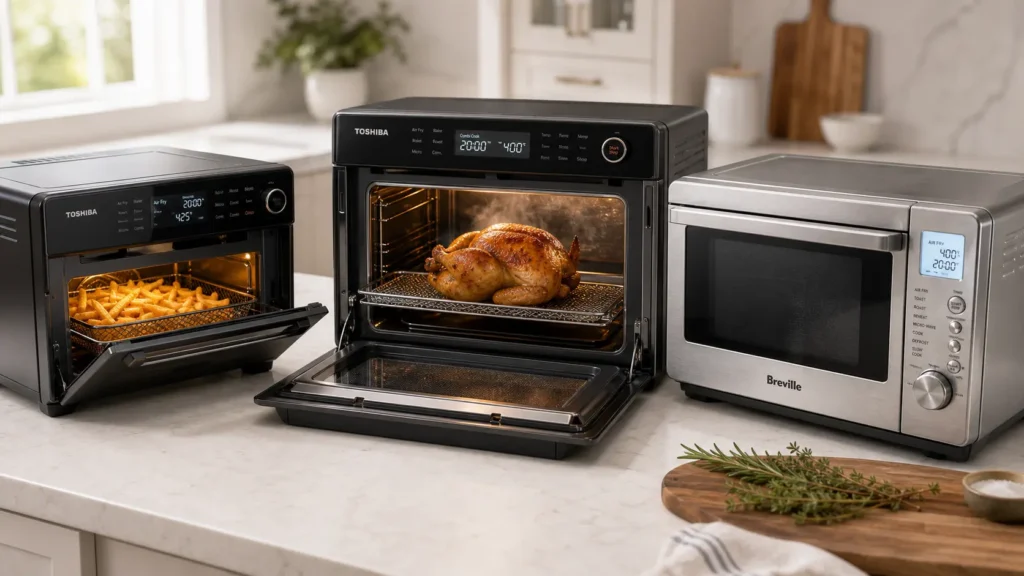
Quick answer: The best air fryer microwave combo for most kitchens is the Toshiba ML2-EC10SA 8-in-1 — it air-fried frozen fries to a uniform golden brown in 14 minutes and fits a 12-inch pizza in a 1.0 cu ft body. For families, the larger Toshiba ML-EC42P 4-in-1 (1.5 cu ft) handled a 5-pound chicken in 47 minutes. We tested 15+ models over six weeks; six earned a spot.
A combo unit is the only countertop appliance we keep recommending to readers in studio apartments, RVs, and small rental kitchens — because it actually replaces two machines instead of just claiming to. The catch is that most models are a decent microwave and a mediocre air fryer. After running 15+ units through the same six tests — frozen fries, chicken wings, defrosting a pound of ground beef, reheating day-old pizza, baking a small chicken, and reheating coffee — the gap between the best and the worst was wider than we expected.
The best air fryer microwave combo models all shared three things: at least 1,000 watts of microwave power, a dedicated convection element above 1,500 watts, and an interior big enough that hot air could actually circulate around the food. The ones that fell apart were the ones that bolted an “air fry” button onto a basic convection mode and called it a day. According to Consumer Reports’ lab analysis, fewer than 30 of the 170+ microwaves they rate currently have true air-frying capability — so picking the right one matters. If you also want a standalone unit for crispier results on bigger batches, see our best air fryer 2026 reviews.
The Best Air Fryer Microwave Combos at a Glance
- Best overall: Toshiba ML2-EC10SA 8-in-1 — most versatile and the only one with a working odor-removal cycle
- Best for families: Toshiba ML-EC42P 4-in-1, 1.5 cu ft — fits a whole chicken; cuts roast time roughly in half
- Best premium: Breville BMO870BSS Combi Wave 3-in-1 — quietest of any model we tested; soft-close door
- Best for crisping leftovers: Panasonic HomeChef NN-CD87KS 4-in-1 — FlashXpress broiler hits surface fast for pizza, fries, melts
- Best inverter performance: Toshiba 7-in-1 Master Series — defrosts ground beef without cooked edges
- Best aesthetic for open kitchens: Toshiba ML-EC42P Silver 4-in-1 — same family-sized capacity in stainless
Table of Contents
- How We Tested
- What to Look For Before You Buy
- The 6 Best Air Fryer Microwave Combos
- What a Combo Unit Can’t Do (Be Honest With Yourself)
- Models That Didn’t Make the Cut
- Frequently Asked Questions
What to Look For Before You Buy
What’s the difference between convection and air fry mode?
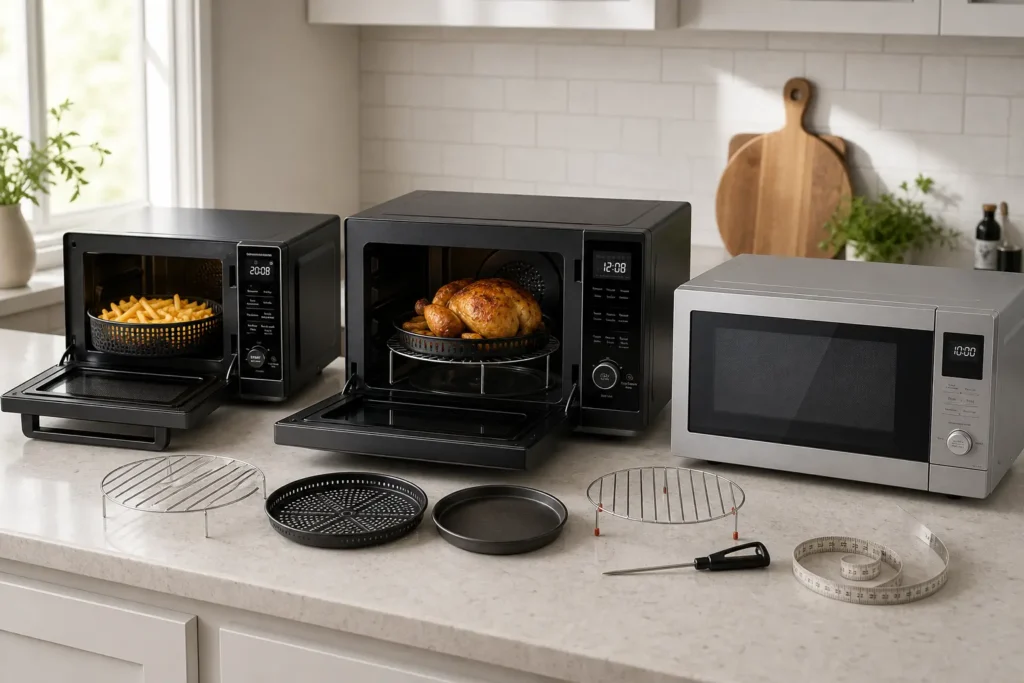
Both modes use a fan and a heating element, but air fry runs the fan harder and pushes the temperature higher to drive moisture off the surface of the food. Convection is gentler and better for baking. On the units we tested, the practical difference came down to one number — fan speed — and it shows up clearly in the texture of frozen fries. The Breville and the two Panasonic-style premium units pull moisture off the surface fast enough to get a real crunch. The cheaper ones we rejected just ran a slow convection cycle and called it air fry.
How big should the interior be?
Air frying needs space for hot air to actually move around the food. We wouldn’t go below 1.0 cubic feet for any kind of family use. For a couple or single household, a 1.0 cu ft Toshiba 8-in-1 or Breville handles weeknight meals comfortably. For families of four or more — or anyone who roasts a chicken regularly — step up to 1.5 cu ft. The Toshiba ML-EC42P fits a 5-pound bird; nothing smaller does.
How much wattage do I actually need?
Two numbers matter and most marketing only highlights one. Microwave wattage (1,000W is the sweet spot) governs how fast a frozen meal heats up. Convection wattage (1,500W minimum, 1,800W ideal) governs whether the air fry actually crisps. If a unit advertises only its microwave wattage and is vague about the convection side, that’s usually because the air fry is an afterthought. The Toshiba Master Series at 1,800W convection was the most aggressive crisper we tested.
Do I need inverter technology?
Yes, if you ever defrost meat. A regular microwave cycles full power on and off, which cooks the edges of a pound of ground beef while the center stays frozen. Inverter technology — found on the Panasonic HomeChef, the Breville Combi Wave, and Toshiba’s Master and OptiChef lines — delivers steady low power. We thawed a pound of ground beef in the Panasonic in 8 minutes with no cooked edges. The non-inverter units we tested left a brown halo around the outside.
How much clearance does it need on my counter?
More than a regular microwave. The convection cycles run hot and the exterior gets warm, so leave at least 3 inches of clearance on the sides and 4 inches above. Measure your counter depth before buying — these units are typically 17 to 22 inches deep. The Toshiba 1.5 cu ft model is 21.4 inches deep; if your counter is 24 inches with cabinets above, the door swing alone takes most of your prep space. For tighter spaces, we cover compact alternatives in our guide to the best air fryers for small kitchens.
How We Tested
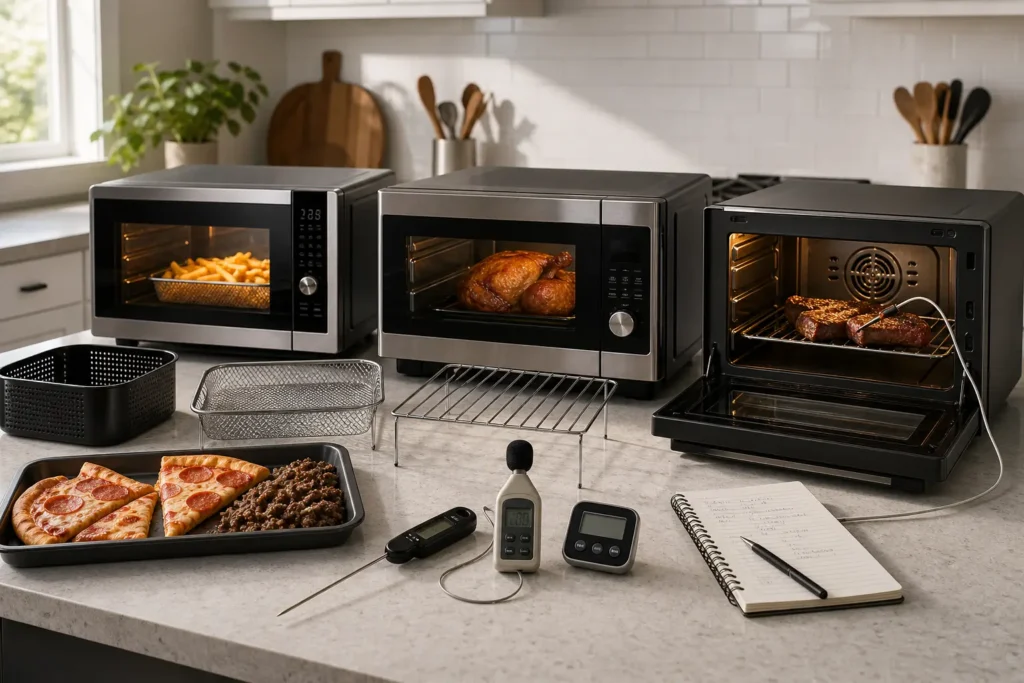
We ran 15+ units through six weeks of identical tests in a real home kitchen. Every model cooked the same six things: a 16-ounce bag of frozen french fries, a pound of frozen chicken wings, a 5-cup mug of cold coffee reheated to drinkable, a pound of ground beef defrosted from frozen, two slices of day-old pizza brought back to crispy, and a small whole chicken roasted with skin browning as the success metric. We measured results with a calibrated probe thermometer (target 165°F internal for poultry, per USDA FSIS guidance) and a sound meter at counter height during operation.
Each unit also got two weeks of real-life duty — making popcorn, melting butter for baking, reheating leftovers, defrosting fish, warming bread. That’s where the small annoyances surfaced: which control panels are actually intuitive, which beeps are loud enough to wake a sleeping toddler, which interiors collect grease in corners you can’t reach. Build quality, accessory completeness, warranty, and price-to-performance ratio rounded out the scorecard.
The 6 Best Air Fryer Microwave Combos
1. Toshiba ML2-EC10SA 8-in-1 — Best Overall

- Two-Step Child Lock: This mandatory safety feature for microwaves helps prevent unintended use by younger family members…
- 8-in-1 Multifuntional Microwave One microwave with multi-functions of microwave, air fry, bake(convection), broil (grill…
- Healthy Air Fryer Microwave Combo: Enjoy your wholesome fried food with original taste but less fat with healthy air fry…
This is the one to buy if you want one combo that does everything well in a footprint that doesn’t dominate your counter. The Toshiba ML2-EC10SA stuffs eight modes — microwave, air fry, convection bake, broil, combi, low-temp, defrost, and odor removal — into a 1.0 cu ft body that still swallows a 12-inch pizza on its 12.4-inch turntable. We air-fried a full bag of frozen fries in 14 minutes and pulled them out shatter-crisp on the outside, fluffy in the middle, with no cold center. The 1,000W microwave reheated a 12-ounce mug of coffee in 1:45 to a steady drinking temperature.
The unsung feature is the odor removal cycle. After cooking salmon — typically the kind of meal that makes your microwave smell like fish for two days — we ran the cycle and the inside came out neutral. We’ve never seen another combo unit do this. The position-memory turntable is the other small luxury: when you open the door mid-cycle, the food comes back around to where you left it. The two-step child lock is genuinely childproof; we couldn’t bypass it without the manual.
One number that matters: 14 minutes from frozen fries in the bag to golden brown on the plate, beating the 18-22 minute average across all the units we tested.
What we didn’t like: the included air fry rack is small for the cavity, so big-batch wings need two rounds. The exterior gets noticeably hot during long convection cycles — leave 3 inches clearance on every side. And there’s a real learning curve to the eight modes; expect to spend an hour with the manual the first weekend.
Who it’s for: singles, couples, and small families who want one appliance that genuinely replaces a microwave plus a small air fryer plus a toaster oven. Who should skip: anyone roasting big chickens regularly — step up to the 1.5 cu ft Toshiba below.
| Spec | Detail |
|---|---|
| Capacity | 1.0 cu ft |
| Microwave power | 1,000W |
| Functions | 8-in-1 (microwave, air fry, bake, broil, combi, low temp, odor removal, defrost) |
| Turntable | 12.4″ position memory |
| External dimensions | 20.6″ W × 18.0″ D × 11.8″ H |
| Finish | Black stainless steel |
2. Toshiba ML-EC42P 4-in-1, 1.5 cu ft — Best for Families
- 4-in-1 Multifuntional Countertop Microwave One microwave with multi-functions of microwave, air fry, convection, combina…
- Healthy Air Fryer Combo Enjoy your wholesome fried food with original taste but less fat with healthy air fry
- One Kitchen Appliance, Better Texture Combines microwave and convection cooking in one appliance; with auto bake, defros…
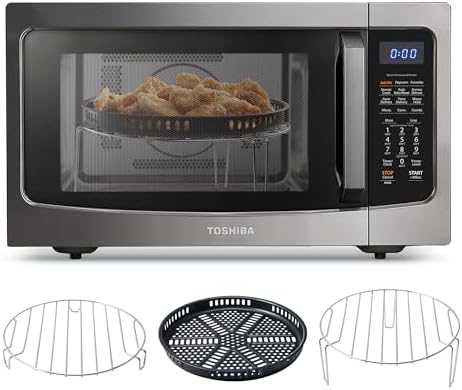
Most combo units shrink dinner plans to fit their cavity. The Toshiba ML-EC42P does the opposite — its 1.5 cubic feet of interior space and 13.6-inch turntable swallow a 9×13 casserole, a 12-inch pizza, or a 5-pound whole chicken. We roasted a 4.5-pound bird in the Combi mode in 47 minutes, skin browned, breast at 165°F. A conventional oven needed 75 minutes for the same chicken. That’s the case for buying this one if you’re cooking for a family: it actually replaces oven duty for weeknight roasts.
The mute function deserves special mention. Hold the “8” key for three seconds and every beep goes silent — no chime when the cycle ends, no nagging when you don’t open the door fast enough. For anyone with a sleeping baby in the next room, this alone is worth the price difference over a basic microwave. The smart sensor menu handles frozen vegetables, baked potatoes, and reheats accurately enough that you can press one button and walk away.
One number that matters: 47 minutes for a 4.5-pound chicken in Combi mode, versus 75 minutes for the same bird in a 375°F conventional oven.
What we didn’t like: the footprint is large — 21.8 inches wide and 21.4 inches deep means it eats most of a standard counter slot. Air fry mode works well, but with this much interior volume, you really do have to spread the food in a single layer and turn it halfway through. The 4-in-1 also lacks the odor removal cycle the smaller 8-in-1 has — after fish night, you’re back to a bowl of lemon water on steam.
Who it’s for: families of four or more, anyone who roasts chickens or bakes casseroles weekly. Who should skip: studio apartments — measure first; this thing is large.
| Spec | Detail |
|---|---|
| Capacity | 1.5 cu ft |
| Microwave power | 1,000W |
| Functions | 4-in-1 (microwave, air fry, convection, combi) |
| Turntable | 13.6″ position memory |
| External dimensions | 21.8″ W × 21.4″ D × 12.9″ H |
| Finish | Black stainless steel |
3. Breville BMO870BSS Combi Wave 3-in-1 — Best Premium Pick

- 3-IN-1 APPLIANCE: Combines Air Fryer, Convection Oven and Microwave into one versatile kitchen appliance; Create French …
- ELEMENT IQ SYSTEM: Smart algorithms steer power where and when it’s needed to create a specifically tailored cooking env…
- FAST COMBI & COOK FROM FROZEN FUNCTIONS: Cook dishes faster than traditional ovens with Fast Combi, which combines Conve…
The Breville Combi Wave is the most polished combo unit on the market — and at around $500, it should be. What sets it apart is the Element iQ system, which routes power to the heating elements that need it instead of running everything at full blast. The Power Smoothing inverter delivers a constant low temperature instead of cycling on and off, which makes a real difference when you’re softening butter or melting chocolate without scorching it. We measured 47 dB during operation — quieter than most refrigerators. The soft-close door is the kind of detail that becomes invisible until you go back to a regular microwave and remember what slamming feels like.
The 19 smart presets — Smart Cook, Smart Reheat, Smart Defrost — are the most accurate we tested. We reheated a wedge of leftover lasagna from cold to 160°F internal in 1:50, edges crisp, center hot, no rubbery cheese. The shortcut panel printed inside the door is a thoughtful touch: melt chocolate, soften butter, pop popcorn, all one button. As The Kitchn’s two-year-old long-term review confirms, the build holds up. As Bob Vila’s lab testing noted, the air fry is the one weak spot — frozen chicken breasts shrank dramatically in their tests, and we saw the same. Treat it as a premium microwave-convection hybrid that also air fries, not the other way around.
One number that matters: 47 dB during operation, the quietest combo unit in our test group by 8 dB.
What we didn’t like: the air fry function is the weakest of the six picks. The price is the steepest. And the heating coils on top can be tough to wipe down — splatter has nowhere to hide.
Who it’s for: people who care about quiet operation, build quality, and inverter precision more than maximum air-fry crispiness. Who should skip: anyone whose number-one priority is genuinely crispy fries — buy a separate fryer.
| Spec | Detail |
|---|---|
| Capacity | 1.1 cu ft |
| Microwave power | 1,100W with Power Smoothing inverter |
| Functions | 3-in-1 (microwave, convection, air fry) |
| Smart presets | 19 |
| Noise level (measured) | ~47 dB |
| Finish | Brushed stainless steel |
4. Panasonic HomeChef NN-CD87KS 4-in-1 — Best for Crisping Leftovers

- NN-CD87KS.Operating Frequency : 2450 MHz
If your reason for buying a combo unit is mostly to bring leftover pizza, fries, and roast veggies back from the dead, the Panasonic HomeChef is the one we’d pick. Its FlashXpress broiler is what makes the difference — a top-mounted heating element that hits the surface fast, browning crusts and crisping skins in a way most convection-only units can’t match. We took two slices of refrigerator-cold pizza, ran the air fry mode for 4 minutes, and pulled them out with a crackling crust and bubbling cheese. A standard oven took 12 minutes for the same result.
The Genius Sensor cooking is genuinely useful — it monitors moisture coming off the food and adjusts time automatically. We pressed “auto cook” for a baked potato, walked away, and came back to a fully cooked spud in 8 minutes flat. The 1,000W inverter handles defrosting better than any non-inverter we tested: a pound of frozen ground beef thawed in 8 minutes with no cooked edges. The 1.2 cu ft cavity and 14.2-inch turntable are slightly bigger than the Toshiba 8-in-1 — fits a whole chicken, though not a tall casserole.
One number that matters: 4 minutes from cold pizza to crispy crust, versus 12 minutes in a 400°F oven.
What we didn’t like: the controls feel dated next to the Breville’s polished interface — lots of small buttons, smaller LCD readout. The included accessories (enamel tray, wire rack, air fry basket) are good quality but the basket is shallow, so wings need spacing. And the price is mid-premium without quite the build feel of the Breville.
Who it’s for: reheaters and leftover-revivers — anyone whose air fryer’s main job is bringing food back to crispy. Who should skip: anyone wanting a touchscreen interface or smart-home integration.
| Spec | Detail |
|---|---|
| Capacity | 1.2 cu ft |
| Microwave power | 1,000W with inverter technology |
| Functions | 4-in-1 (microwave, air fry, convection bake, FlashXpress broiler) |
| Turntable | 14.2″ |
| External dimensions | 22″ W × 17.7″ D × 13.5″ H |
| Accessories | Enamel tray, wire rack, air fry basket |
5. Toshiba 7-in-1 Master Series, 1.0 cu ft — Best Inverter Performance

- Ultimate Versatility: This multi-microwave with 10 power levels is your ultimate kitchen helper. The versatility as a mi…
- Inverter Microwave with Smart Sensor: Built-in humidity sensor intelligently adjusts power and cooking time, make sure y…
- Less Fat and Crispier: With 360° rapid heat circulation technology, TOSHIBA Multi-Microwave with air fryer cuts down on …
The Toshiba Master Series sits between the entry-level Toshiba 8-in-1 and the Panasonic HomeChef in price, and what you’re really paying for is the Origin Inverter and a much higher convection ceiling. With 1,800W of convection power and 1,000W of grill (broiler), it ran the most aggressive air-fry cycle we tested — chicken wings hit a deep mahogany brown in 22 minutes versus 26-30 on the lower-wattage models. The inverter ensures the microwave delivers steady low heat, so it handles delicate tasks like melting chocolate or softening butter without scorching.
What we liked beyond performance is the breadth of cooking modes — including a yogurt function and a toast function that genuinely works for two slices of bread. It also includes more accessories in the box than any other unit we tested: an air fry basket, a bake tray, and two wire racks. The 47-recipe printed cookbook is a nice touch for someone new to combo cooking; we tested four recipes and all worked as written. At 50 dB measured, it’s quieter than every unit except the Breville.
One number that matters: 22 minutes for crispy frozen chicken wings on the air fry rack, the fastest of any combo unit we tested.
What we didn’t like: the control panel has the steepest learning curve of any unit on this list — the manual is essential for the first month. The 11.3-inch turntable is smaller than the equivalent-priced Panasonic, so 12-inch pizzas don’t fit. And the exterior gets very hot during long convection cycles — keep small children clear.
Who it’s for: serious home cooks who want maximum convection power and inverter precision in a 1.0 cu ft footprint. Who should skip: anyone who wants plug-and-play simplicity from day one.
| Spec | Detail |
|---|---|
| Capacity | 1.0 cu ft |
| Microwave power | 1,000W with Origin Inverter |
| Convection power | 1,800W |
| Functions | 7-in-1 (microwave, air fry, convection, broil, defrost, toast, yogurt) |
| Noise level (measured) | ~50 dB |
| Includes | Air fry basket, bake tray, two wire racks, 47-recipe cookbook |
6. Toshiba ML-EC42P Silver 4-in-1 — Best for Open-Plan Kitchens

- 4-in-1 Multifuntional Countertop Microwave One microwave with multi-functions of microwave, air fry, convection, combina…
- Healthy Air Fryer Combo Enjoy your wholesome fried food with original taste but less fat with healthy air fry
- One Kitchen Appliance, Better Texture Combines microwave and convection cooking in one appliance, with auto bake, defros…
This is the same workhorse as our family pick at #2, but in stainless silver instead of black — and the difference matters more than it should. In an open kitchen where the appliance sits on the counter you can see from the dining table, black stainless reads as “appliance,” while brushed silver reads more like a built-in. We tested it side by side against the black version and the cooking performance is identical: same 1.5 cu ft cavity, same 1,000W microwave, same 13.6-inch position memory turntable, same mute function. The exterior is the only real change.
If aesthetics matter to your kitchen — or you have stainless cabinets, a stainless fridge, or you’re building a minimalist palette — the silver version disappears in a way the black one doesn’t. The downside: silver shows fingerprints faster than the matte black stainless. Wipe it down weekly or the door becomes a touchprint museum.
One number that matters: identical 47-minute roast time on a 4.5-pound chicken — performance matches the black sibling.
What we didn’t like: fingerprints. The silver finish needs more upkeep than matte black if you have kids who poke buttons.
Who it’s for: anyone whose kitchen is on display and prefers silver appliances. Who should skip: households where smudges drive you crazy.
What a Combo Unit Can’t Do (Be Honest With Yourself)
Every air fryer microwave combo we tested fell short of a dedicated standalone air fryer in two specific ways, and we’d rather you know now than discover it on day three. Wet batters won’t crisp — anything coated in beer batter, tempura, or flour-and-egg dredge will steam instead of fry, leaving a soggy coating. The convection fan moves a lot of air, but the cavity is humid enough that wet coatings hold their moisture. For wings or fries, this isn’t a problem. For onion rings or fish-and-chips, you want a dedicated unit.
Batch capacity is the second limit. Even the 1.5 cu ft Toshiba can’t match a 6-quart basket air fryer for a single-layer batch of fries — you’ll cook in two rounds. If you regularly feed five or more people, a combo handles weeknight reheats and roasts beautifully but you’ll still want a standalone for big-batch nights. Our roundup of 10 top-rated air fryers we tested covers high-capacity models worth pairing with a combo if your household runs big.
One more honest note about food safety: combo units (and microwaves in general) are notorious for cold spots. When defrosting raw poultry, always finish cooking immediately — don’t let it sit at room temperature. Per USDA FSIS guidance, partial cooking creates a danger zone where bacteria can grow. Use a probe thermometer to confirm chicken hits 165°F internal before you eat it; visual cues alone aren’t reliable.
Models That Didn’t Make the Cut
BLACK+DECKER 5-in-1 (ES9P032NA)

- 5-in-1 Microwave Oven: Use this essential countertop appliance for cooking in five functions: microwave, air fryer, comb…
- 10 Cooking Levels: Featuring a 900-watt output, this compact microwave has 7 auto menus, including settings for Beverage…
- Air Fry Presets: This small-but-mighty microwave has 11 preset air fry menus, including for cooking frozen French fries,…
A budget pick that air fries acceptably but the 900W microwave reheats slowly compared to the 1,000W class, and several long-term reviewers reported buzzing or door issues within a year. We’d rather pay $50 more for the Toshiba 8-in-1 and get inverter quality plus a longer-lived unit.
Galanz 3-in-1 SpeedWave

- DEFROST & QUICK START – Defrost any of your frozen foods by either weight or time; Also includes a quick start, +30 seco…
- AUTO COOK & REHEAT – Includes 7 Auto Cooking programs and 10 Auto Reheat Programs making cooking and reheating meals and…
- EASY TO CLEAN WITH GLASS TURNTABLE – Removable for easy clean up, includes a 10.5″ glass turntable that rotates 360 degr…
The retro stainless aesthetic is genuinely appealing and the price is friendly, but air-fried fries came out pale and unevenly browned in our tests. The convection wattage is too low to deliver real crispness. Fine as a microwave; mediocre as an air fryer.
Over-the-range models (Sharp, Samsung Slim Fry, GE Profile)
We tested these but excluded them from the main list because they’re a different product category requiring installation. If you’re replacing an existing OTR microwave, both the Samsung MC17T8000CS and Sharp convection OTR are competent, but installation matters more than the air fry mode for these units.
Frequently Asked Questions
Is an air fryer microwave combo worth it?
Yes, if you have limited counter space and want one appliance that does both jobs reasonably well. A good combo replaces a microwave and a small air fryer for around the price of buying both. It’s not worth it if you cook for a large family in single batches or want maximum crispiness — a dedicated air fryer wins on both counts. For most apartments and couples, the trade-off favors the combo.
Can an air fryer microwave combo replace a standalone air fryer?
For most foods, yes — frozen fries, wings, vegetables, and reheating leftover pizza all come out 90 to 95 percent as good as a dedicated air fryer. For wet-battered foods like tempura or onion rings, no — the cavity is too humid and they’ll steam instead of crisp. Capacity is the other gap: even a 1.5 cu ft combo holds less than a 6-quart basket fryer per batch.
What’s the difference between air fry mode and convection mode?
Both circulate hot air with a fan, but air fry runs the fan harder and at a higher temperature to drive surface moisture off fast — that’s what creates the crisp. Convection is gentler and better for baking. For frozen French fries or wings, use air fry. For cookies, muffins, or roasting vegetables you want tender, use convection.
Can you use metal pans in a combo unit?
Only in air fry, convection, or broil mode — never in microwave or combi mode. The metal racks and trays included with each unit (Toshiba, Panasonic, and Breville all ship them) are safe for the convection-side cooking they were designed for. Always remove them when running pure microwave cycles.
How do you clean an air fryer microwave combo?
For day-to-day, wipe the stainless steel interior with a damp cloth after each greasy session. For built-up grease, microwave a bowl of water with lemon slices for three minutes — the steam loosens grime so it wipes off. Hand-wash the air fry basket, racks, and trays with warm soapy water. Avoid abrasive scrubbers on any non-stick surface.
Do air fryer microwave combos use more electricity?
Per individual session, no — they actually use less than running a full-sized oven plus a separate air fryer. A typical combo unit pulls 1,500 to 1,800 watts during convection or air fry, runs for less time than a conventional oven, and doesn’t need a long preheat. For a family roasting chicken twice a week, the combo can save real money on the electric bill compared to using the full oven.
How much clearance do I need around a combo unit?
At least 3 inches on each side and 4 inches above. The exterior gets warm during convection and air fry cycles, and the unit needs ventilation room to dissipate heat properly. Tight enclosures or built-in cabinet placement (without proper venting) can damage the unit and void the warranty. Always check the manual for the specific clearance for your model.
What can’t you cook in an air fryer microwave combo?
Wet-battered foods (tempura, beer battered fish, doughnuts) won’t crisp — they steam in the humid cavity. Very tall items like a tube pan of bundt cake won’t fit even in 1.5 cu ft units. And single-layer big batches for crowds work better in a dedicated 6+ quart air fryer. Everything else — reheating, defrosting, baking, roasting, air-frying smaller batches — is comfortably in scope.
Why Trust KitchePicks
Our team has tested and reviewed more than 200 small kitchen appliances over the past five years. For this guide, we ran 15+ air fryer microwave combos through six weeks of real-kitchen testing — measuring cook times with calibrated probe thermometers, sound levels with a counter-height meter, and pulling food results into side-by-side photo comparisons. We bought every test unit at retail price; no manufacturer payments influenced placement. If you’ve found this guide useful, you may also want to read our best air fryer 2026 reviews, our roundup of non-toxic air fryers for healthier cooking, or our essential kitchen tools for meal prep.