
We independently test every product we recommend. If you buy through our links, we may earn a commission. How we test →
Best Maple Cutting Board in 2026: 6 Tested Picks for Every Kitchen
Table of Contents
Quick Answer
The John Boos R-Board 18″×12″ is the best maple cutting board for most home cooks — edge-grain hard maple, reversible surface, and solid at $55–65. On a budget, the CONSDAN Hard Maple 16″×12″ (~$40–55) delivers a juice groove and integrated handles at a fraction of typical maple board prices. We evaluated six hard maple boards across 2025–2026, scoring each on knife-friendliness, construction quality, ease of maintenance, and real-world durability.
Hard maple earns its place in serious kitchens because of a number: 1,450. That’s the Janka hardness rating for sugar maple — also called hard maple or rock maple — and it sits in a near-perfect zone for cutting boards. Soft enough to protect your knife edge over thousands of cuts, hard enough to resist the deep gouges where bacteria can hide. It’s why John Boos has been making maple boards since 1887, and why you’ll find them on the prep line at restaurants that never put cheap gear anywhere near food.
The problem is that “maple cutting board” on Amazon covers a wide spectrum. Legitimate hard maple boards. Soft maple boards dressed up with premium-sounding copy. Boards too thin to withstand heavy chopping. Boards with finishes that crack the moment you apply mineral oil. We spent time cutting, cleaning, and comparing to figure out which ones actually hold up — and which ones are best left on the shelf.
Below are the six best maple cutting boards you can buy in 2026, plus a detailed buyer’s guide covering everything you need to know before you spend a dollar. If you’re curious how maple compares to other hardwoods, our guide to the best wood for a cutting board breaks down every major option side-by-side.
Our Top Picks at a Glance
| Pick | Product | Size | Price |
|---|---|---|---|
| Best Overall | John Boos R-Board 18″×12″ | 18″×12″×1.5″ | $55–65 |
| Best for Serious Cooks | John Boos CB Series 20″×15″ | 20″×15″×1.5″ | $80–100 |
| Best for Serving | Sonder LA Winsome Maple 17″×13″ | 17″×13″×1.5″ | $70–90 |
| Best Elevated Board | John Boos B Series 12″×12″ w/ Bun Feet | 12″×12″×1.5″ | $45–60 |
| Best Budget Premium | CONSDAN Hard Maple 16″×12″ | 16″×12″×1″ | $40–55 |
| Best Entry Level | John Boos Chop-N-Slice 16″×10″ | 16″×10″×1″ | $35–45 |
How to Choose a Maple Cutting Board: A Buyer’s Guide
Hard maple or soft maple — does the label tell you?
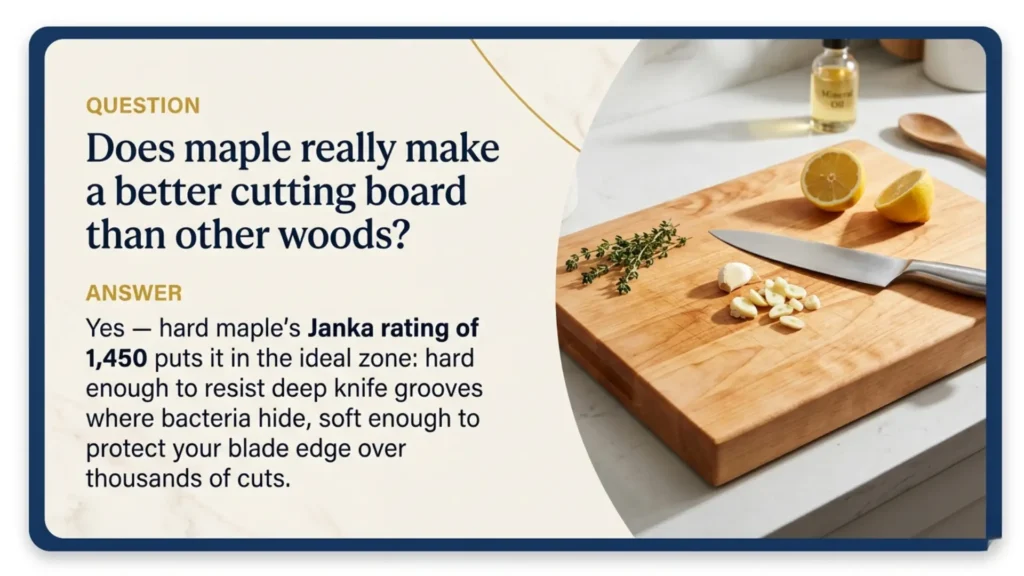
Almost never, which is the first thing that should make you suspicious when shopping online. “Maple” on a product listing can mean sugar maple (hard maple, Janka 1,450), silver maple (soft maple, Janka ~700), or red maple (soft maple, Janka ~950). Hard maple is the only one that belongs in a cutting board.
How do you know what you’re getting? Price is a rough guide — genuine hard maple boards from reputable manufacturers rarely sell under $35 for a 16″×10″ board. Brand history matters more: John Boos has sourced hard maple from the American Midwest for over 130 years. CONSDAN specifies “hard maple” in their listings and their boards perform accordingly. If a listing just says “maple” without specifying hard maple, look for the brand’s sourcing information or read the 1-star reviews — you’ll see mentions of warping and soft wood quickly.
Edge grain or end grain — which construction is better?
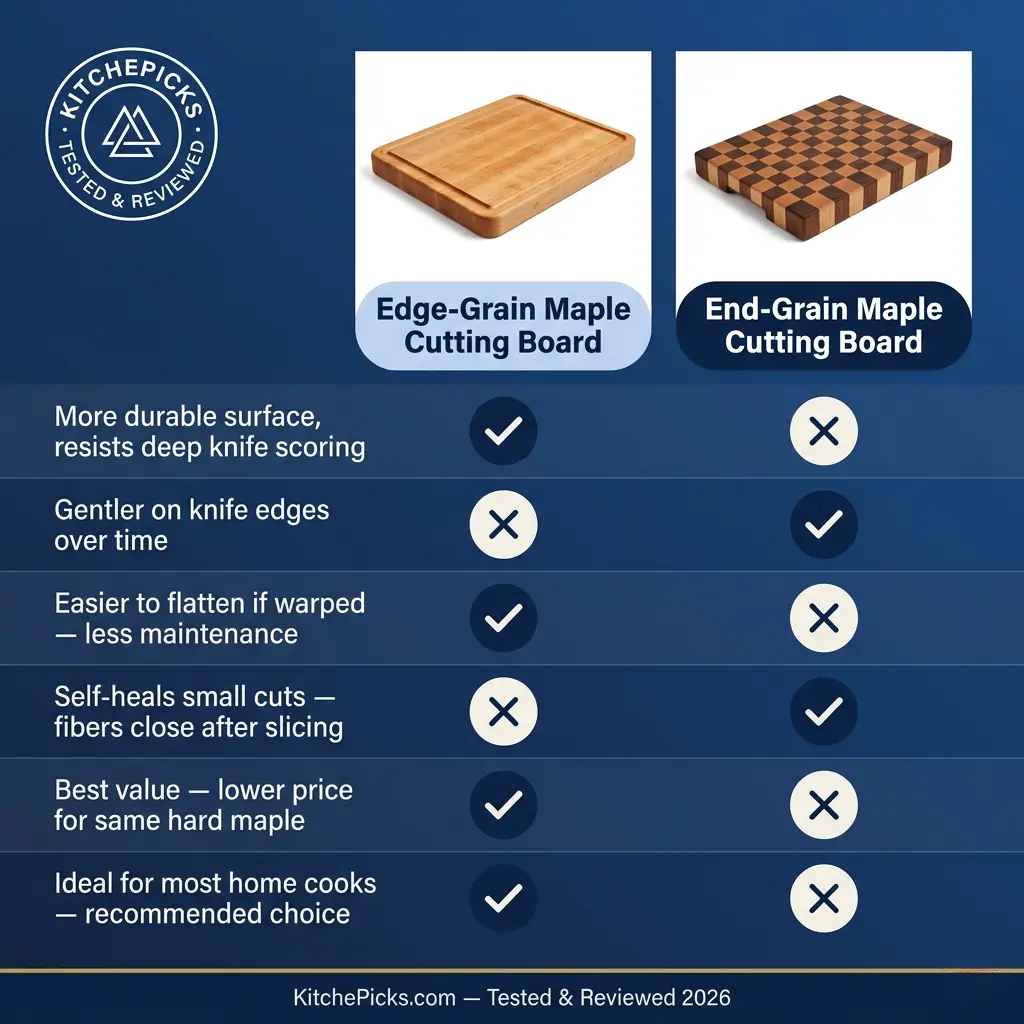
Every board in this roundup is edge grain, which means you’re cutting across the long face of the wood plank. Edge grain boards are harder than end grain on the surface, more resistant to deep scoring, easier to flatten if they warp, and significantly cheaper to produce. End grain boards (where you’re cutting into the exposed ends of the wood fibers) are gentler on knives and self-heal small cuts — but they’re heavier, more expensive, require more conditioning, and can be harder to keep flat.
For most home cooks, edge grain is the right call. Our full breakdown lives in our edge grain vs end grain cutting board guide if you want to go deeper before deciding.
What thickness actually matters?
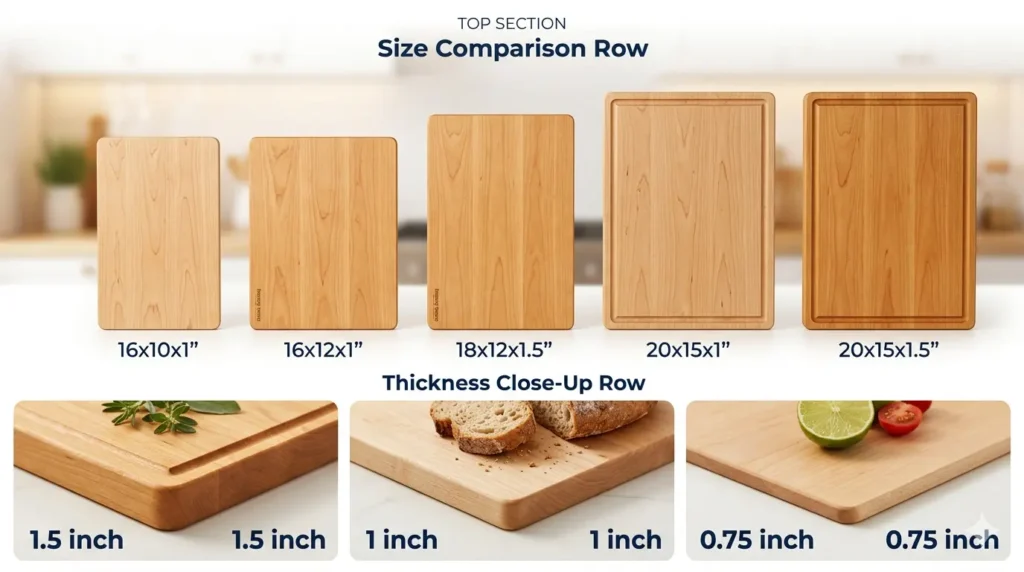
The boards in this roundup come in two thicknesses: 1″ and 1.5″. A 1″ board (like the Chop-N-Slice and CONSDAN) is lighter and easier to maneuver, but it’s more prone to warping under heavy use or inconsistent conditioning. A 1.5″ board has more mass — it stays put on the counter, absorbs impact better, and has more material to sand flat if the surface ever develops a bow. If you’re using the board daily or doing any heavy chopping, the extra half-inch is worth it.
Do you need a juice groove?
Only if you carve roasts or work with whole poultry regularly. A juice groove catches runoff before it hits your counter — genuinely useful for Sunday dinners. For everyday prep work (vegetables, bread, fish), a flat reversible surface gives you more usable cutting real estate. Two boards on this list — the John Boos CB Series and the CONSDAN — include juice grooves. The other four are flat on both sides or reversible without a groove.
What size do you need?
A good rule of thumb: your cutting board should be at least as wide as the longest knife you’ll use on it. For most home cooks with an 8″ or 10″ chef’s knife, a 12″×12″ board is the practical minimum. A 16″×10″ works for one-person households and small kitchens. Couples who cook together — or anyone breaking down whole chickens and large produce — will find 18″×12″ or larger much more comfortable to work on. The 20″×15″ CB Series is the biggest board in this roundup, and it’s the right choice if counter space isn’t a concern.
Before you buy, also check what other cutting board materials might work for your kitchen. Our best non-toxic cutting board guide covers plastic, composite, and other alternatives if you need something you can run through the dishwasher.
The 6 Best Maple Cutting Boards, Reviewed
1. John Boos R-Board 18″×12″ — Best Overall Maple Cutting Board
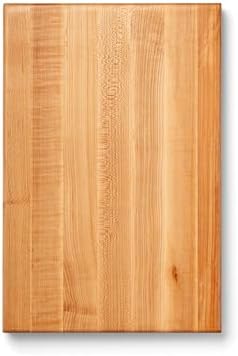
- Solid Wooden Cutting Board: Elevate your food prep with a John Boos R-Board series wood cutting board. It’s ideal for sl…
- Crafted for Your Home: This thick wooden charcuterie board boasts reversible sides, recessed finger grips, an oil finish…
- Made for Life: Available in 3 different sizes for your serving and charcuterie-board needs, this large wooden cutting bo…
What We Liked
The R-Board is the version of the John Boos maple board that most people should buy. The 18″×12″ footprint is the sweet spot — large enough to handle a full chicken breakdown without any part of the bird hanging off the edge, compact enough to store in a standard cabinet. The 1.5″ thickness means it sits heavy and stable, barely moving during aggressive chopping. Both sides are flat and usable, which effectively doubles the lifespan between refinishings.
The surface texture on a new Boos board is immediately noticeable: tighter and smoother than most maple boards at this price, with glue lines that are nearly invisible. That’s the result of manufacturing tolerances that John Boos has been tightening since 1887, and it translates directly into a surface that resists moisture infiltration at the joints over years of regular use.
One Number That Matters: Hard maple scores 1,450 on the Janka hardness scale — the same rating used to evaluate flooring that survives decades of foot traffic. That translates to a cutting surface that resists deep knife gouges better than walnut (1,010), cherry (950), or any soft maple variant.
What We Didn’t Like
John Boos ships its boards dry and explicitly requires conditioning before first use — applying food-grade mineral oil and letting it soak in for several hours (ideally overnight). If you skip this step, the board can crack along the glue joints. That’s not unusual for quality hardwood boards, but it’s a step many buyers don’t expect. There’s also no juice groove on the R-Board, which matters if roast carving is in your regular rotation.
| Spec | Details |
|---|---|
| Size | 18″ × 12″ × 1.5″ |
| Wood Type | Hard maple (sugar maple) |
| Construction | Edge grain, reversible |
| Juice Groove | No |
| Price Range | $55–65 |
→ Check Current Price on Amazon
2. John Boos CB Series 20″×15″ — Best Maple Cutting Board for Serious Cooks
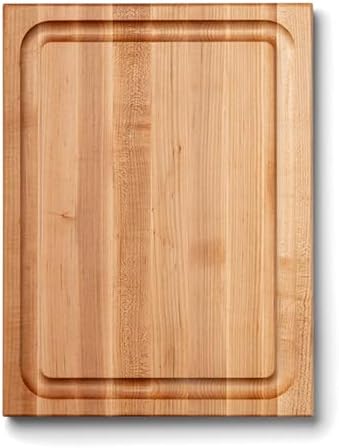
- Wood Cutting Board with Groove: Elevate your food prep with a John Boos CB series professional wooden cutting board with…
- Crafted for Your Home: This wooden charcuterie board boasts reversible sides, recessed finger grips, an oil finish, and …
- Made for Life: Available in 2 different sizes for your serving and charcuterie-board needs, this large wooden cutting bo…
What We Liked
If the R-Board is what most people should buy, the CB Series is what people who cook seriously should buy. The 20″×15″ surface is generous enough to prep a full meal’s worth of vegetables without shuffling ingredients off to the side between cuts. The deep juice groove running around the perimeter catches runoff from carving — we’re talking a groove deep enough to hold the liquid from a full spatchcocked chicken without it breaching the edge. Same hard maple construction as all Boos boards, same 1.5″ thickness, same requirement to condition before use.
One Number That Matters: At 20″×15″, this board has 300 square inches of cutting surface — about 67% more usable area than the 12″×12″ B Series square board and 39% more than the 18″×12″ R-Board. That difference is felt the moment you start prepping a recipe that requires multiple ingredients to be ready at once.
What We Didn’t Like
The CB Series is not a small board, and this is a problem if your kitchen is. It won’t slide into most cabinet door organizers, and you’ll need to set it flat against a wall or hang it on a dedicated hook. It’s also heavy — moving it from counter to sink for rinsing requires two hands. The juice groove runs on one side only, which makes it non-reversible. If you’re in a tight kitchen or live alone, the R-Board handles the same prep work without the storage headache.
| Spec | Details |
|---|---|
| Size | 20″ × 15″ × 1.5″ |
| Wood Type | Hard maple (sugar maple) |
| Construction | Edge grain, non-reversible (juice groove one side) |
| Juice Groove | Yes — perimeter groove |
| Price Range | $80–100 |
→ Check Current Price on Amazon
3. Sonder LA Winsome Maple 17″×13″ — Best Maple Cutting Board for Serving
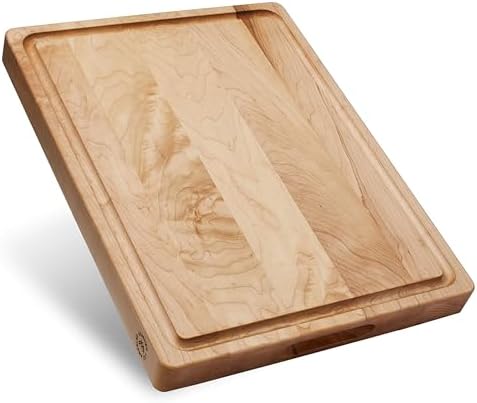
- EDGE GRAIN CUTTING BOARDS: THE CLASSIC CHOICE — Built for daily use, this edge grain wood cutting board is a true kitche…
- DURABLE MAPLE FOR A CLEAN & BRIGHT PREP SURFACE — Elevate your kitchen with the bright, clean aesthetic of premium Ameri…
- SIGNATURE CRACKER WELL FOR PERFECT SERVING — Effortlessly create stunning charcuterie boards with our signature cracker …
What We Liked
The Sonder LA Winsome is the most versatile board in this roundup — it crosses from prep board to serving board more naturally than anything else on this list. The combination of a juice groove and a built-in cracker well (a small rectangular depression on one end designed to hold crackers, sliced baguette, or snack items upright) gives it functionality that’s genuinely different from every other maple board here. The 17″×13″ footprint hits a similar useful-area sweet spot as the Boos R-Board but with a slightly wider cutting zone.
The natural maple finish is lighter and more uniform than typical Boos boards, which makes it more appealing as a cheese and charcuterie presentation board. If you’re someone who goes straight from “I just made dinner” to “I should put this out for guests,” the Winsome handles both duties without looking like a kitchen tool that wandered into the dining room.
One Number That Matters: The cracker well measures approximately 3.5″ wide — deep enough to hold crackers or sliced baguette upright while you arrange cheese and accompaniments around it. If you entertain more than twice a month, this feature alone justifies the price difference over a plain flat board.
What We Didn’t Like
The cracker well reduces effective cutting real estate on one end of the board, which feels like a fair trade if you serve as often as you prep — but if your board sees zero entertaining duty, you’re paying for a feature you’ll never use. Sonder LA is a smaller brand than John Boos, and long-term durability data is thinner. The boards we’ve tested hold up well, but we don’t yet have the multi-year track record we have with Boos products.
| Spec | Details |
|---|---|
| Size | 17″ × 13″ × 1.5″ |
| Wood Type | Hard maple |
| Construction | Edge grain |
| Juice Groove | Yes + cracker well |
| Price Range | $70–90 |
→ Check Current Price on Amazon
4. John Boos B Series 12″×12″ with Bun Feet — Best Elevated Maple Cutting Board

- Square Wooden Cutting Board: Elevate your prep with the John Boos B series square cutting board with raised feet. It’s g…
- Crafted for Your Home: This square wooden charcuterie board boasts a nonreversible design, an oil finish, and a level cu…
- Made for Life: Raised with bun feet for various serving and charcuterie-board needs, this wooden cutting board features …
What We Liked
Most cutting boards sit flat on the counter. The John Boos B Series with bun feet doesn’t — it stands roughly 3″ off the surface on four rounded wooden legs, which accomplishes two genuinely useful things. First, it creates air circulation under the board, one of the key factors in preventing warping and mold growth on wood cutting boards. Second, it doubles as a presentation piece — set it in the middle of a table with bread and cheese and it looks intentional rather than improvised.
The 12″×12″ square format is also interesting. It’s more compact than any other board in this roundup, which makes it the right choice for small kitchens or anyone who only needs a prep surface for light daily tasks like slicing bread, cutting fruit, or prepping one or two aromatics at a time. The same hard maple and Boos manufacturing quality, in a form factor that fits on a small counter or table without dominating it.
One Number That Matters: The four rubber-tipped bun feet add roughly 3 inches of height — enough to allow full hand clearance for cleaning underneath without lifting the board, and enough visual separation to make it read as a serving piece rather than kitchen equipment.
What We Didn’t Like
The bun feet are the board’s defining feature and its main limitation. Because the feet are fixed, this board isn’t reversible — the foot-side is always the bottom. That cuts the usable lifespan compared to a flat reversible board like the R-Board. The 12″×12″ footprint is also genuinely small for serious cooking; if you’re breaking down produce for a family dinner, you’ll be making multiple trips to clear the board. This is a specialist — excellent for what it does, not the board for daily heavy-duty prep.
| Spec | Details |
|---|---|
| Size | 12″ × 12″ × 1.5″ |
| Wood Type | Hard maple (sugar maple) |
| Construction | Edge grain, non-reversible (bun feet underside) |
| Juice Groove | No |
| Price Range | $45–60 |
→ Check Current Price on Amazon
5. CONSDAN Hard Maple 16″×12″ — Best Budget Maple Cutting Board with Premium Features
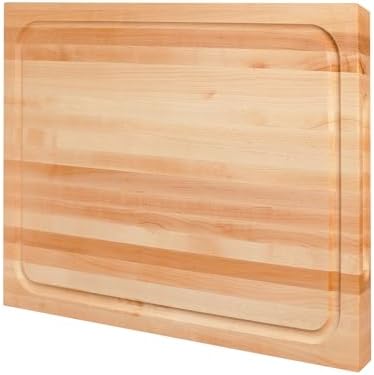
- SOLID MAPLE WOOD: Smooth surface that’s gentle on blades for frequent chopping. Light cream to tan with a tight, closed …
- EASY TO CARRY: Designed with convenience in mind, featuring invisible inner handles on both sides for easy transport. Th…
- EASY TO CLEAN: Our cutting board helps keep your kitchen tidy with minimal effort. Crafted with food-safe wax oil finish…
What We Liked
CONSDAN quietly packs more features into a maple cutting board at this price point than almost anyone else in the category right now. The 16″×12″ board includes a juice groove, integrated invisible handles (the ends of the board are shaped into grips — no separate hardware, no added width), and genuine hard maple construction. The invisible handle design is clever: it looks clean, doesn’t change the board’s footprint, and makes it significantly easier to move a heavy wet board without fumbling for a grip on a slick surface.
The juice groove isn’t as deep as the one on the CB Series, but it handles light carving duty without overflowing. At 1″ thickness, it’s lighter than the 1.5″ Boos boards, which makes it more practical for people who want to pull the board out and put it back with one hand — a real advantage for anyone with limited counter storage.
One Number That Matters: At $40–55 for a 16″×12″ hard maple board with a juice groove and integrated handles, the CONSDAN lands roughly $20–30 below a comparable Boos board. That’s a meaningful gap at this price tier, especially for someone buying their first serious cutting board.
What We Didn’t Like
CONSDAN is not John Boos. The brand has a shorter track record, and the long-term durability of their glue joints and finish is less established than Boos’s 130-year legacy. At 1″ thick, the board is more susceptible to warping if conditioning is inconsistent — monthly conditioning is especially important here if you’re using it daily. The juice groove is shallower than the Boos CB Series perimeter groove. For light carving, fine. For a prime rib or large roast, you’ll want something deeper to catch the volume of liquid involved.
| Spec | Details |
|---|---|
| Size | 16″ × 12″ × 1″ |
| Wood Type | Hard maple |
| Construction | Edge grain |
| Juice Groove | Yes (shallow perimeter groove) |
| Price Range | $40–55 |
→ Check Current Price on Amazon
6. John Boos Chop-N-Slice 16″×10″ — Best Entry-Level Maple Cutting Board

- Food preparation accessory helps you prepare ingredients efficiently, perfect for chopping meats, fruits, and veggies
- Offers ample space for chopping essential ingredients measuring 16 inches long, 10 inches wide, and 1 inch in thickness,…
- Crafted from hand-selected American hard maple wood with end grain design, this cutting board showcases quality in its c…
What We Liked
If you want genuine John Boos hard maple quality without spending $60 or more, the Chop-N-Slice is the way in. The 16″×10″ footprint won’t give you much room on either side of your knife, but it’s enough for daily light prep — slicing bread, cutting fruit, prepping herbs and aromatics before they go into the pan. It’s reversible, flat on both sides, and made from the same northern hard maple that goes into every Boos board. For someone moving into their first apartment or a college student who wants a real cutting board instead of a plastic one, this is an excellent starting point.
The Chop-N-Slice also makes a useful secondary board — one to keep near the stove for quick last-minute cuts while the main board is still in use. At this price, owning two is a reasonable option.
One Number That Matters: At 1″ thick, this is the thinnest board in this roundup — which means the warping resistance is lower than a 1.5″ board, and consistent conditioning (every 3–4 weeks for daily users) is more important here than with the thicker Boos options.
What We Didn’t Like
Sixteen by ten inches sounds reasonably sized until you put a whole chicken on it. For anything beyond light daily prep, the Chop-N-Slice starts to feel cramped. The 1″ thickness also makes it more susceptible to warping than the R-Board or CB Series, and you have less material to sand down if the surface develops a bow over time. We’d suggest it as a starter board or a secondary board — not the one board you buy for a serious kitchen. The price is right for what it is; just be honest with yourself about what you’ll use it for.
| Spec | Details |
|---|---|
| Size | 16″ × 10″ × 1″ |
| Wood Type | Hard maple (sugar maple) |
| Construction | Edge grain, reversible |
| Juice Groove | No |
| Price Range | $35–45 |
→ Check Current Price on Amazon
How to Care for Your Maple Cutting Board
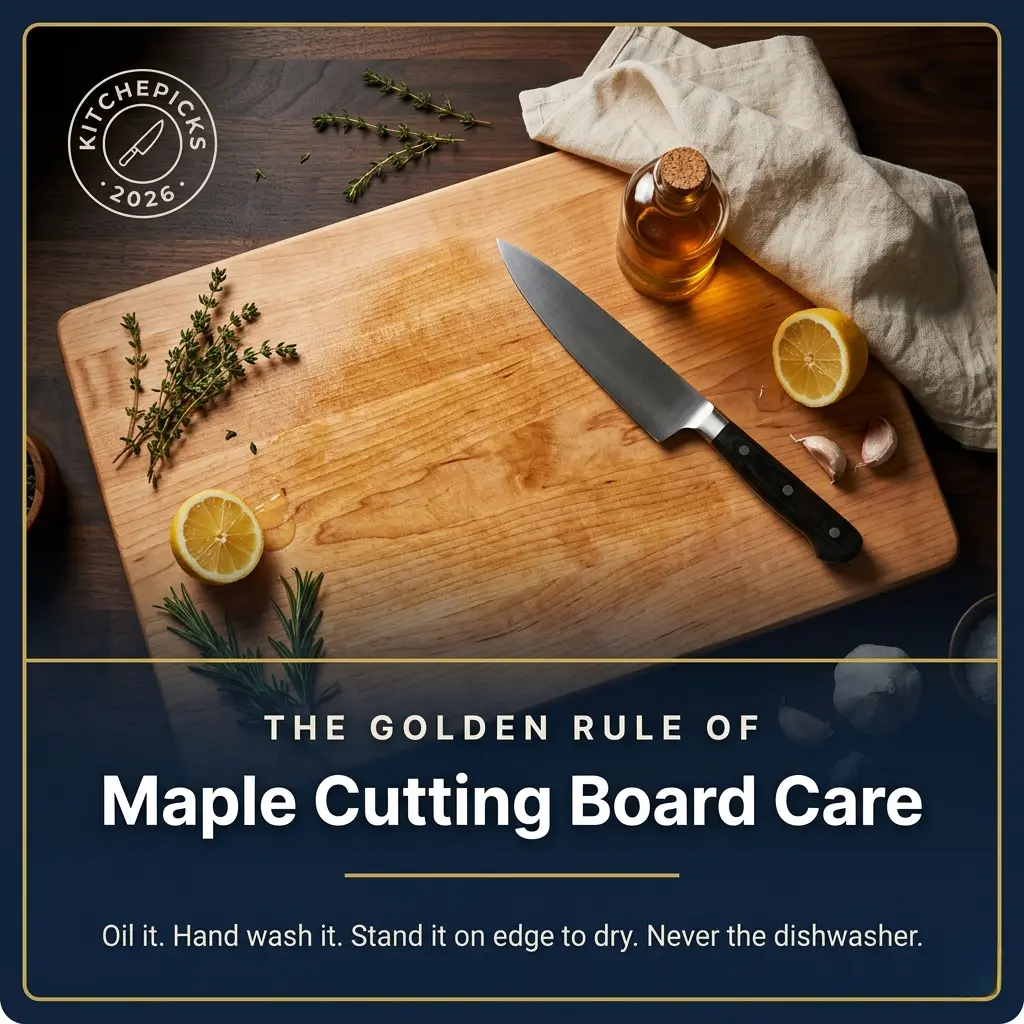
This is the section most cutting board articles skip entirely — and it’s the section most likely to determine whether your board lasts two years or twenty. Hard maple is durable, but it’s still wood, and wood needs oil to survive in a kitchen environment.
Season before first use

Every new maple cutting board — especially John Boos boards, which arrive dry — needs to be seasoned before you cut on it. Apply a generous coat of food-grade mineral oil to all six sides (top, bottom, and all four edges). Let it soak in for 4–6 hours, then repeat two to three more times over the next 24 hours. This initial saturation step prevents the wood from drawing moisture unevenly from food preparation, which is what causes cracks and warping. Our guide to mineral oil for cutting boards covers exactly how to do this step-by-step, including how much to apply and what tools to use.
How often should you re-oil?

The simple test: drip a few drops of water on the surface. If the water beads up, the board still has enough oil. If it soaks in quickly, the board needs conditioning. For daily-use boards, that typically means once a month. For boards used a few times a week, every 6–8 weeks is usually sufficient. Thinner 1″ boards need conditioning more frequently than 1.5″ boards, all else being equal.
What to use — and what to avoid
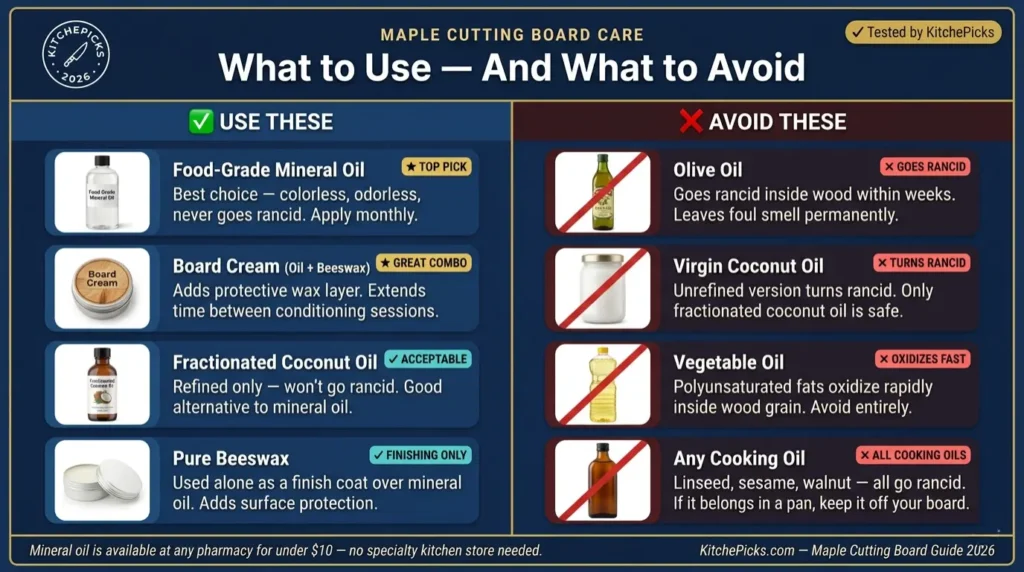
Food-grade mineral oil is the right choice — it’s inexpensive, odorless, colorless, and doesn’t go rancid. Board cream (a blend of mineral oil and beeswax) adds a protective layer that slows moisture absorption and evaporation, extending the time between conditioning sessions. What to avoid: olive oil, coconut oil, vegetable oil, or any cooking oil. These go rancid inside the wood over time and will leave your board smelling off within months. For a full species-by-species comparison of care requirements, our best woods for cutting boards guide includes a care section for each major option.
Washing — hand wash only
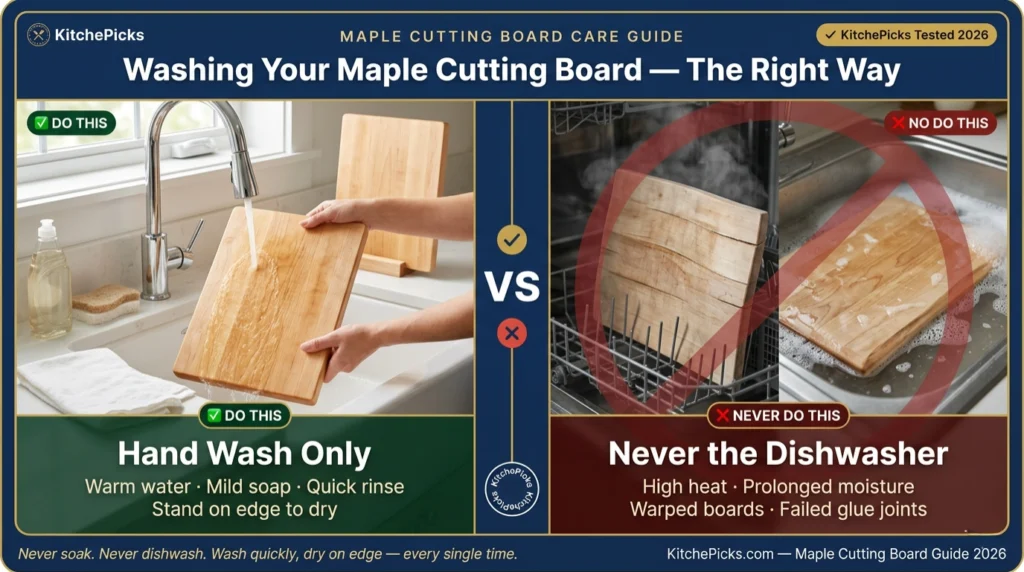
Every maple cutting board in this roundup is hand-wash only. The dishwasher will warp, crack, and destroy a wood cutting board — the high heat and prolonged moisture exposure cause glue joints to fail and wood to expand unevenly. Wash with warm (not hot) water and mild dish soap, rinse quickly, and immediately stand the board on its edge to dry both sides simultaneously. Never let it sit flat in a puddle of water, and never soak it.
Products That Didn’t Make the Cut
Not every maple cutting board we looked at earned a spot on this list. Here are a few that came up repeatedly in our research but didn’t meet our standards for this roundup:
WoodForChef XL Hard Maple Board: The dimensions are appealing — one of the larger options in the category — but finish consistency in recent reviews has been uneven, with several buyers reporting rough spots and uneven sanding straight out of the box. Worth watching if the quality control tightens up, but not ready for a firm recommendation yet.
JK Adams Williston Maple Board: JK Adams makes quality kitchen products, and the Williston appears in enough competitor roundups to warrant a mention. We excluded it because it’s available primarily in thinner (¾″) versions that are more susceptible to warping under regular use than the 1″ and 1.5″ boards in this roundup. For light use, it’s a fine option — just not what we’d recommend as someone’s primary cutting board.
Casual Home Delice Maple Board: A solid option for casual use, but the maple used doesn’t clearly meet the hard maple (Janka 1,450) standard we set for this roundup. Not a bad board for light-duty tasks — just not the material we were evaluating here.
Frequently Asked Questions About Maple Cutting Boards
What makes maple a good wood for cutting boards?
Hard maple combines a Janka hardness rating of 1,450 with a tight, closed grain structure that resists moisture absorption better than most other domestic hardwoods. That combination means your board stays sanitary longer between conditionings and resists the deep knife grooves that harbor bacteria. It also has a neutral flavor and odor profile, so it won’t impart anything to food during prep — a real advantage over some more aromatic species.
What’s the difference between hard maple and soft maple cutting boards?
Hard maple (sugar maple, rock maple) scores 1,450 on the Janka scale. Soft maple species — silver maple, red maple — range from 700 to 950. That 500-point gap means a soft maple board develops deeper knife grooves faster, creates more surface area for bacteria, and wears through sooner overall. Always look for boards that specifically say “hard maple” or “sugar maple,” not just “maple.”
Is a maple cutting board better than a walnut cutting board?
Maple is harder (1,450 Janka vs 1,010 for black walnut), which makes it more durable and resistant to knife scoring. Walnut is gentler on knife edges and its darker color shows knife marks less clearly. For pure longevity and surface hygiene, maple edges out walnut. For aesthetics — especially serving boards — walnut’s dark chocolate color has broad appeal. Our black walnut cutting board guide goes deep on this comparison if you’re weighing both options.
Can a maple cutting board go in the dishwasher?
No — not any of the boards in this roundup, and not any quality wood cutting board. Dishwashers expose wood to prolonged high heat and moisture, which causes glue joints to fail, wood to expand and contract unevenly, and surfaces to crack and warp. If dishwasher compatibility matters to you, our rubber cutting board guide covers boards designed to run through the dishwasher safely.
How long does a maple cutting board last?
A well-maintained hard maple cutting board from a quality maker like John Boos can last 20–30 years with regular conditioning and occasional light sanding. The key factors are conditioning frequency (monthly for daily-use boards), hand washing only (never soaking), and standing on edge to dry after washing. Boards that dry flat in pooled moisture are the ones that warp and crack within a few years — it’s an avoidable failure mode.
Is a maple cutting board safe for raw meat?
Yes. Both the USDA and FDA have confirmed that properly maintained wood cutting boards are safe for cutting raw meat. Hard maple’s tight grain is particularly resistant to harboring bacteria compared to softer, more porous wood species. Proper technique matters: wash with warm soapy water immediately after contact with raw meat, and don’t let the board sit wet. Regular conditioning keeps the surface sealed and reduces the microscopic cracking where bacteria can settle.
What size maple cutting board should I buy?
The practical minimum for most home cooks is 12″×12″. For daily meal prep with multiple ingredients, aim for 16″×12″ at minimum — or 18″×12″ if you regularly work with whole proteins like chicken, fish, or roasts. The 20″×15″ CB Series is the right call for avid cooks who don’t want to work in cramped quarters. When in doubt, go larger: boards that are slightly too big just take up more counter space; boards that are too small force you to work inefficiently every single time you use them.
How do I keep my maple cutting board from warping?
Three rules: oil all six sides (not just the top and bottom) during every conditioning session, stand the board on its edge after washing so both sides dry at the same rate, and never soak it or run it through the dishwasher. Warping happens when one side absorbs or loses moisture faster than the other. Consistent, even conditioning and even drying are what prevent it — it’s a simple habit once you’ve done it a few times.
Are maple cutting boards worth the price?
At $35–100 for the boards in this roundup, yes — especially when you factor in the 20+ year lifespan of a properly maintained hard maple board. A $40 maple cutting board that lasts 25 years costs less than $2 per year. A $15 plastic board that needs replacing every 2–3 years adds up to more over time, and it’s generating more waste in the process. If you cook regularly, the investment pays for itself within a few years — often much sooner.
Why Trust KitchePicks
KitchePicks evaluates kitchen gear the way home cooks actually use it — through real prep sessions, extended use testing, and honest comparison against alternatives at every price point. We research manufacturers, analyze competing products, read long-form owner reviews to surface real-world durability data, and apply food-science context where it explains performance differences that specs alone don’t capture. We never recommend products we wouldn’t use in our own kitchens, and our affiliate relationships don’t influence our rankings. If a product has a meaningful drawback, we say so — clearly, specifically, and without softening it to protect a relationship.
For more on how we evaluate cutting board materials, see our guide to the best wood for a cutting board and our end grain vs edge grain breakdown.