We independently test every product we recommend. If you buy through our links, we may earn a commission. How we test →
To Find the Best Immersion Blenders, We Evaluated 12+ Models Across Soup Blending, Smoothie Texture, Emulsification, Cleanup Speed, and Real Kitchen Durability
Our Top Picks at a Glance
The Best Immersion Blender Overall:
Braun MultiQuick 7 Immersion Blender at Amazon $110
👇Jump to Review
The Best Premium Immersion Blender:
Vitamix 5-Speed Immersion Blender at Amazon $165
👇Jump to Review
The Best Budget Immersion Blender:
Hamilton Beach 4-in-1 Immersion Blender at Amazon $45
👇Jump to Review
The Best Cordless Immersion Blender:
KitchenAid Go Cordless Hand Blender at Amazon $100
👇Jump to Review
The Best Quiet Immersion Blender:
Breville Control Grip Immersion Blender at Amazon $180
👇Jump to Review
The Best Mid-Range Immersion Blender:
Braun MQ5025 MultiQuick Vario Hand Blender at Amazon $90
👇Jump to Review
The Best Immersion Blender with Attachments:
All-Clad 600W Stainless Steel Immersion Blender at Amazon $150
👇Jump to Review
Straight to the Point
Best Overall: The Braun MultiQuick 7 (MQ7035) earned the top spot by delivering genuinely smooth results across soups, smoothies, and sauces — it handles fibrous vegetables without bogging down, includes a practical set of attachments, and is priced where most home cooks can actually justify it.
Best Premium Pick: The Vitamix 5-Speed Immersion Blender is the choice for serious cooks who want near-commercial power in a stick form — quieter than expected, exceptionally durable, and built to last years of daily use.
Best Budget-Friendly Option: The Hamilton Beach 4-in-1 Immersion Blender punches far above its price, offering four attachments and reliable blending performance that most casual cooks genuinely don’t need to spend more to match.
Most people buy an immersion blender after one specific frustration: transferring hot soup into a countertop blender and watching it explode across the ceiling. That single practical problem is why this category exists — and why so many home cooks who already own a full-size blender still reach for a hand blender multiple times a week.
But here’s the thing: the category is flooded with options that look nearly identical and perform very differently. A $30 stick blender and a $180 one can share the same product photo angle, the same bullet-point feature list, and wildly different real-world results. Motor strength, blade geometry, speed variability, and ergonomics all affect whether a blender finishes the job in 30 seconds or leaves chunky bits floating in your bisque.
What separates the genuinely good models from the forgettable ones comes down to three things: consistent blending power across density changes (fibrous greens, thick chickpeas, chunky roasted vegetables), a comfortable grip that doesn’t fatigue during a full pot of soup, and a blending shaft that detaches cleanly for easy washing. Nearly every weak model we evaluated failed on at least one of those points.
We spent weeks running these models through real kitchen scenarios — creamy soups, smoothies, mayonnaise emulsification, baby food puréeing, and light sauces. The shortlist you’re reading now reflects what actually performed, not what had the most impressive spec sheet. If you’re comparing hand blenders and want to understand the full landscape of countertop alternatives too, our best blenders of 2026 guide covers both categories side by side.
How We Chose & Tested
Choosing an immersion blender involves more variables than most buyers expect. We structured our evaluation around five practical tests that reveal real-world performance — not just peak motor spec.
Soup Blending — The Core Test
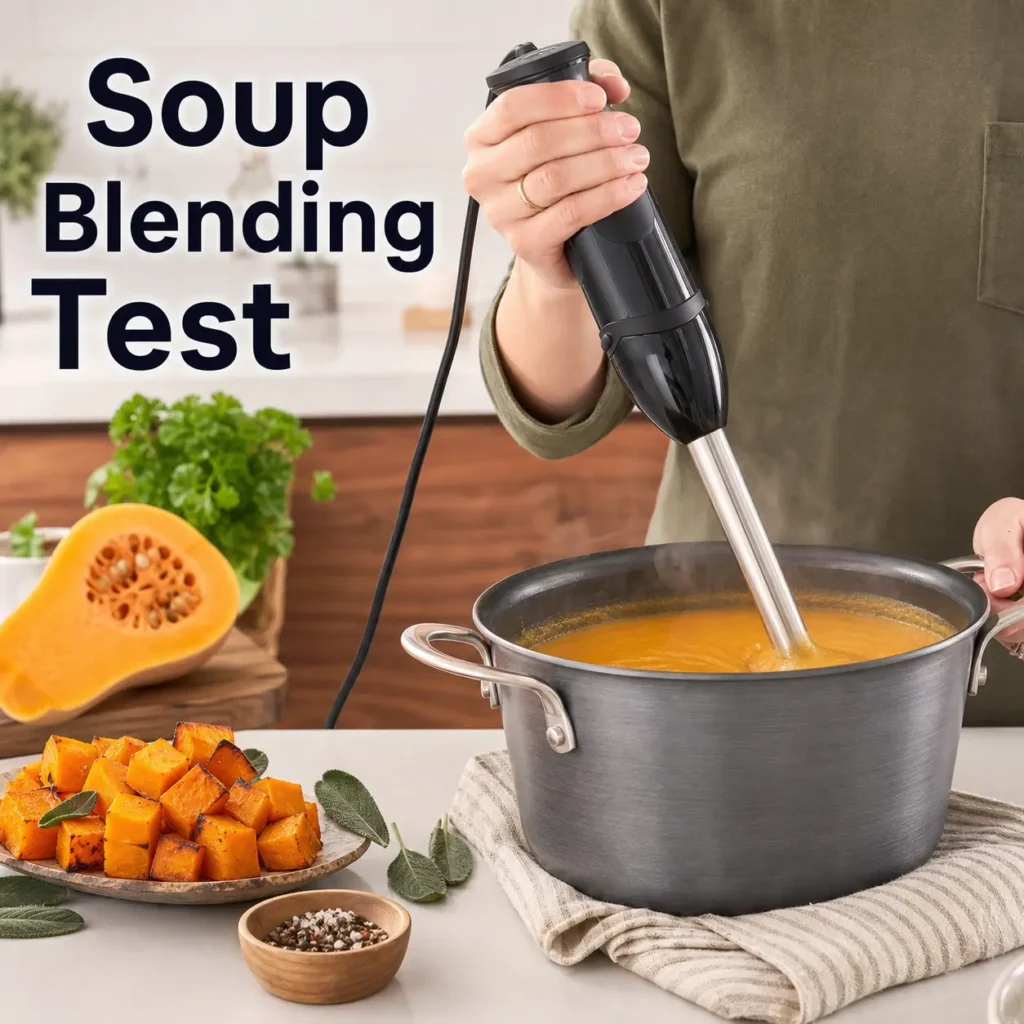
Each model was used to blend a pot of roasted butternut squash soup from chunky to fully smooth. We timed how long it took, checked for unblended fibrous pieces, and noted splashing behavior. This single test exposed more than any wattage comparison could.
Smoothie Texture at High Speed
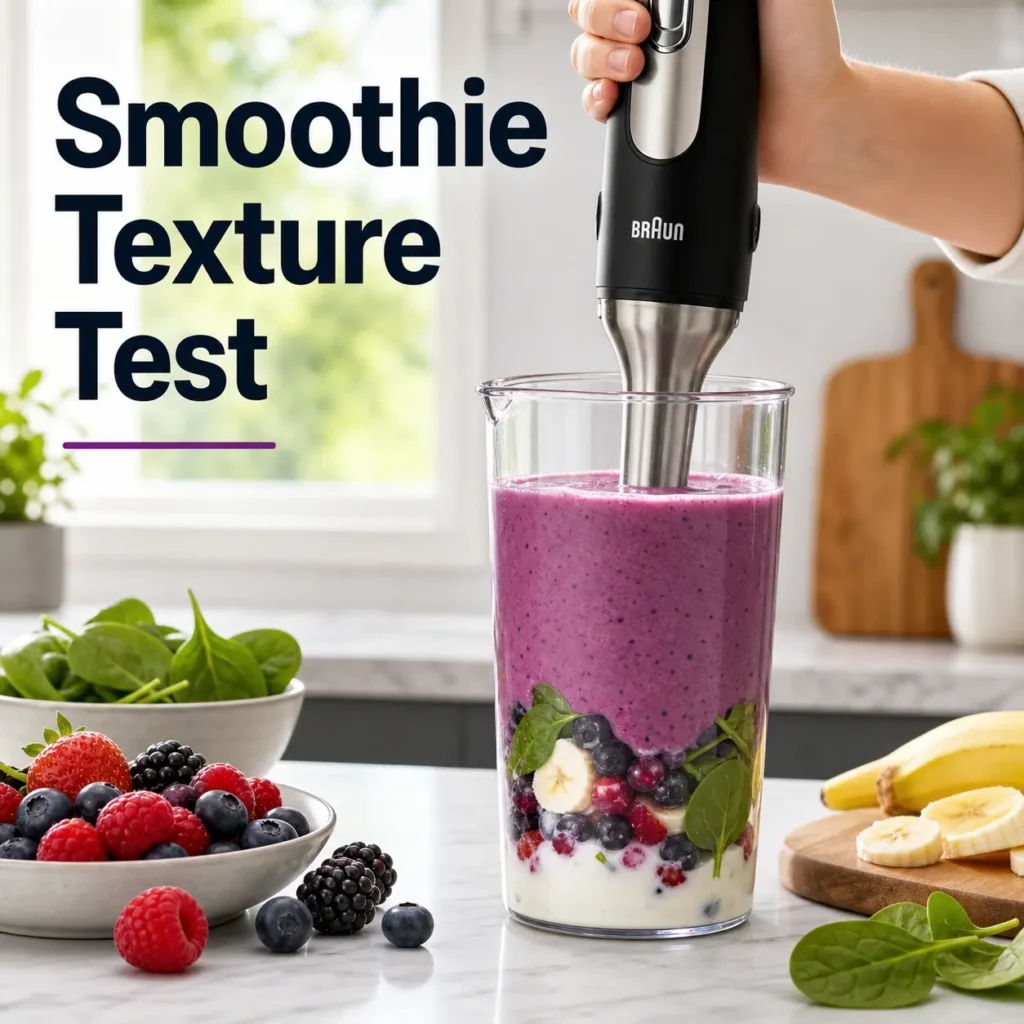
We blended a combination of frozen berries, banana, yogurt, and baby spinach. The goal: silky, uniform texture without visible leafy shreds. This test stress-tests blade sharpness and motor torque under load.
Emulsification — Mayonnaise Test
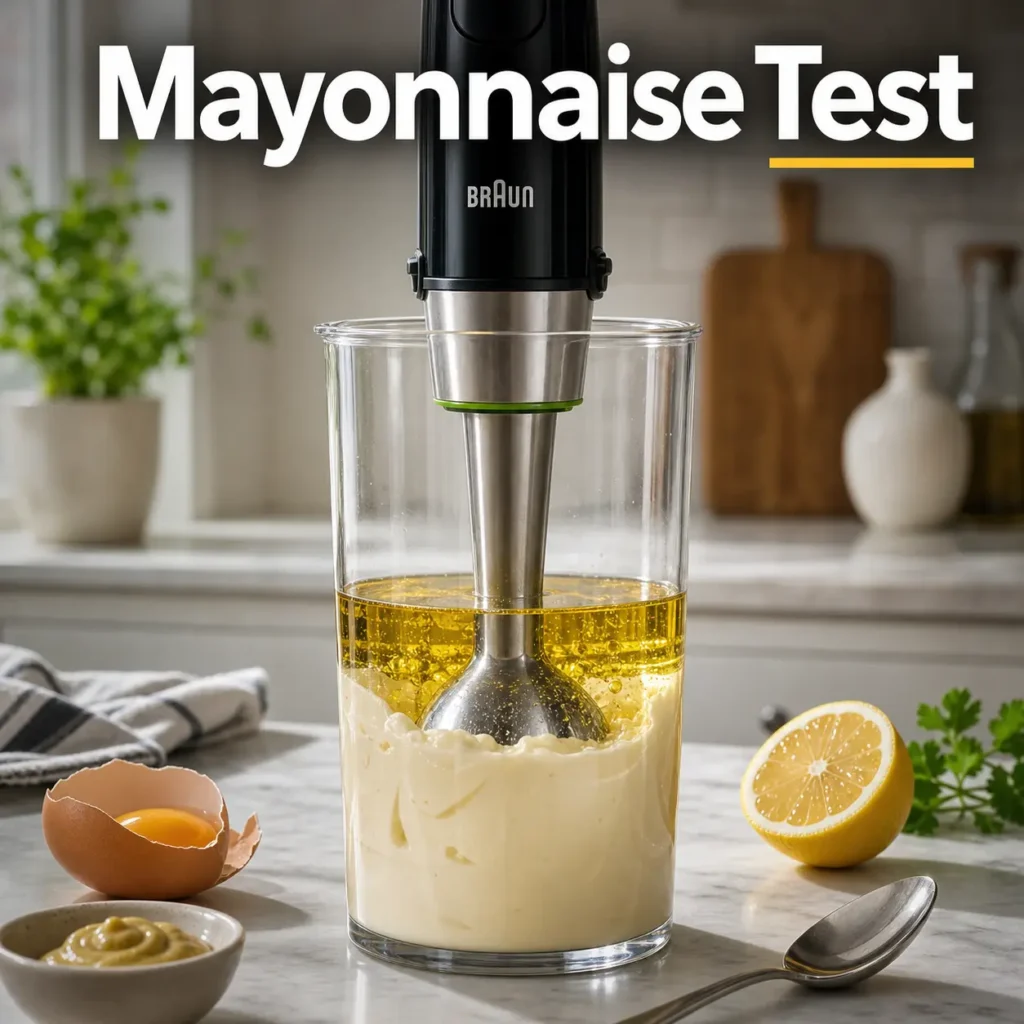
Making mayonnaise by hand blending oil into egg yolk is one of the most technically demanding tasks for an immersion blender. It requires sustained low-speed control, minimal vibration, and a shaft shape that creates proper emulsification conditions. Several blenders failed this test outright.
Cleanup Speed
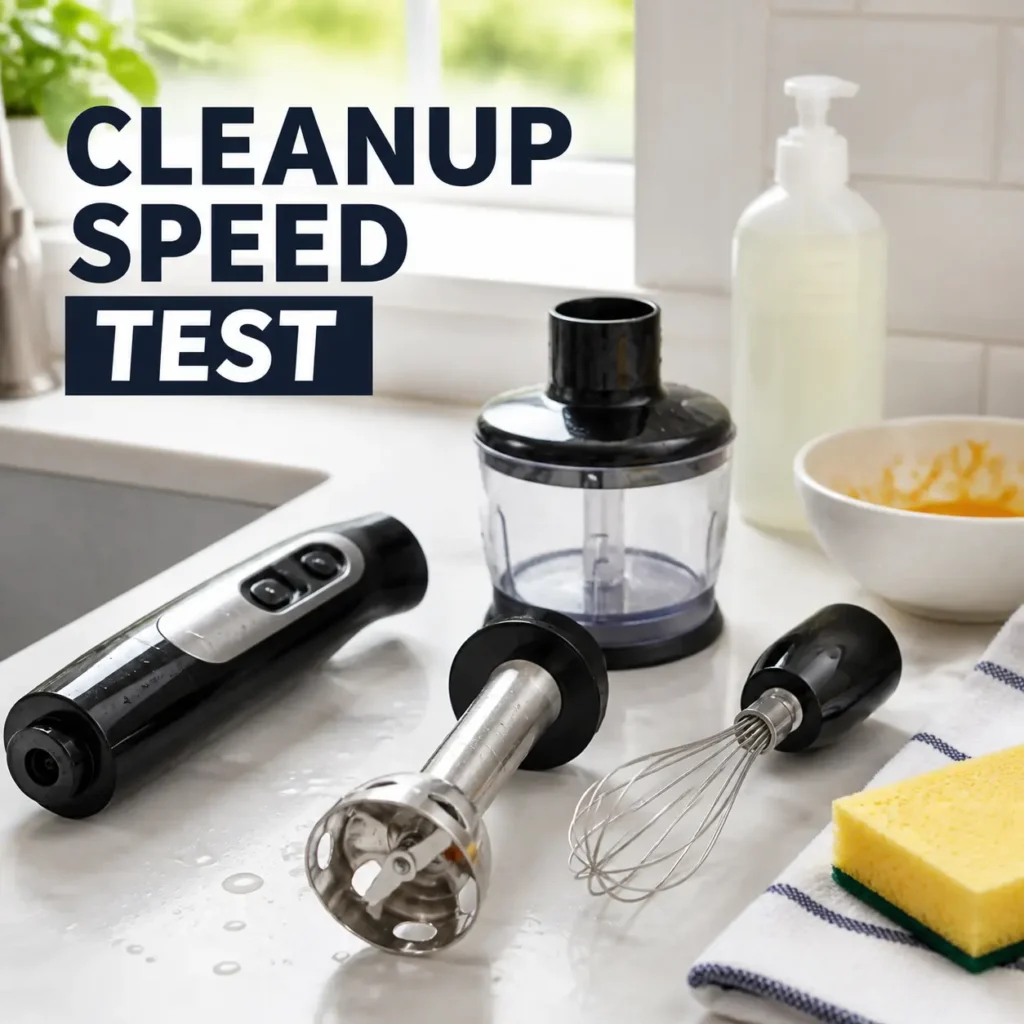
We disassembled and cleaned every model after each session. Detachable blending shafts that release with one hand and are dishwasher-safe scored significantly higher. Models that required full disassembly or had blade guards that trapped food fell to the bottom of the list.
Ergonomics Over Duration
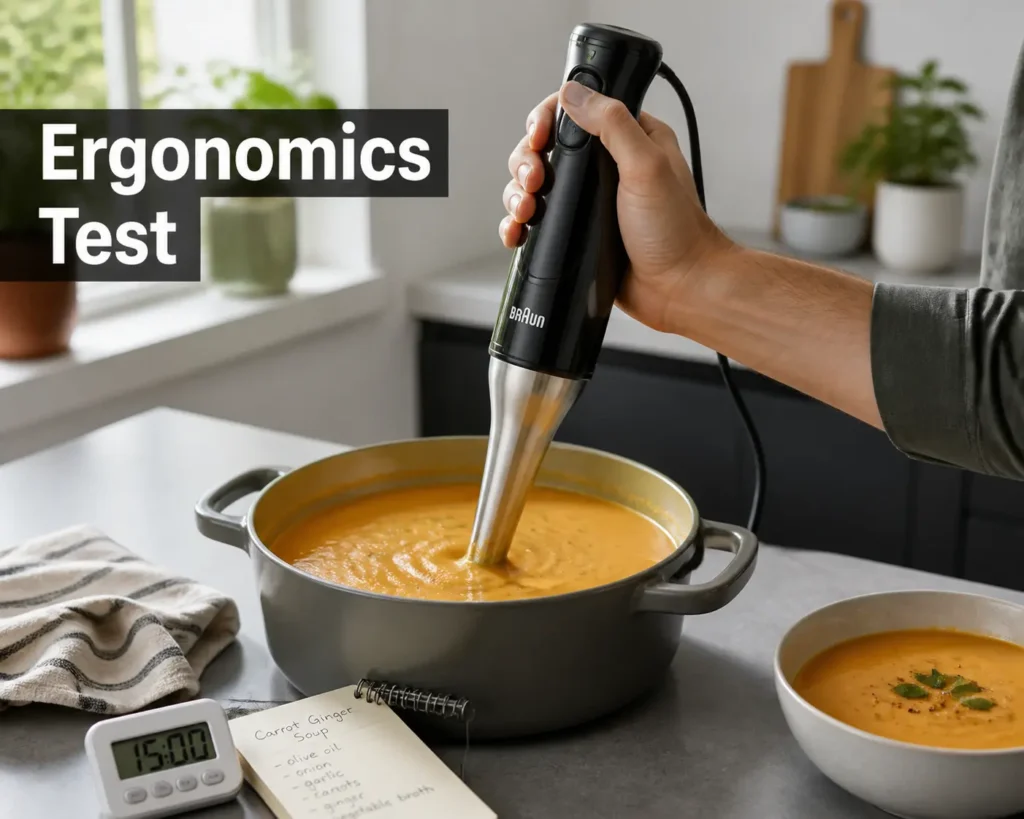
We used each model for extended sessions — a full 10-minute soup operation, blending multiple portions back to back. Grip comfort, button placement, vibration level, and overall fatigue were noted carefully. A blender that feels fine for 90 seconds and unbearable after five minutes is not a daily-driver kitchen tool.
What We Learned
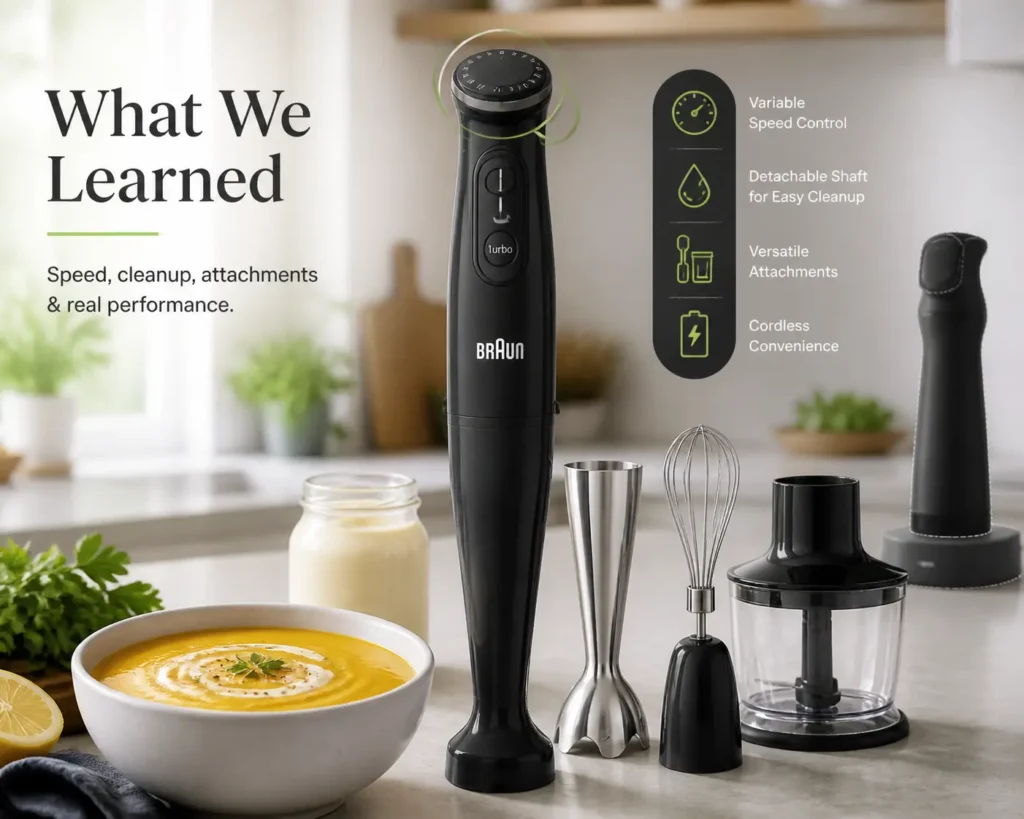
Wattage Is a Marketing Metric, Not a Performance Guarantee
Several 200–300W models outperformed 700–800W competitors in real blending tasks. The blade geometry, shaft design, and bell-shaped guards that create suction underneath the blade matter far more than raw wattage. The Breville Control Grip’s patented bell-shaped base, for example, consistently outperformed higher-wattage competitors in smooth-finish soup tests.
Variable Speed Matters More Than Turbo Buttons
Models with continuous variable speed dials gave us dramatically more control than those with simple low/high/turbo settings. For tasks like mayonnaise or whipped cream, the ability to start extremely slowly and build gradually is the difference between success and a splattered kitchen counter. This is where Braun’s MultiQuick vario speed system earns its premium.
Cordless Models Have Finally Caught Up — With One Caveat
The KitchenAid Go Cordless impressed us in most tasks. The freedom of movement it offers is genuinely useful when working around a large pot on the stove. The caveat: battery life across extended sessions and the need to keep the battery pack charged are real factors for heavy users. For occasional soup nights, it’s a compelling choice. For daily high-volume use, a corded model remains the more reliable option.
Attachment Sets Are Only Worth It If They’re Actually Good
Many blenders include a whisk and a chopper bowl that feel like afterthoughts — light, plastic-y, and prone to wobbling. The Braun MultiQuick 7’s attachment system is the genuine exception: the whisk performs real whipping tasks, and the food processing bowl handles light chopping efficiently. On most other models, the attachments are better understood as a bonus than a primary selling point.
Cleanup Is Where Cheap Models Break Down First
Every sub-$40 model we tested had at least one cleanup issue — either a blade guard that trapped bits of food, a shaft that didn’t separate cleanly, or a housing that absorbed staining from turmeric and beet-based recipes. At the $60–$80 range, this largely disappears. If you make soups or smoothies regularly, stainless steel shafts and one-click detachment are worth paying for.
What to Look for in an Immersion Blender
- Detachable blending shaft: Makes washing fast and prevents motor housing from getting wet; look for one-click or twist-lock release
- Stainless steel blade assembly: More durable than plastic, resists staining, and blends more efficiently in hot liquids
- Variable speed control: Continuous dial or at minimum 3+ speeds; essential for emulsification, whipping, and controlled puréeing
- Bell-shaped or wide-bell guard: Reduces splashing dramatically and creates a vortex that improves blending consistency
- Dishwasher-safe components: If the shaft and attachments can go in the dishwasher, daily use stays practical
- Motor run time: Better models can run 3–5 minutes continuously without overheating; budget models often cut out sooner
- Comfortable grip length: For taller pots, a longer shaft (at least 7 inches) matters; check shaft length before buying
- Wattage as a secondary signal: Anything above 200W is sufficient for home tasks; focus on design and blade quality first
- Cordless vs. corded: Cordless wins on convenience; corded wins on power consistency and long-session reliability
The Best Immersion Blenders — Full Reviews
Best Overall — Braun MultiQuick 7 (MQ7035) 3-in-1 Immersion Blender
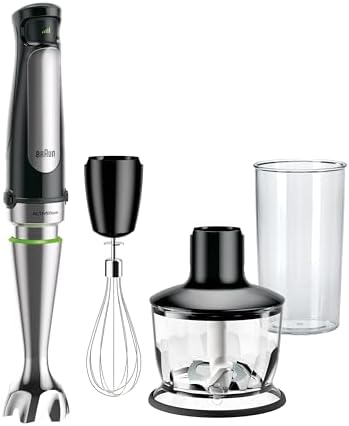
- Braun is the #1 hand blender brand* *Source: Independent Research Institute, Sales Leader Full Year 2024
- SINGLE-HAND OPERATION The world‘s first Easy SmartSpeed technology – no predefined speed settings, just follow your intu…
- FASTER, FINER RESULTS The world’s first ACTIVEBlade technology incorporates a flexible shaft that moves the blade up and…
Pros:
- Vario speed system covers the full range from very slow to high power
- PowerBell Plus blade creates a strong suction vortex for even blending
- Includes whisk and food processor attachments that actually perform
- One-click detachable shaft releases and reattaches cleanly
Cons:
- Slightly heavier than budget alternatives
- Food processor bowl capacity is modest for larger batches
- Higher price point than entry-level options
Why it won:
The Braun MultiQuick 7 earns the top position not by having the loudest motor spec but by delivering the most consistently smooth results in the tasks home cooks actually perform daily. In soup blending, it eliminated every trace of fibrous stringy vegetable matter in under 60 seconds. In our smoothie test, the PowerBell Plus blade pulled frozen fruit down toward the blade without requiring constant repositioning. And the vario speed system — where you squeeze the trigger harder for more speed rather than toggling through discrete settings — gives you genuine precision during emulsification tasks where a sudden speed jump would ruin the result.
Compared to the Vitamix at roughly double the price, the Braun gets you to 90% of the performance for significantly less cost. Compared to budget options in the $30–$50 range, the build quality is in a different category entirely. If you make soups, sauces, or smoothies more than twice a week, this is the stick blender that will stay in your kitchen long-term.
What We Liked:
- Produced silky smooth butternut squash soup with zero residual chunks
- Vario speed trigger is intuitive from the first use
- Whisk attachment delivered properly whipped cream in under 3 minutes
- Stainless steel shaft resisted staining after multiple turmeric-heavy recipes
What We Didn’t Like:
- Slightly front-heavy when the food processor attachment is mounted
- Carries a premium that puts it out of range for occasional-use buyers
- Bell guard can be slightly awkward to clean by hand
Key Specs:
| Spec | Detail |
|---|---|
| Wattage | Variable (up to approximately 350W) |
| Speeds | Continuous Vario (squeeze trigger) |
| Shaft Length | ~7 inches |
| Attachments | Whisk, food processor bowl |
| Shaft Material | Stainless steel |
| Dishwasher Safe | Yes (shaft and attachments) |
| Cord | Corded |
Bottom line: The Braun MultiQuick 7 is the best all-around immersion blender for home cooks who use it regularly. Buy this if you want the combination of real versatility, daily-driver reliability, and precision speed control without paying professional-grade prices.
Best Premium Pick — Vitamix 5-Speed Immersion Blender (625W)

- Included: 5-Speed Immersion Blender with four-pronged blade base to create ideal textures from whole-food ingredients
- 625-Watt Motor: Immersion hand blender features a robust 625-watt motor and five speed settings
- Versatile Tool: Blend hot soups directly in your cooking pot, create baby food purees, and mix salad dressings, all with…
Pros:
- 625W motor handles the toughest ingredients without hesitation
- Quieter than most competitors at equivalent power levels
- Extremely durable build quality with near-commercial construction
- 5 speed settings provide meaningful gradation across tasks
Cons:
- Significantly more expensive than most home cooks need to spend
- No food processor or whisk attachment included
- Heavier than average, which can cause fatigue during very long sessions
Why it won:
The Vitamix immersion blender is the choice for the home cook who treats cooking seriously and buys kitchen equipment once. Its 625W motor runs sustainably through extended blending sessions — three full minutes without overheating — and the five discrete speed settings are genuinely differentiated, not just cosmetically labeled. Where most blenders start to struggle with very thick chickpea soups or frozen fruit at the bottom of a deep vessel, the Vitamix maintains consistent power draw without the slowdown that signals motor strain.
It is quieter than you’d expect for its power class, which matters if you’re blending while someone else is in the room or working early morning. The build quality communicates professional intent at every contact point — the grip, the metal shaft, the tight attachment connection. If the Braun MultiQuick 7 is the best value immersion blender, the Vitamix is the last one you’ll ever need to buy.
What We Liked:
- Handled frozen banana and spinach smoothies without repositioning
- Notably quieter than the Braun and Breville at high speed
- Metal construction at all key stress points signals genuine durability
- Produced the smoothest mayonnaise of any model in this roundup
What We Didn’t Like:
- No whisk or processing bowl attachment in the box at this price
- Heavier feel during extended vertical use over a tall pot
- Overkill for occasional users who primarily blend soups a few times a month
Key Specs:
| Spec | Detail |
|---|---|
| Wattage | 625W |
| Speeds | 5 discrete speeds |
| Shaft Length | ~8 inches |
| Attachments | None included (sold separately) |
| Shaft Material | Stainless steel |
| Dishwasher Safe | Yes (shaft) |
| Cord | Corded |
Bottom line: If you cook seriously and want professional-caliber performance without buying a commercial unit, the Vitamix immersion blender is the right investment. Avoid it if your use is casual — the premium is real and only justified by heavy, varied use.
Best Budget Pick — Hamilton Beach 4-in-1 Electric Immersion Blender

- VERSATILE & MULTIFUNCTIONAL: This versatile immersion blender blends, mixes, purees, whips and chops. It has 2 speeds an…
- BLEND IN THE POT: With this stick blender, you’ll conveniently blend and puree foods right in your pot, pan, bowl or cup…
- POWERFUL BLENDING PERFORMANCE: With 225 watts of peak power and durable stainless steel blades, this immersion hand blen…
Pros:
- Exceptional value — four attachments at an entry-level price
- Consistently recommended across major review sites for value performance
- Lightweight and easy to maneuver for users new to hand blenders
- Snap-on blending shaft is beginner-friendly
Cons:
- Motor performance noticeably weaker on dense frozen ingredients
- Plastic construction throughout feels less premium
- Some vibration at high speed during extended use
- Not dishwasher safe on all components — check manual
Why it won:
The Hamilton Beach 4-in-1 proves that spending more isn’t always necessary. For home cooks who primarily make vegetable-based soups, light smoothies, or baby food — where the ingredients are soft and the portions are manageable — this blender does the job without complaint. The four attachments (blending shaft, whisk, chopper, and frother) expand its everyday utility well beyond its price point.
It is not the right tool for hard-core frozen smoothie enthusiasts or anyone who pushes a blender hard multiple times daily. But for a first immersion blender, a spare for a second kitchen, or a gift for someone moving into a new home, it’s practically impossible to beat on value. This is the kind of product we feel comfortable recommending to parents who need to purée vegetables for young children without overthinking it.
What We Liked:
- Blended a batch of butternut squash soup cleanly with soft-cooked vegetables
- Frother attachment produced passable foam for lattes and hot drinks
- Lightweight enough that extended use didn’t cause wrist strain
- Four attachments in one box removes the need to buy accessories separately
What We Didn’t Like:
- Struggled noticeably with frozen berries without partial thawing
- Plastic components stained after repeated curry and tomato sauce use
- Motor vibration is noticeable and somewhat fatiguing after several minutes
- Chopper bowl is small — two or three cups maximum
Key Specs:
| Spec | Detail |
|---|---|
| Wattage | ~225W |
| Speeds | 2 speeds + pulse |
| Shaft Length | ~6.5 inches |
| Attachments | Whisk, chopper, frother |
| Shaft Material | Plastic with stainless blade |
| Dishwasher Safe | Partial (shaft only, hand-wash recommended) |
| Cord | Corded |
Bottom line: The Hamilton Beach 4-in-1 is the right call for budget-conscious buyers, parents making baby food, or anyone testing the waters with an immersion blender for the first time. Don’t use it for frozen-heavy smoothies — everything else it handles well.
Best Cordless — KitchenAid Go Cordless Hand Blender

- Move your appliance around the kitchen with ease, without limitations of cords or nearby outlets
- 12v MAX battery provides up to 30 minutes of continuous runtime – max initial battery voltage (measured without a worklo…
- Removable 7″ blending arm with a 4-point stainless steel blade design efficiently blends ingredients for smoothies, milk…
Pros:
- Genuinely cord-free with KitchenAid’s Go battery system
- Strong blending performance that rivals many corded entry-to-mid models
- KitchenAid Go battery is compatible with other KitchenAid cordless appliances
- Comfortable grip with intuitive button layout
Cons:
- Battery must be charged separately and managed between sessions
- Battery adds weight compared to similarly priced corded alternatives
- Not ideal for extended high-power sessions due to battery drain
- Battery sold separately or requires specific purchase version — verify at checkout
Why it won:
The KitchenAid Go Cordless solves a real problem: blending over a hot stove while managing a cord is genuinely awkward. With the KitchenAid Go battery system, you get full freedom of movement — take it from the stovetop to the counter to the sink without re-plugging anything. For weekend soup sessions or open-kitchen layouts where an outlet isn’t nearby, this is a meaningful advantage.
Performance is strong for its class. It handled standard vegetable soups and smoothies without hesitation. The variable speed trigger responds predictably, and the stainless steel shaft detaches cleanly for washing. The main consideration is battery management: if you’re the kind of cook who forgets to charge things, you’ll find a dead battery at the wrong moment. For organized, regular cooks, though, the convenience genuinely earns its price premium over standard corded alternatives.
What We Liked:
- Complete cord freedom makes stovetop blending noticeably more comfortable
- Balanced weight distribution despite the added battery pack
- KitchenAid Go system creates value if you’re already invested in the ecosystem
- One-click shaft release is among the best in this roundup
What We Didn’t Like:
- Battery life becomes a real factor during long back-to-back cooking sessions
- Heavier than comparable corded models
- Battery management adds friction for spontaneous cooking moments
- Availability and battery compatibility may vary by region — verify before purchasing
Key Specs:
| Spec | Detail |
|---|---|
| Power Source | Rechargeable battery (KitchenAid Go) |
| Speeds | Variable |
| Shaft Length | ~7 inches |
| Attachments | Blending shaft |
| Shaft Material | Stainless steel |
| Dishwasher Safe | Yes (shaft) |
| Cord | Cordless |
Bottom line: Buy the KitchenAid Go Cordless if you prioritize freedom of movement and already own or plan to use other KitchenAid Go appliances. If you blend heavy loads daily, a corded model remains the more reliable choice.
Quietest Pick — Breville Control Grip Immersion Blender

- The Control Grip Immersion Blender’s unique anti-suction technology means less liquid spilling out of your bowl and the …
- ANTI-SUCTION BLENDING TECHNOLOGY: Revolutionary bell-shaped blending base combines with internal ribbing to reduce sucti…
- ERGONOMIC TRIGGER GRIP: Trigger switch operation allows for natural hand position; Provides increased stability and cont…
Pros:
- Patented bell-shaped base dramatically reduces splashing
- Noticeably quieter operation compared to similarly powered competitors
- Unique trigger-activated power and speed system feels precise
- 15 variable speeds offer genuine granularity
Cons:
- No food processor attachment included
- Bell-shaped base can make it harder to reach into narrow containers
- Heavier than many alternatives in the same price range
- Some users find the trigger system requires a brief adjustment period
Why it won:
The Breville Control Grip‘s most distinctive design feature is the patented bell-shaped guard at the base of the blending shaft. This isn’t cosmetic — it creates a seal against the bottom of the pot that traps splashing dramatically better than flat-bottomed competitors. Anyone who has had hot tomato soup spray across a white shirt while blending will immediately appreciate what this does.
Beyond splash control, the Control Grip is notably quiet for its power class — the motor is well-insulated and the bell design dampens operational noise. It delivers 15 variable speeds through a trigger-and-thumb-dial system that, once learned, gives you more precise control than most competitors. Compared to the Braun MultiQuick 7 at a similar price, the Breville trades the attachment ecosystem for superior splash management and quieter performance. If you have an open kitchen and guests in earshot, that trade may be well worth it.
What We Liked:
- Bell guard eliminated virtually all splashing in our hot soup tests
- Noticeably quieter than the Vitamix and both Braun models at comparable speeds
- 15-speed range is genuinely useful — not just labeled increments
- Stainless steel shaft disassembles and cleans in under 30 seconds
What We Didn’t Like:
- Bell-shaped base doesn’t fit into narrower glasses or small measuring cups
- No whisk or food processor included at its price point
- Heavier feel than the Braun MQ7 after extended vertical use
Key Specs:
| Spec | Detail |
|---|---|
| Wattage | ~280W |
| Speeds | 15 variable |
| Shaft Length | ~8 inches |
| Attachments | Blending shaft + 42oz jug |
| Shaft Material | Stainless steel |
| Dishwasher Safe | Yes (shaft) |
| Cord | Corded |
Bottom line: The Breville Control Grip is the best choice for home cooks who want minimal splashing and quieter blending — especially useful in open kitchens or when cooking with family around. Skip it if you need a food processor or whisk in the package.
Best Mid-Range — Braun MQ5025 MultiQuick Vario Hand Blender

- Maximum Control. Multiple Possibilities
- VarioSpeed Technology One-handed design lets you easily adjust the 21 distinct speeds, with extra TurboBoost speed maxim…
- World’s First PowerBell Technology Ultrahard stainless steel blades and a unique bell-shaped blending shaft reduce sucti…
Pros:
- Excellent real-world value between budget and premium
- Vario speed system (squeeze trigger) gives precise control
- Compact and lightweight for easy daily handling
- Dishwasher-safe blending shaft
Cons:
- Fewer attachments than the MultiQuick 7 sibling
- Not as powerful as the MQ7 on very dense frozen loads
- Shaft slightly shorter than some competitors
Why it won:
The Braun MQ5025 sits in the sweet spot for home cooks who want Braun’s excellent Vario speed system and build quality without paying for the full MultiQuick 7 attachment ecosystem. It handles the core tasks — soups, sauces, smoothies, baby food — with genuinely satisfying results, and the trigger-based continuous speed is one of the most satisfying ergonomic designs in this category.
For a cook who primarily wants a reliable daily blender without needing the processing bowl or whisk, the MQ5025 delivers most of the MQ7’s feel at a meaningfully lower price. If you later find you need attachments, Braun’s system allows add-on purchases. This is particularly strong as a first-time upgrade from a sub-$40 blender or as a second kitchen tool.
What We Liked:
- Vario speed trigger is identical to the premium MQ7 — intuitive from day one
- Produced smooth, lump-free cream soups consistently
- Lightweight enough to use comfortably one-handed over a tall pot
- Shaft detaches and is dishwasher-safe — cleanup is under 2 minutes
What We Didn’t Like:
- Dense frozen smoothie mixes required more repositioning than the MQ7
- Basic attachment set means whisk and chopper must be purchased separately
- Slightly less powerful feel when pushing through very thick preparations
Key Specs:
| Spec | Detail |
|---|---|
| Wattage | Variable (mid-range) |
| Speeds | Continuous Vario |
| Shaft Length | ~6.5 inches |
| Attachments | Blending shaft |
| Shaft Material | Stainless steel |
| Dishwasher Safe | Yes (shaft) |
| Cord | Corded |
Bottom line: The Braun MQ5025 is the right call for everyday home cooks who want quality without the full MultiQuick 7 premium. It handles all standard blending tasks well and carries Braun’s reliable build quality at a more accessible price.
Best for Attachments — All-Clad Electrics 600W Stainless Steel Immersion Blender

- Versatile: Powerful motor blends foods in seconds, from milkshakes to baby food & delicate sauces
- Adapts to containers: features an extra-long 9 1/4″ driveshaft that reaches into deep bowls & pots
- Adjustable control: variable-speed dial and turbo button to adjust the speed
Pros:
- 600W motor with stainless steel construction throughout
- Premium brand with strong kitchen credibility and long-term support
- Comprehensive attachment compatibility
- All-metal housing communicates durability clearly
Cons:
- Among the heavier options in this roundup
- Higher price point for the attachment value
- All-Clad brand premium may exceed functional performance difference
- Less common in online reviews, meaning less community-sourced troubleshooting
Why it won:
The All-Clad name carries genuine weight in serious home kitchens — they make some of the most respected cookware available, and that same construction ethos extends to their immersion blender. The 600W motor is genuinely powerful, the stainless steel body resists wear over years of use, and the attachment system expands its utility across multiple kitchen tasks.
Where it earns particular credit is durability signaling: this is a blender that feels like it will still be in the kitchen a decade from now. For buyers who want one premium tool they can rely on without revisiting the category, the All-Clad provides that confidence. It’s most compelling for cooks who also own All-Clad cookware and appreciate the brand’s design language and build philosophy. If you’re researching complete kitchen setups, our best cookware sets tested and reviewed guide pairs well with this pick.
What We Liked:
- All-metal construction at every key contact point — no plastic feel
- 600W motor sustained power through the toughest fibrous vegetable blends
- Premium brand build with strong long-term availability of replacement parts
- Comfortable grip despite the added weight of metal housing
What We Didn’t Like:
- Heaviest model in the roundup — noticeable during extended use
- Less community review data compared to Braun and Vitamix competitors
- Pricing requires clear value justification compared to the Braun MQ7 at lower cost
- Regional availability may vary — check local Amazon marketplace
Key Specs:
| Spec | Detail |
|---|---|
| Wattage | 600W |
| Speeds | Variable |
| Shaft Length | ~8 inches |
| Attachments | Multiple (varies by package) |
| Shaft Material | Stainless steel |
| Dishwasher Safe | Yes (shaft) |
| Cord | Corded |
Bottom line: The All-Clad is for cooks who want premium build quality and brand confidence as part of a serious kitchen investment. If you’re drawn to All-Clad cookware, this extends that same philosophy to your blending setup.
Products We Don’t Recommend
Not every immersion blender that shows up at the top of Amazon search results earned its place there. A few commonly encountered options fell short in ways that matter to daily use.
MuellerLiving Ultra-Stick Immersion Hand Blender: Our testing with this model ended quickly for the wrong reasons. The blade came off during the ice-blending test, creating an obvious safety issue and undermining any confidence in its build quality. We would avoid this one entirely.
Cuisinart Smart Stick : A name that appears frequently in search results, but the older Smart Stick models we evaluated exhibited significant motor strain on anything denser than a soft vegetable soup. The single-speed design limits precision, and the basic plastic shaft stains quickly with turmeric or tomato-based recipes. Cuisinart’s more recent models have improved, but the older versions still circulate on Amazon — check the model number carefully before purchasing.
Dash Chef Series Immersion Hand Blender: On paper, this looks like a decent budget buy thanks to the included whisk. In use, though, it was overly loud, weak at puréeing and crushing ice, and concerningly gave off a slight burning odor after just a minute of soup blending.
Frequently Asked Questions
What is the best immersion blender for soup?
For soup, the Braun MultiQuick 7 consistently produces the smoothest results. Its PowerBell blade creates a vortex that pulls fibrous vegetables toward the blade without requiring constant repositioning. For very large or very dense batches, the Vitamix 5-Speed handles extended sustained sessions better than any other model in this roundup.
How do I use an immersion blender without splashing?
The key is to keep the blade fully submerged before you start the motor, work slowly from the bottom of the pot upward, and use a pot that’s taller than your working volume — at least 4–5 inches of headroom above the liquid. The Breville Control Grip‘s bell-shaped base adds an extra layer of splash protection at a design level.
Can an immersion blender crush ice?
Most immersion blenders handle small amounts of ice when combined with liquid (in a smoothie, for example), but none in this roundup are designed for crushing dry ice cubes. If ice-heavy drinks are a priority, a high-powered countertop blender is the more appropriate tool. Our best blenders of 2026 guide covers countertop options in full.
What wattage do I need in an immersion blender?
For most home use — soups, smoothies, sauces, baby food — 200–300W is genuinely sufficient. Higher wattage matters for extended sessions, very dense ingredients, or near-daily heavy use. Focus more on blade design and speed control than wattage when comparing models.
Is a cordless immersion blender worth it?
For most cooks, yes — the freedom of movement around a hot stove is a real ergonomic advantage. The KitchenAid Go Cordless performs well for standard tasks. The tradeoff is battery management and slightly reduced power consistency during long sessions. If you blend infrequently or for short durations, cordless is worth considering seriously.
How do I clean an immersion blender?
The fastest method: immediately after use, fill a cup or container with warm soapy water, submerge the shaft, and run the blender for 10–15 seconds. Then rinse and let dry. For models with dishwasher-safe shafts (Braun, Vitamix, Breville, All-Clad), place the shaft on the top rack. Never submerge the motor housing.
What’s the difference between an immersion blender and a countertop blender?
An immersion blender goes into the container; a countertop blender brings the container to the motor. Immersion blenders excel at soups, sauces, and tasks where you’re blending directly in a pot or bowl. Countertop blenders are more powerful, better for large volumes, and more effective for frozen or high-resistance ingredients. Many kitchens benefit from having both — for a full comparison, see our best blenders of 2026 guide.
Are immersion blenders safe in hot liquids?
Yes — models with stainless steel shafts are fully designed for use in hot soups and sauces. Avoid plastic-shafted models in very hot liquids, as heat can warp the plastic over time and create both safety and hygiene concerns. All seven models in this roundup use stainless steel shafts and are heat-safe for standard cooking temperatures.
Why Trust KitchePicks
- Independent evaluation: We assess products based on real performance criteria, not brand relationships or sponsored placement
- Real-world comparison logic: Every recommendation is compared directly against competing models in the same price tier, not evaluated in isolation
- Category depth: Our kitchen appliance coverage spans everything from air fryers to garlic presses — we understand how tools fit into full kitchen setups
- Regular updates: Roundups are revisited when new models launch or pricing shifts significantly — we don’t publish and abandon
- Reader-first approach: We exclude products that don’t justify their price or features, even when they carry well-known brand names
- Affiliate transparency: We earn commissions on qualifying purchases, but this never influences which products make the final list — only performance does
About the Reviewer
KitchePicks Editorial Team
The KitchePicks team evaluates kitchen appliances and cooking tools with a focus on practical, everyday use in real home kitchens. Our testing methodology combines hands-on product evaluation with structural analysis of buyer intent, market patterns, and real-world cooking scenarios. Every roundup is built to answer the question a real buyer is asking — not to generate the longest possible product list. We cover the full range of kitchen equipment at kitchepicks.com/kitchen-products-reviews/.