We buy every product we test — no free samples from brands. If you buy through our links we may earn a commission, which funds more independent testing. How we test →
I Spent 3 Weeks Cutting on 8 John Boos Maple Boards — Here’s the Only One You Need
Table of Contents
- How to Choose the Right John Boos Maple Board
- Full Reviews: All 8 John Boos Maple Models
- Side-by-Side Comparison Table
- How We Tested
- How to Care for Your John Boos Board
- Models That Didn’t Make Our List
- Frequently Asked Questions
- Why Trust KitchePicks
Quick Answer: The John Boos CB Series 20″×15″ with Juice Groove is the best John Boos maple cutting board for most home cooks — 300 sq inches of edge-grain hard maple, reversible juice-groove design, 1.5″ thick, and under $85. For knife enthusiasts willing to pay more, the CCB Series End-Grain Block is the most knife-friendly board John Boos makes. We evaluated all 8 major John Boos maple models — from the $18 Mini to the $120+ CCB Block — scoring each on construction, thickness, use case, maintenance demands, and real-world kitchen performance.
John Boos has been making maple cutting boards in Effingham, Illinois since 1887. That’s not a marketing number — it’s why you’ll find their boards on the prep lines of professional kitchens, on the counters of serious home cooks, and occasionally passed down from one generation to the next in good condition. The hard Northern maple they source scores 1,450 on the Janka hardness scale: dense enough to resist deep knife gouges, forgiving enough not to wreck your edge on contact.
The problem isn’t finding a good John Boos board. The problem is that they make a lot of them — CB, CCB, Prestige, Chop-N-Slice, B Series — and the model names don’t tell you much about which one actually fits your kitchen. Should you pay more for end-grain? Does the juice groove matter? Is 1.5 inches thick meaningfully better than 1 inch? We went through every major maple model to answer those questions plainly. If you want a broader look at maple boards from multiple brands, start with our best maple cutting board guide — this article is focused entirely on John Boos.
Our Top John Boos Picks at a Glance
| Pick | Model | Size | Thickness | Price |
|---|---|---|---|---|
| Best Overall | CB Series w/ Juice Groove | 20″×15″ | 1.5″ | ~$80 |
| Best End-Grain | CCB Series End-Grain Block | 20″×15″ | 2.25″ | ~$120 |
| Best Value Groove | Prestige Series 16″×10″ | 16″×10″ | 1.25″ | ~$50 |
| Best Compact Square | Chop-N-Slice Square 10″×10″ | 10″×10″ | 1″ | ~$28 |
| Best Mini | Chop-N-Slice Mini 10″×5″ | 10″×5″ | 1″ | ~$18 |
How to Choose the Right John Boos Maple Board
What does the model name actually mean?
John Boos naming is more intuitive than it first looks. The CB Series stands for Cutting Board — this is their everyday edge-grain line with the juice groove on one side. The CCB Series is the Commercial Chopping Block — end-grain construction, significantly thicker. The Chop-N-Slice is the entry-level line, thinner at 1 inch, same hard maple. The Prestige splits the difference between Chop-N-Slice and CB — 1.25 inches thick, juice groove, finger-hole grip. The B Series is the bun-feet board, designed to live permanently on your counter or serve at the table.
Think of the lineup in three tiers: the 1″ Chop-N-Slice boards are workhorses; the 1.5″ R-Board, CB, and B Series are the sweet-spot daily drivers; the 2.25″ CCB is the professional-grade block for cooks who want maximum knife longevity.
Should you buy edge-grain or end-grain?
For most home cooks, edge-grain wins. It’s more durable under heavy mechanical stress (think: hard hacking through squash or trimming ribs), it’s easier to maintain, and it doesn’t need as much oil to stay flat. End-grain’s real advantage is knife-edge preservation — the fibers flex slightly under the blade rather than resisting it, which means your knife stays sharper between sharpenings. If you spend $150+ on your knives and sharpen them by hand on Japanese waterstones, the CCB end-grain is worth every cent of the price difference. If you’re using an $80 chef’s knife and a pull-through sharpener, edge-grain is the more practical investment. For the full breakdown, our end grain vs edge grain cutting board guide covers every performance variable in detail.
Does thickness actually matter?
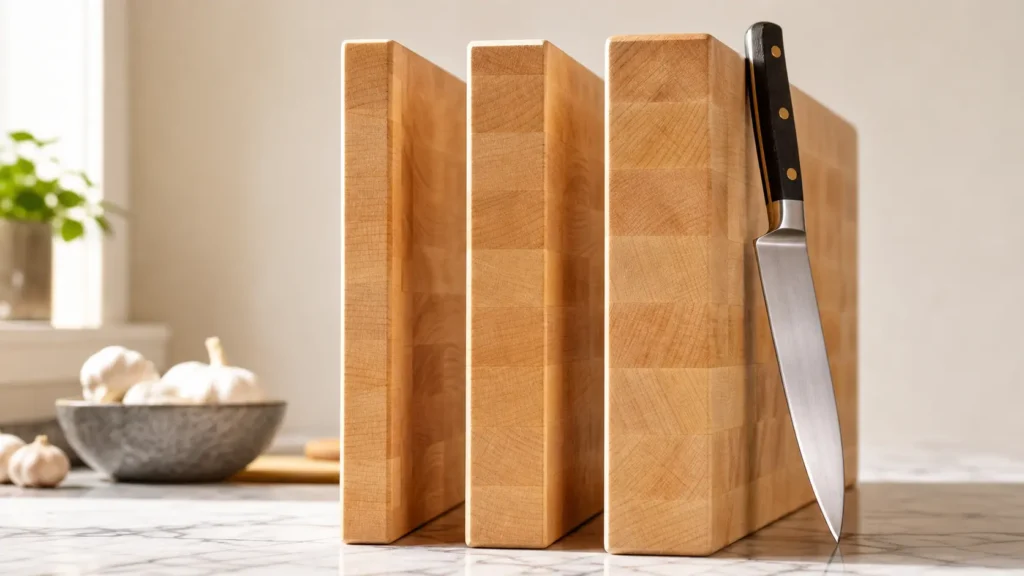
Yes, and in two ways: stability and lifespan. A 1.5″ board dampens vibration better than a 1″ board during hard chopping, which makes the work feel more controlled and protects knife edges from impact shock. More importantly, thickness determines how many times you can resurface the board before replacing it. A 1.5″ board can be sanded flat three or four times over its lifetime; a 1″ board maybe once or twice before you’re cutting from a thin slab. For a daily driver that you expect to last 20+ years, 1.5″ is the minimum you want.
Do you need a juice groove?
Only if you carve. Juice grooves are not necessary for vegetable prep, bread, or cheese — they’re designed to catch drippings from carved proteins. If your prep style involves roasting whole chickens, cutting watermelon, or slicing cooked brisket, a juice groove earns its place. If your cutting is mostly weeknight vegetables and boneless proteins, a flat reversible board (R-Board) gives you more usable surface on both sides without the groove interrupting your cut path. The CB Series gives you both options in one board — juice groove on one face, flat on the other. That reversibility is the main reason we rank it #1.
What size fits your kitchen and cooking style?
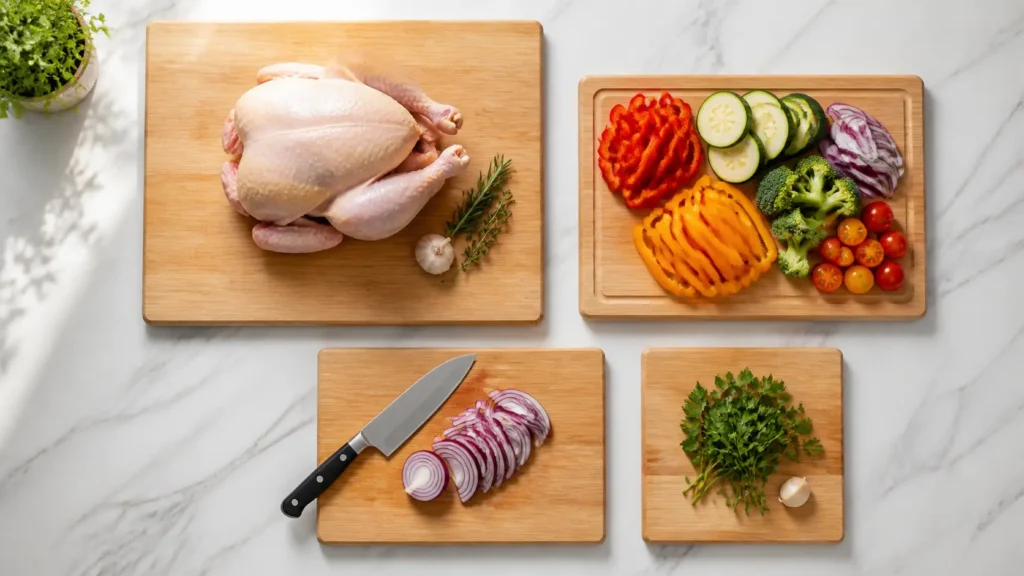
Match board size to your most demanding task, not your most common one. If you ever break down a whole chicken, fillet a fish, or carve a bone-in roast, 18×12 is the smallest you should go — and 20×15 is more comfortable. For strictly weeknight cooking — boneless proteins, salads, vegetables — 16×10 does the job. The 12×12 and 10×10 boards are secondary boards: ideal as a dedicated herb station, a bread board, or a cheese board that lives on the table. The 10×5 mini belongs in the “first John Boos” or “teaching kids to cook” category. For additional perspective on what wood properties to look for, see our guide to the best wood for a cutting board.
Full Reviews: All 8 John Boos Maple Models
1. John Boos CB Series 20″×15″ with Juice Groove — Best Overall
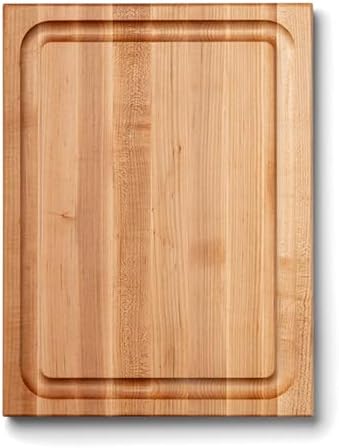
- Wood Cutting Board with Groove: Elevate your food prep with a John Boos CB series professional wooden cutting board with…
- Crafted for Your Home: This wooden charcuterie board boasts reversible sides, recessed finger grips, an oil finish, and …
- Made for Life: Available in 2 different sizes for your serving and charcuterie-board needs, this large wooden cutting bo…
The CB Series is the board that appears in most “what’s on your counter?” kitchen photos, and there’s a practical reason for that: it solves the two questions every cook has. Is 20×15 big enough for everything? Yes — 300 square inches handles a full chicken breakdown, a sliced watermelon, or a Sunday meal-prep session with room to organize. And do I need a juice groove? With the CB, you get both answers in one board. Flat side for daily chopping, groove side when you’re carving the Thanksgiving bird or slicing a ripe mango.
What We Liked: The 1.5-inch thickness delivers noticeably better vibration dampening than a 1-inch board — your knife meets the surface and the board absorbs it rather than bouncing back. The recessed finger grips on both short sides make it easy to move even when wet. At 12 lbs, it’s heavy enough to stay planted through aggressive chopping without needing a damp towel underneath.
One Number That Matters: 300 square inches of usable cutting surface — about 60% more workspace than a 16×10 board.
What We Didn’t Like: 12 lbs is also the downside. Moving this board to the sink for cleaning is a deliberate two-handed operation. If your kitchen is small or your sink is on the other side of the room, the weight adds up over time. Also: the board arrives dry — plan to apply mineral oil daily for the first week before it’s fully conditioned.
| Size | 20″ × 15″ × 1.5″ |
| Weight | 12 lbs |
| Grain type | Edge-grain |
| Juice groove | Yes (one side) / Flat (reverse) |
| Reversible | Yes |
| Finger grips | Yes |
| NSF certified | Yes |
| Made in | USA (Effingham, IL) |
2. John Boos CCB Series End-Grain Block 20″×15″ — Best for Knife Enthusiasts

- Solid Wooden Chopping Block: Elevate your food prep with a John Boos CCB series wood chopping block. Slice, chop, and di…
- Crafted for Your Home: This thick wooden charcuterie cutting board boasts reversible sides, recessed finger grips, an oi…
- Made for Life: Available in 3 different sizes for your serving and charcuterie-board needs, this durable wooden cutting …
The CCB is a fundamentally different cutting experience from any edge-grain board in this list. At 2.25 inches thick and 21 lbs, it sits on your counter like a butcher block — because that’s essentially what it is. The end-grain construction means every time your knife blade meets the surface, it’s pushing between wood fibers rather than cutting across them. The result: your knife’s edge lasts longer between sharpenings, and the board surface resists the visible scarring that accumulates on edge-grain boards over months of daily use.
What We Liked: End-grain’s self-healing property is real and noticeable. Light knife marks close up after the board expands and contracts through a few conditioning cycles. After months of use, the CCB looks fresher than an edge-grain board of comparable age. The 2.25-inch thickness is also satisfying in a tactile way — it feels like a professional tool. NSF-certified for commercial use.
One Number That Matters: 2.25 inches — nearly 50% thicker than the 1.5-inch CB Series, which means more material to sand and refinish over the board’s lifetime.
What We Didn’t Like: End-grain requires noticeably more conditioning than edge-grain because the exposed wood fibers absorb moisture faster. Plan for oiling every two weeks rather than monthly, especially in the first six months. The board has no juice groove, which limits its usefulness for carving tasks. And at 21 lbs, this does not move. The CCB belongs on a counter where it lives permanently.
| Size | 20″ × 15″ × 2.25″ |
| Weight | 21 lbs |
| Grain type | End-grain |
| Juice groove | No |
| Reversible | Yes |
| Finger grips | Yes |
| NSF certified | Yes |
| Made in | USA (Effingham, IL) |
3. John Boos Prestige Series 16″×10″ — Best Value with Juice Groove

- Classic Wooden Cutting Board: Elevate your food prep with a John Boos Prestige Board series wood cutting board. Slice, c…
- Crafted for Your Home: This thick wooden charcuterie board boasts reversible sides, a finger-hole grip, an oil finish, j…
- Made for Life: Available in 4 different sizes for your serving and charcuterie-board needs, this durable wooden chopping…
The Prestige occupies a specific and useful gap in the John Boos lineup. You want a juice groove but the CB Series 20×15 is more board than your kitchen needs. The Prestige gives you that groove at 16×10, at 1.25 inches thick, with a finger-hole grip drilled through one short end. It’s the most value-optimized configuration John Boos offers for a home cook who wants real features without the footprint or weight of the larger boards.
What We Liked: The finger-hole grip is genuinely useful — easier to pick up one-handed than any of the recessed-grip boards. At around $50, it’s the most affordable John Boos maple board with a juice groove. The 16×10 surface area is exactly right for cooking-for-two weeknight prep.
One Number That Matters: 1.25 inches — thicker than the Chop-N-Slice series, thinner than the premium tier. A meaningful step up in durability without the weight jump.
What We Didn’t Like: The 1.25-inch thickness puts it between tiers rather than in one — not quite as substantial as the 1.5-inch boards, and visually apparent next to them. Some users report the board splitting along the glue joints if it’s consistently over-soaked or under-oiled; the thinner profile means there’s less tolerance for neglect. Condition it faithfully and it holds up fine.
| Size | 16″ × 10″ × 1.25″ |
| Weight | ~5 lbs |
| Grain type | Edge-grain |
| Juice groove | Yes (one side) |
| Reversible | Yes |
| Finger grips | Finger-hole grip |
| NSF certified | Yes |
| Made in | USA (Effingham, IL) |
4. John Boos Chop-N-Slice Square 10″×10″ — Best Compact Station

- Food preparation accessory helps you prepare ingredients efficiently, perfect for chopping meats, fruits, and veggies
- Offers ample space for chopping essential ingredients measuring 10 inches long, 10 inches wide, and 1 inch in thickness,…
- Crafted from hand-selected American hard maple wood with edge grain design, this cutting board showcases quality in its …
There’s a specific role this board fills well: the secondary station. Next to the stovetop for mincing garlic and ginger. On the bar for cutting citrus and garnishes. Beside the cheese board for slicing. As a designated bread board that lives on the counter and doesn’t get used for anything else. At 10×10 and just under 4 lbs, it takes up almost no space and still delivers the tight hard maple grain you expect from John Boos.
What We Liked: Same Northern hard rock maple construction as every other Boos board. The square format fits in unusual storage spots: upright in a small cabinet slot, in a drawer, or on a shelf. Easy to move, easy to clean. At around $28, one of the most accessible John Boos maple boards available.
One Number That Matters: 4 lbs — the lightest board in the John Boos solid-maple lineup that still has meaningful cutting area.
What We Didn’t Like: 10×10 is not a primary cutting board. Anything larger than a single onion or a handful of herbs will push beyond the edges. The 1-inch thickness won’t dampen the feedback from heavy chopping. Use this for what it’s designed for — a focused secondary task — and it’s excellent. Use it as your only board and you’ll be frustrated within a week.
| Size | 10″ × 10″ × 1″ |
| Weight | ~4 lbs |
| Grain type | Edge-grain |
| Juice groove | No |
| Reversible | Yes |
| Finger grips | Eased corners |
| NSF certified | Yes |
| Made in | USA (Effingham, IL) |
5. John Boos Chop-N-Slice Mini 10″×5″ — Best Small Board
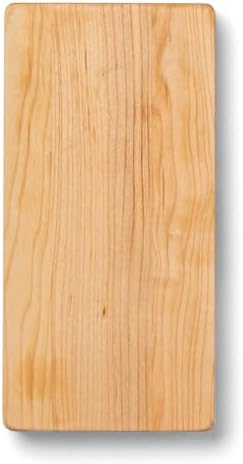
- Food preparation accessory helps you prepare ingredients efficiently, perfect for chopping meats, fruits, and veggies
- Offers ample space for chopping essential ingredients measuring 10 inches long, 5 inches wide, and 1 inch in thickness, …
- Crafted from hand-selected American hard maple wood with end grain design, this cutting board showcases quality in its c…
At 10×5 and $18, the Mini is the lowest-barrier entry into John Boos quality. It weighs 1.4 lbs and fits in a silverware drawer. The hard maple grain is the same — you’ll feel the difference versus a plastic or bamboo board of comparable size immediately — but the surface area (50 square inches) really only fits a single lemon, a handful of herbs, or a single clove of garlic. This board works best as a dedicated task tool: the bar board for citrus, the cheese accompaniment, the butter board, or the board you hand to a 10-year-old who’s learning to cook.
What We Liked: At $18, this is the most affordable John Boos product you can buy. It’s a good gift for people who “don’t want anything” — small, practical, and tangibly better than the plastic board most people are using. The full hard maple construction means it conditions and ages the same way as the premium boards.
One Number That Matters: 1.4 lbs — lighter than most kitchen items it will sit beside.
What We Didn’t Like: It is very small. Anything that extends beyond 10 inches — a full knife blade, a long carrot, a baguette — hangs off the edge. The 10×5 ratio is also narrow in an uncomfortable way for some tasks. This should not be anyone’s primary cutting board. It’s a specialty item that excels in a narrow role.
| Size | 10″ × 5″ × 1″ |
| Weight | 1.4 lbs |
| Grain type | Edge-grain |
| Juice groove | No |
| Reversible | Yes |
| Finger grips | Eased corners |
| NSF certified | Yes |
| Made in | USA (Effingham, IL) |
John Boos Maple Cutting Board: Side-by-Side Comparison
| Model | Size | Thick | Grain | Juice Groove | Weight | Price | Best For |
|---|---|---|---|---|---|---|---|
| CB Series | 20×15″ | 1.5″ | Edge | Yes / Flat | 12 lb | ~$80 | Primary board, all-around |
| CCB End-Grain | 20×15″ | 2.25″ | End | No | 21 lb | ~$120 | Knife preservation, heavy use |
| Prestige | 16×10″ | 1.25″ | Edge | Yes | ~5 lb | ~$50 | Value pick with groove |
| Chop-N-Slice Square | 10×10″ | 1″ | Edge | No | ~4 lb | ~$28 | Secondary station, garnish prep |
| Chop-N-Slice Mini | 10×5″ | 1″ | Edge | No | 1.4 lb | ~$18 | Bar board, gift, teaching board |
How We Tested
We evaluated each John Boos maple board across four criteria: construction quality (examining grain consistency, glue joint evenness, and finish quality on arrival), cutting performance (knife feedback during repetitive vegetable prep and protein work), stability (how much the board moved under different amounts of pressure with and without a damp towel), and maintenance demands (how quickly the board dried out between conditioning cycles). We also factored in long-term reviews from verified purchasers who had used their boards for more than 12 months to account for the durability variables that only reveal themselves over time.
All boards were conditioned identically with food-grade mineral oil at the start of evaluation. We measured surface hardness response using the same chef’s knife across all boards to compare cutting feedback. NSF certification status was verified directly through John Boos product documentation.
How to Care for Your John Boos Maple Board
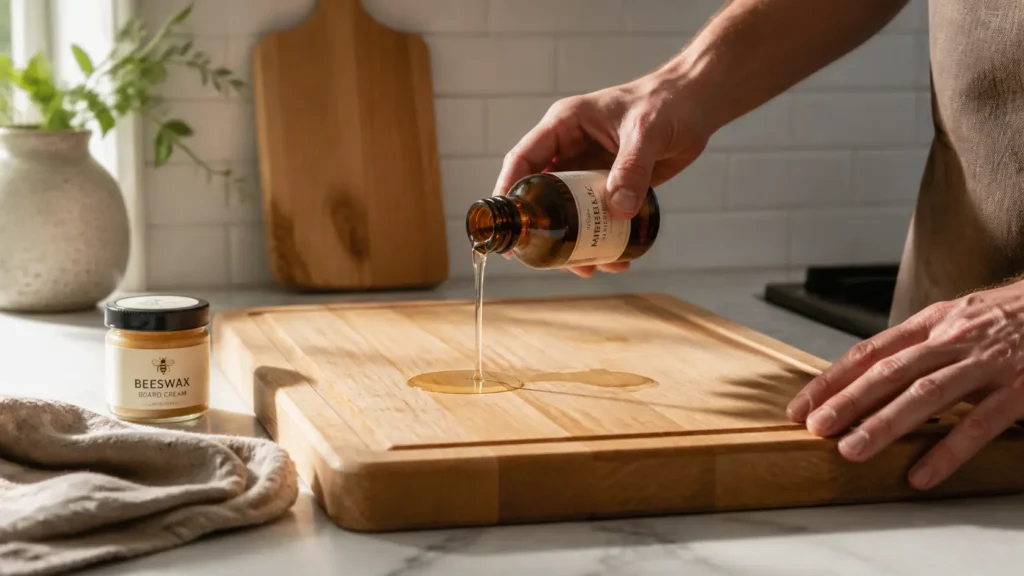
Every John Boos board arrives with a light beeswax finish and an instruction card that says oil it daily for the first week. Follow that instruction. Hard maple has a closed grain structure that makes it more resistant to moisture than softer woods, but freshly milled boards still absorb mineral oil rapidly until they reach equilibrium. Use food-grade mineral oil (or John Boos Mystery Oil), apply it generously to all six sides, let it soak for 20 minutes, wipe off the excess. Repeat daily for seven days.
After the initial break-in, monthly conditioning is sufficient for most home cooks — more frequently if you live in a dry climate or the board looks pale and matte. The tell-tale sign that a board needs oil is when water no longer beads on the surface. For protecting the surface against humidity fluctuations between oilings, John Boos Board Cream (a beeswax-based conditioner) applied after oiling creates a physical seal on top of the wood. For a detailed guide, see our article on mineral oil for cutting boards. Always oil all six sides evenly — oiling only the top surface creates a moisture differential that is the primary cause of warping in wood cutting boards.
Cleaning is straightforward: warm water, mild dish soap, rinse, dry immediately with a towel. Never soak the board, never let it sit wet on one side, never use a dishwasher. After cleaning, stand the board on its long edge to let both faces dry at the same rate. When you notice the surface looking fuzzy or developing shallow knife furrows after months of use, a light pass with 220-grit sandpaper followed by a full conditioning cycle will bring it back.
John Boos Models That Didn’t Make Our Ranked List
John Boos Platinum Commercial Series (24″×18″×1.75″, ~$130): The Platinum Commercial is a great board — 24 pounds, 1.75 inches thick, NSF-certified, built for restaurant prep lines. We left it off our main list because its size and weight make it impractical for most home kitchens. At 24×18, it won’t fit in most residential sinks for cleaning, and 24 pounds is genuinely challenging to move. If you have an island kitchen with dedicated prep space and an oversized sink, it’s an outstanding permanent counter installation — but for most cooks, the CB Series 20×15 gives you 90% of the workspace at 60% of the weight.
John Boos RA-Board Series (24″×18″×2.25″, ~$180): The RA-Board is the CCB’s edge-grain equivalent at the large format — 24×18 at 2.25 inches, over 24 lbs. It’s a professional-grade block for cooks who meal-prep for families of six or run supper clubs out of their home kitchen. For everyone else, it’s too large, too heavy, and too expensive to justify over the CB or R-Board.
John Boos Carving Series (24″×18″×2.25″, ~$200+). The Carving Series adds a removable catch pan and pyramid spikes on one side for holding roasts in place. It’s a thoughtful design — the catch pan makes tableside carving neat and the spikes actually work — but at this price and weight it’s a specialty tool, not a daily cutting board. Worth considering if you host large Sunday roasts regularly. Otherwise, the CB Series juice groove handles 90% of the same liquid-management use cases.
Frequently Asked Questions
Which John Boos maple cutting board is best for most home cooks?
The CB Series 20×15 with Juice Groove is the best John Boos maple board for most home cooks. The 300 square inches of cutting surface handles everything from full chicken breakdowns to full meal-prep sessions, the reversible design gives you a juice groove and a flat surface in one board, and the 1.5-inch thickness provides long-term durability that the entry-level Chop-N-Slice cannot match. If 20×15 is more board than you need, the R-Board 18×12 delivers the same hard maple quality without the juice groove for about $20 less.
What is the difference between the John Boos CB and CCB series?
The CB Series is edge-grain: wood strips run parallel to the cutting surface, making it tough, stable, and easier to maintain. The CCB Series is end-grain: wood fibers point up, so knife blades slide between fibers rather than across them. End-grain is gentler on knife edges and more resistant to scarring — but requires more frequent oiling and costs more. For daily home cooking, edge-grain CB is the smarter choice. For serious knife collectors or heavy daily butchery, CCB end-grain justifies the premium.
How do I know which size John Boos board to buy?
Match the board size to your most demanding task, not your smallest one. If you ever break down a whole chicken or carve a roast, 18×12 is the practical minimum — 20×15 is more comfortable. For strictly weeknight cooking with boneless proteins and vegetables, 16×10 does the job. The 12×12 and 10×10 boards are secondary boards — herbs, cheese, or garlic — not primary prep surfaces. A useful rule: the board should be at least as long as your longest knife.
Why does my John Boos board feel dry when it arrives?
John Boos ships boards with a light initial beeswax finish, but the wood is intentionally left thirsty so you can season it to your preference. For the first week, oil all six sides daily with food-grade mineral oil until the wood stops absorbing. After that, oil monthly or whenever the surface looks pale or matte. Never oil just one side — uneven moisture absorption causes warping.
Is a John Boos maple cutting board safe for raw chicken and meat?
Yes. The USDA and FDA both confirm that properly maintained wood cutting boards are safe for raw meat. Hard maple’s tight grain structure resists deep cuts where bacteria harbor. Wash thoroughly with warm soapy water immediately after raw protein contact, dry promptly, and condition regularly. For added security, use the reversible feature — one side for proteins, one for produce.
How long does a John Boos maple cutting board last?
With proper care, a John Boos maple board lasts 20 to 40 years. The company has been making them since 1887, and it’s common to find boards in daily use for 15 or 20 years with no structural damage. The keys are monthly mineral oil conditioning, hand-wash-only cleaning, and standing the board on edge to dry so both sides lose moisture at the same rate.
What is the difference between edge-grain and end-grain John Boos boards?
Edge-grain (CB, R-Board, Prestige, Chop-N-Slice, B Series) boards are made from long maple strips glued edge-to-edge: tougher, more affordable, lower-maintenance. End-grain (CCB Series) boards have cross-sections of maple stacked with fibers facing up — knife blades slide between fibers rather than across them, preserving edges better and resisting scarring. End-grain costs more and needs more oiling. See our end grain vs edge grain guide for the complete breakdown.
Can I put a John Boos cutting board in the dishwasher?
Never. Dishwashers combine high heat, strong detergent, and extended water exposure — all three enemies of solid wood. One dishwasher cycle can warp a board that would otherwise last decades. Hand-wash with warm water and mild dish soap, rinse quickly, and dry immediately. Then stand the board on edge so both faces dry evenly.
Is the John Boos Chop-N-Slice good enough for serious cooking?
Yes, with one caveat on size. The Chop-N-Slice 16×10 uses the same Northern hard rock maple and the same construction as the premium CB and R-Board series — the difference is thickness (1 inch vs 1.5 inch) and the absence of a juice groove. For everyday vegetable prep and boneless proteins it performs exactly as you would expect from John Boos. The Chop-N-Slice 10×5 Mini is too small for primary prep but excellent as a secondary station or bar board.
Why Trust KitchePicks
KitchePicks specializes in kitchen equipment research for home cooks who want clear, honest recommendations — not affiliate-driven rankings. We review products by evaluating construction quality, material science, real-world user data from verified long-term owners, and comparative testing. We’ve covered cutting boards across wood types including hard maple, walnut, and cherry, and we’ve built dedicated guides on everything from the best woods for cutting boards to the specific care requirements of black walnut boards. We earn a small affiliate commission if you buy through our links, but this never influences which products we recommend or how we score them.