You’ve just installed a sleek new induction cooktop or brought home a portable induction burner, placed your favorite skillet on the glass surface, turned it on—and nothing happens. This frustrating scenario plays out in thousands of kitchens because induction cooktops use electromagnetic fields to generate heat, and they only work with cookware compatible with induction. Not every stainless steel, aluminum, or copper pan will heat on induction, which is why understanding compatibility is crucial before you cook or shop. This guide explains exactly what to look for, how to test your existing pans, and which specific pieces deliver the best performance based on hands-on testing and real cooking scenarios—from searing steaks to simmering delicate sauces.
Some of Our Favorite Induction-Compatible Cookware
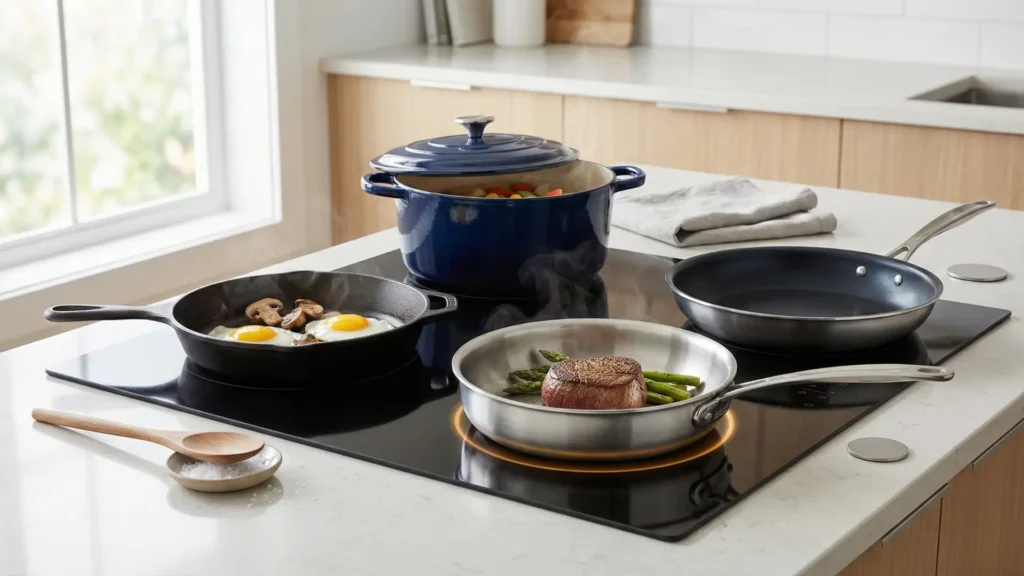
- A Durable, Affordable Cast Iron Skillet: Naturally magnetic with excellent heat retention and a flat base that sits perfectly on induction zones, ideal for searing and baking.
- A Versatile Tri-Ply Stainless Steel Sauté Pan: Fully clad construction with responsive heating, straight sides for shallow braises, and helper handles for safe maneuvering.
- An Induction-Ready Nonstick Fry Pan: Aluminum body with a bonded magnetic base plate for quick, even heating and effortless egg cooking.
- A Heavy-Duty Enameled Cast Iron Dutch Oven: Perfect for stews, bread baking, and braises, with a magnetic iron core and oven-safe enamel finish.
- A Flat-Bottomed Carbon Steel Wok: Fast-heating and naturally magnetic, designed for high-heat stir-frying with maximum contact on induction cooktops.
- A Multi-Clad Stainless Steel Stockpot: Large capacity with even heat distribution from base to rim, preventing scorching during long simmers.
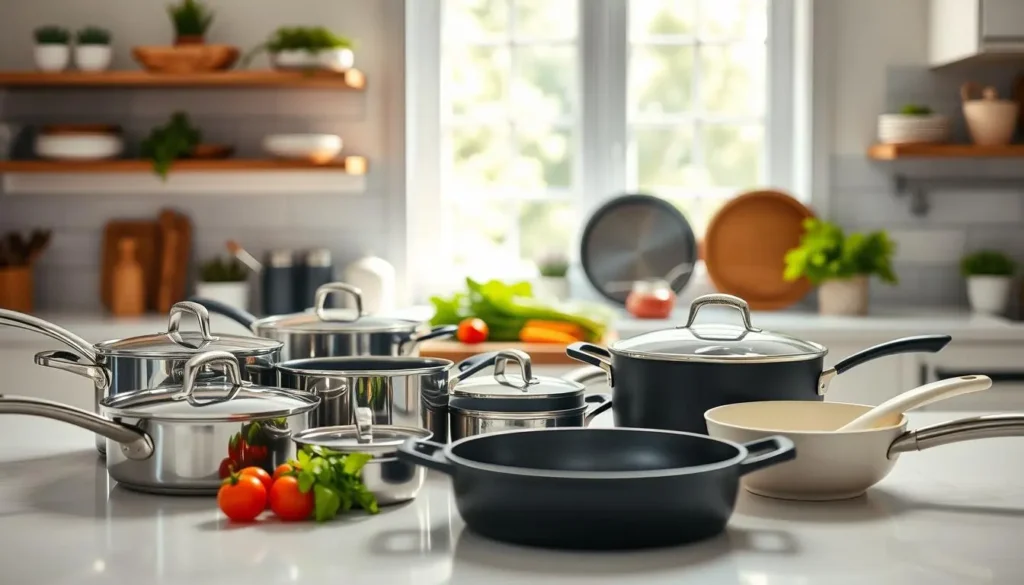
- A Complete Induction-Compatible Cookware Set: Fully clad or disk-bottom construction across all pieces, smart size assortment, and no filler items.
How Induction Cooktops Work (And Why Not All Cookware Is Compatible)
Induction cooktops use an electromagnetic coil beneath the glass surface to create a magnetic field that directly heats cookware containing ferromagnetic material—primarily iron or magnetic stainless steel. When you place a compatible pot or pan on the burner, the magnetic field agitates the molecules within the metal, generating heat inside the cookware itself rather than heating the cooktop surface. This means the glass remains relatively cool while your pan becomes the heat source, which is why non-magnetic pans simply won’t heat at all.
This electromagnetic principle is why some stainless steel, copper, and aluminum pans don’t work unless they feature a bonded magnetic base layer specifically engineered for induction compatibility. Pure aluminum, copper, glass, and ceramic cookware lack the necessary magnetic properties and will trigger an error message or simply fail to activate the burner.
The benefits of this technology are significant: induction cooking offers restaurant-quality responsiveness with instant temperature changes, exceptional energy efficiency since heat goes directly into the cookware, precise control down to single-degree increments on many models, and a cooler kitchen environment since the surrounding glass surface doesn’t radiate excess heat.
What Makes Cookware Compatible With Induction?
To be cookware compatible with induction, a piece must meet several practical criteria beyond simply being metal. First and most importantly, it needs a magnetic base made from ferromagnetic material such as cast iron, carbon steel, or certain grades of stainless steel. The base must be thick and completely flat to make solid, consistent contact with the glass cooktop surface—warped or uneven bases create air gaps that reduce heating efficiency and may cause the pan to wobble.
Base diameter also matters significantly: the pan must adequately cover the induction zone to trigger the sensor and heat efficiently. Many induction cooktops automatically shut off or display an error code if the cookware base is too small relative to the burner size, typically requiring at least 4–5 inches of magnetic surface area for smaller zones and 7–8 inches for larger burners.
The magnet test is your simplest compatibility check: take a standard refrigerator magnet and place it flat against the bottom of your pan. If the magnet sticks firmly and doesn’t slide off when you turn the pan upside down and give it a gentle shake, the cookware will work on induction. If the magnet barely clings or falls off immediately, the pan lacks sufficient magnetic material and won’t heat reliably—or at all. Keep in mind that a very weak attraction can mean poor coupling and inconsistent performance, so look for strong magnetic grip.
When shopping, check the bottom of cookware for induction compatibility markings—a coiled spring symbol or text stating “induction ready” or “suitable for all cooktops”. Always verify manufacturer specifications online if the packaging isn’t clear, since visual inspection alone can be misleading with multi-layer construction.
Induction adapter disks or diffuser plates do exist for using non-magnetic cookware, but they significantly compromise the speed, efficiency, and precise control that make induction cooking appealing. These disks essentially act as a middleman that heats first, then transfers heat to your pan—negating many of induction’s advantages.
Which Materials Are Compatible With Induction?
You don’t need to replace your entire cookware collection when switching to induction; many popular materials work beautifully, though each brings distinct performance characteristics to the cooktop. Understanding how different materials behave on induction helps you make smart upgrade decisions and maximize what you already own.
Cast Iron and Enameled Cast Iron
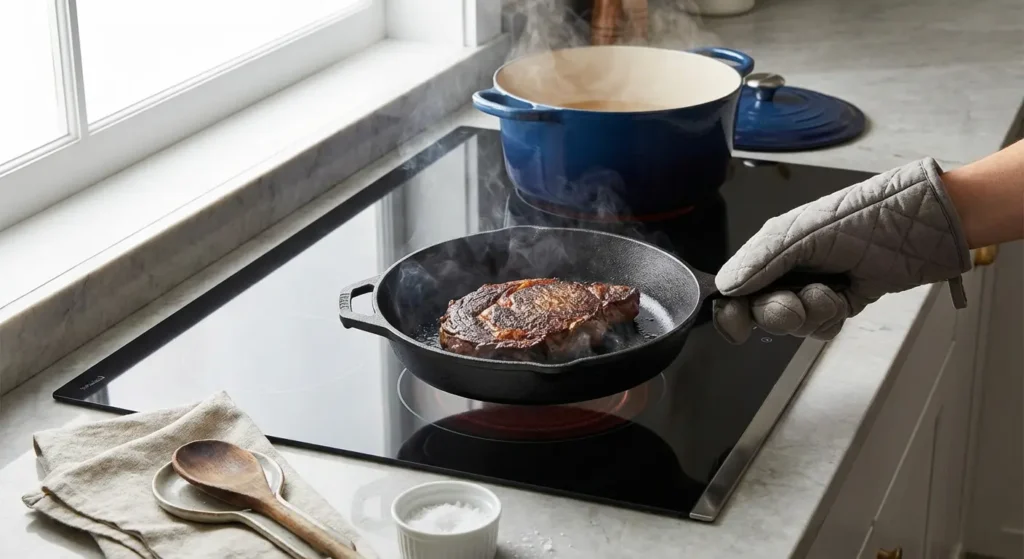
Bare cast iron and enameled cast iron are naturally 100% induction compatible because they’re made primarily of iron, a highly ferromagnetic material. Cast iron excels at heat retention, making it ideal for searing thick steaks, browning chicken thighs, baking cornbread, and executing long braises that hold steady temperatures. Enameled versions offer the same magnetic compatibility with easier maintenance and no seasoning requirements.
The main considerations on induction are weight and surface care: cast iron is heavy and can scratch or crack glass cooktops if dragged or dropped, so always lift rather than slide. Cast iron also responds more slowly to temperature adjustments compared to thinner metals, since the dense material takes time to heat and cool. Typical uses include skillets for searing and baking, Dutch ovens and braisers for stews and bread, grill pans, and tagines.
Stainless Steel and Multi-Clad
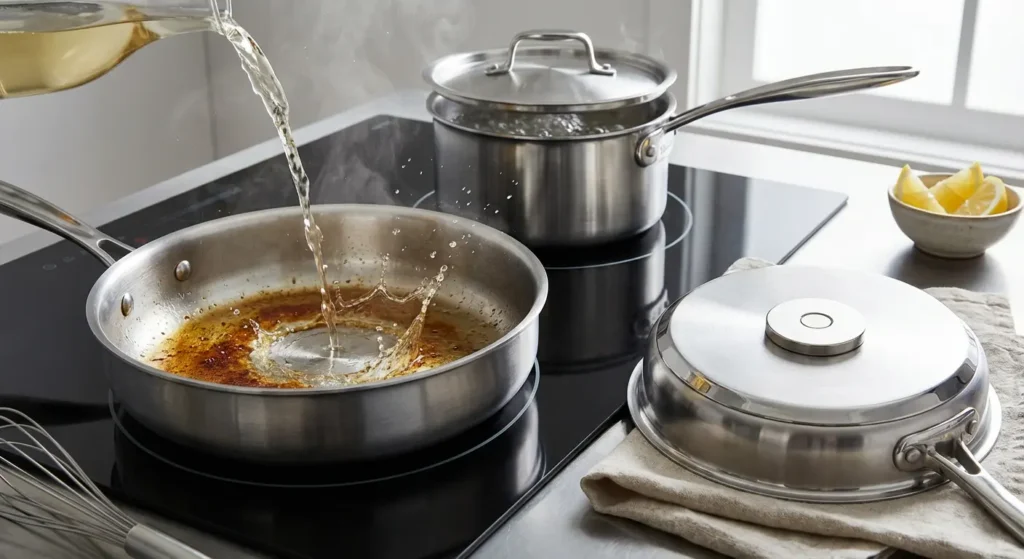
Not all stainless steel contains enough ferromagnetic material to work on induction, but many fully clad (tri-ply, 5-ply, or 7-ply) pans feature magnetic stainless steel exterior layers bonded to aluminum or copper cores, making them fully compatible. Multi-ply stainless is often considered the most versatile choice for induction cooking because it balances responsive heating, excellent durability, compatibility with all cooktops, including gas and electric, and the ability to develop fond for pan sauces.
Disk-bottom stainless steel cookware—where a thick magnetic plate is bonded to the base while the walls remain thin stainless—also works well on induction and can be more affordable, though heat distribution up the sides is less uniform than fully clad construction. Always test stainless pieces with a magnet, especially older or imported cookware, since certain stainless steel grades (particularly 18/0 composition) are magnetic while others (like some 18/10 blends) are not.
Carbon Steel
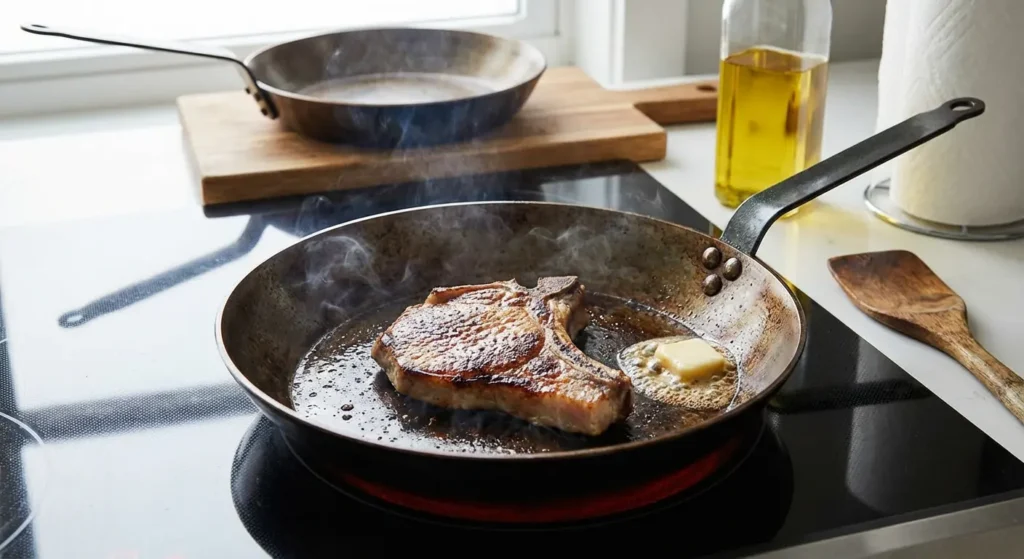
Carbon steel is composed of approximately 99% iron and 1% carbon, making it fully magnetic and induction compatible with no modifications needed. Carbon steel pans are similar to cast iron in composition but typically thinner and significantly lighter, offering faster heat response and easier handling. They excel at high-heat searing, browning, and wok cooking, and when properly seasoned, develop a natural nonstick-like patina.
On induction, carbon steel heats quickly and responds immediately to power adjustments, but very thin pans can warp if exposed to maximum induction power from a cold start. Quality carbon steel cookware with slightly thicker gauge metal (14–16 gauge for skillets, slightly thinner for woks) minimizes warping risk. Carbon steel requires seasoning and hand-washing to maintain the patina, and it will rust if stored wet.
Aluminum and Nonstick With Induction Bases
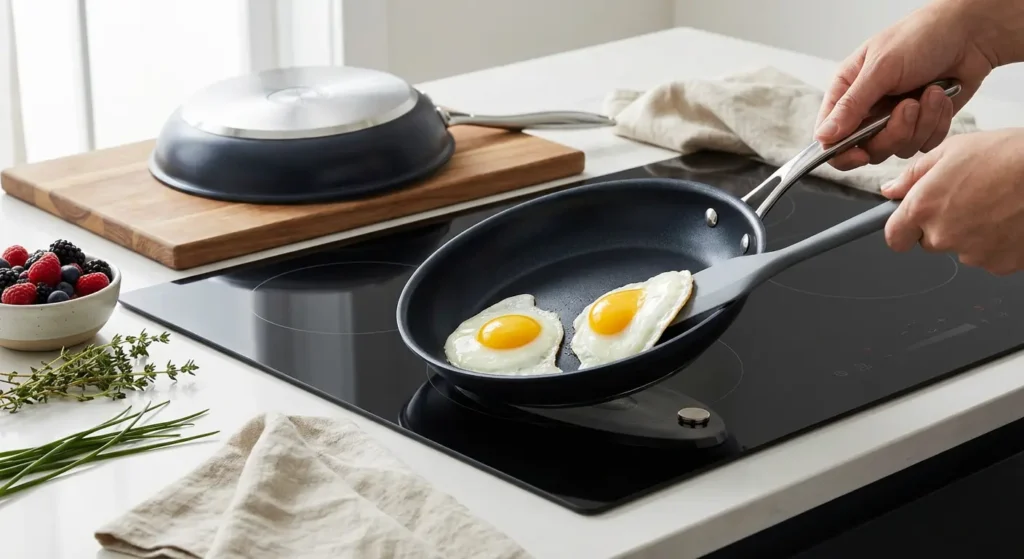
Pure aluminum and traditional nonstick cookware with aluminum bodies are not magnetic and won’t work on induction unless the manufacturer bonds a steel or magnetic stainless steel base plate to the bottom. Many modern “induction-compatible nonstick skillets” use this construction: a lightweight aluminum body for even heating and quick response, plus a thick magnetic disk at the base for induction compatibility.
These pans offer excellent convenience for cooking eggs, pancakes, delicate fish, and quick weeknight meals with minimal oil and easy cleanup. However, the nonstick coating has a limited lifespan (typically 2–5 years with proper care), and some induction-ready nonstick pans can buzz or click during use if the magnetic base layer is thin or not perfectly flat against the cooktop. Ceramic nonstick cookware follows the same principle, with an aluminum or stainless core and bonded magnetic base.
Copper, Clad Copper, and Other Specialty Bases

Pure copper cookware is typically not induction compatible because copper is non-magnetic. However, some premium copper cookware lines feature a bonded stainless steel or iron base layer specifically added to enable induction use while preserving copper’s superior thermal conductivity in the body of the pan. These hybrid copper pieces are niche, expensive, and require careful verification of induction compatibility through product specifications or the magnet test, since not all copper cookware includes the magnetic layer. If you own traditional copper cookware and want to use it on induction, an adapter disk is your only option, though performance will be compromised.
How To Test If Your Cookware Is Induction Compatible
Before investing in new pans, test what you already own using these simple methods to identify compatible pieces and avoid unnecessary purchases.
The magnet test is your first and easiest check: grab any refrigerator magnet and hold it firmly against the flat bottom center of your cookware. If the magnet sticks securely and doesn’t slide off when you flip the pan upside down and shake it gently, the cookware is induction compatible. If the magnet barely grabs or falls off immediately, that piece won’t work. Test both the center and edges of the base, since some disk-bottom pans have magnetic centers but non-magnetic rims.
Live cooktop testing provides the definitive answer: place the pan on an induction burner, select medium power, and observe whether the cooktop engages or displays an error code. Compatible cookware will trigger the burner within seconds and begin heating; incompatible pieces will cause the cooktop to beep, flash an error message like “no pan detected,” or simply shut off.
Common failure scenarios include warped bases that rock on the glass surface, reducing contact area and causing intermittent heating or automatic shutoff. Very small pans—typically those with base diameters under 4–5 inches—may not cover enough of the induction coil to activate the sensor, even if they’re magnetic. Some thin pans, especially inexpensive disk-bottom stainless or lightweight aluminum nonstick, produce noisy buzzing, clicking, or humming sounds when used on induction due to vibration between the metal layers in the base.
Test your entire existing collection systematically before shopping, marking compatible pieces with a small dot of nail polish or tape on the handle so you can quickly identify them. You may discover that you only need to replace a few key items rather than buying a complete new set.
Best Cookware Compatible With Induction by Type
Each category below highlights what makes that piece essential for induction cooking and what features to prioritize when selecting your own version for testing or purchase.
Best Induction-Compatible Nonstick Skillet
A quality nonstick skillet is indispensable for cooking eggs, pancakes, delicate fish fillets, and quick weeknight stir-fries with minimal oil and effortless cleanup. On induction, look for a thick, fully magnetic base that makes complete contact with the glass—thin or warped bases cause uneven heating and hot spots that can damage the nonstick coating prematurely.
The best induction nonstick skillets feature an aluminum body for fast, even heat distribution, a bonded steel or magnetic stainless base plate for reliable induction coupling, and oven-safe construction to at least 400–450°F so you can start dishes on the cooktop and finish them under the broiler. A comfortable, stay-cool handle that’s securely riveted (not just welded) provides confident control when flipping or transferring food.
Tramontina Professional Aluminum Nonstick Fry Pan, 10-Inch

- Generous 16-Quart Capacity: Perfect for preparing large batches of soups, stews, stocks, boiling pasta, and more.
- Tri-Ply Base: Features an impact-bonded tri-ply base for excellent heat distribution and even cooking, ideal for everyth…
- Durable 18/10 Stainless Steel: Crafted from high-quality 18/10 stainless steel for lasting durability and a beautiful sh…
Tramontina’s professional-grade nonstick skillet delivers exceptional value with heavy-gauge aluminum construction and a specially designed magnetic base for reliable induction performance. The reinforced PTFE nonstick interior ensures effortless food release and easy cleanup, while the ergonomic handle stays comfortable during cooking. This pan heats quickly and evenly on induction cooktops, eliminating hot spots that can damage nonstick coatings over time.
Key specs to look for:
- Heavy-gauge aluminum body with magnetic steel base
- Reinforced PTFE nonstick coating
- Oven-safe to 400°F
- Dishwasher-safe (hand-washing extends coating life)
- Lifetime warranty
Best for: Budget-conscious home cooks who want a reliable everyday pan for eggs, omelets, and quick sautés, or anyone seeking low-fat cooking with easy cleanup.
Best Induction-Friendly Ceramic Pan
Ceramic nonstick cookware appeals to cooks avoiding PTFE-based coatings, offering a naturally derived, sand-based nonstick surface that’s free from PFAS chemicals. Most ceramic pans use an aluminum body for even heating plus a bonded magnetic base to enable induction compatibility.
However, ceramic nonstick coatings are generally more delicate than PTFE and more prone to staining, scratching, and loss of nonstick properties over time, especially if overheated. On induction, ceramic pans perform best at low to medium power settings—high heat can degrade the coating quickly. Look for ceramic cookware with a 5-ply stainless-steel clad base for maximum durability and heat distribution.
GreenPan Valencia Pro Ceramic Nonstick Fry Pan, 10-Inch

- SET INCLUDES: 10” frypan, 12” frypan
- CUTTING-EDGE CERAMIC NONSTICK: Infused with diamonds, GreenPan’s metal utensil safe ceramic nonstick offers remarkable d…
- TOXIN-FREE: Our signature ceramic nonstick coating is free of PFAS, PFOA, lead or cadmium.
GreenPan’s Valencia Pro line features a diamond-reinforced ceramic nonstick coating that’s PFAS-free and designed to withstand higher temperatures than standard ceramic. The hard-anodized aluminum body with magnetic base ensures even heating on induction cooktops, while the stainless steel handle provides a secure, comfortable grip.
Key specs to look for:
- Hard anodized aluminum body with magnetic base
- Diamond-reinforced ceramic nonstick coating (PFAS-free)
- Oven-safe to 600°F
- Dishwasher-safe
- Metal utensil safe
Best for: Health-conscious cooks who prefer PTFE-free nonstick and are willing to use gentler heat and more careful maintenance to preserve coating longevity.
Best Cast Iron Skillet for Induction Cooktops
A cast iron skillet is a true kitchen workhorse, perfect for searing thick steaks, roasting whole chickens, baking cornbread or Dutch baby pancakes, and even cooking pizza on the cooktop. Cast iron’s exceptional heat retention makes it ideal for tasks requiring sustained high temperatures, and it’s naturally 100% induction compatible.
On induction cooktops, prioritize cast iron with a perfectly flat, smooth base—check by placing the cold pan on a flat surface and pressing the center; it shouldn’t rock or wobble. Avoid extremely thin or lightweight cast iron, which can warp on high induction power. Look for pre-seasoned skillets with helper handles on larger sizes (12-inch and up) to make lifting easier and safer.
Lodge Cast Iron Skillet, 12-Inch

- CAST IRON SKILLET is 10.25 inches in diameter and includes red silicone hot handle holder. An improvement on the origina…
- SEASONED CAST IRON COOKWARE. A good seasoning makes all the difference. Lodge seasons its cookware with 100% vegetable o…
- CAST IRON provides superior heat retention and is unparalleled for even cooking. Lodge Cast Iron Skillets are at home in…
Lodge’s iconic 12-inch cast iron skillet has been a kitchen staple for over 125 years, offering unbeatable durability and heat retention at an affordable price. Pre-seasoned with natural vegetable oil for immediate use, this American-made skillet features Lodge’s signature teardrop handle design and a helper handle for safe maneuvering. The flat, machined base sits securely on induction cooktops and delivers excellent heat distribution.
Key specs to look for:
- Pre-seasoned cast iron construction
- Flat machined base for induction compatibility
- Helper handle for balance and control
- Oven-safe to 500°F+
- Hand-wash only
Best for: Serious home cooks who want a pan that can handle high-heat searing, oven-to-table presentation, and decades of heavy use with proper care.
Best Dutch Oven for Induction Cooktops
An enameled cast-iron Dutch oven is one of the most versatile pieces in any kitchen, equally capable of braising short ribs, simmering chili, baking no-knead bread, deep-frying chicken, and roasting vegetables. The heavy lid traps moisture and heat, creating an ideal environment for low-and-slow cooking, while the iron core provides natural induction compatibility.
Look for Dutch ovens with smooth, chip-resistant enamel interiors in light colors (cream or white) so you can monitor fond development and browning. Tight-fitting lids with steam vents prevent boil-overs during long simmers. Wide loop handles on both pot and lid make handling safer when wearing oven mitts, and oven-safe construction to at least 500°F enables versatile cooking methods.
Amazon Basics Enameled Cast Iron Dutch Oven, 6-Quart
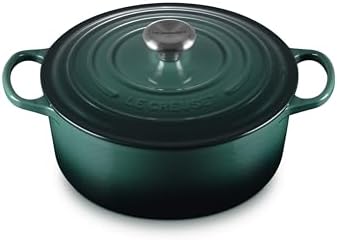
- Enameled cast iron delivers superior heat distribution and retention
- Ready to use, requires no seasoning
- Easy-to-clean and durable enamel resists dulling, staining, chipping and cracking
The Amazon Basics enameled Dutch oven delivers exceptional value, offering the same performance as premium brands at a fraction of the cost. Built with durable cast iron and finished with a smooth, easy-to-clean enamel coating, this 6-quart pot features sturdy side handles and a tight-fitting lid for moisture retention. After years of testing, users report that the enamel maintains its nonstick properties without chipping or rusting, even with regular use.
Key specs to look for:
- Enameled cast iron construction
- 6-quart capacity
- Induction-compatible base
- Oven-safe to 500°F
- Tight-fitting lid with heat-resistant knob
Best for: Home cooks who want one pot that can braise, bake bread, deep-fry, and serve at the table, justifying the investment through years of multi-purpose use.
Best Wok for Induction Cooktops
Traditional round-bottomed woks don’t work well on flat induction surfaces, but flat-bottomed carbon steel woks are specifically designed for induction and deliver excellent high-heat stir-fry performance. Carbon steel’s thin gauge heats quickly and responds instantly to temperature changes, essential for proper wok cooking technique where ingredients move rapidly between hot and cooler zones.
Look for flat-bottomed woks with wide bases (at least 6–7 inches) to ensure good induction coil coverage and heat distribution. Carbon steel woks require seasoning before first use and regular maintenance to build and preserve a natural nonstick patina. Choose models with comfortable, stay-cool handles—either a long handle with a short helper handle opposite, or two short loop handles for maneuverability.
Yosukata Carbon Steel Wok, 13.5-Inch
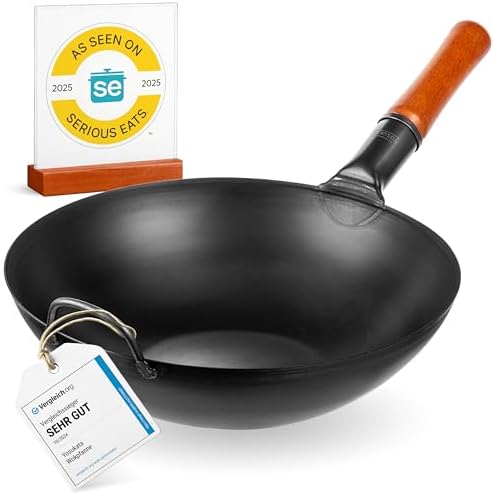
- GENUINE TASTE: Bring authentic wok flavor to your kitchen or outdoor cooking with the YOSUKATA 13.5” flat-bottom carbon …
- PRE-SEASONED: : Unlike many stir fry pans, this carbon steel wok is pre-seasoned at over 600°F using advanced techniques…
- HEAVY-DUTY MATERIALS AND ERGONOMIC HANDLE: Crafted from high-grade black carbon steel, this extra large wok delivers exc…
Yosukata’s flat-bottomed carbon steel wok is pre-seasoned and ready to use on induction cooktops, featuring a wide, flat base for excellent heat coverage and wooden handles that stay cool during cooking. The 13.5-inch diameter provides ample space for stir-frying family-sized portions, while the pre-seasoned surface offers natural nonstick properties that improve with use. This wok heats quickly and evenly on induction, making it ideal for achieving authentic wok hei.
Key specs to look for:
- Pre-seasoned carbon steel construction
- Flat bottom with 7+ inch diameter for induction coverage
- Wood handles (stay cool)
- Oven-safe to 500°F+
- Includes lid
Best for: Home cooks who frequently stir-fry vegetables, proteins, and noodles at high heat and want authentic wok performance on an induction cooktop.
Best Stockpot for Induction Cooktops
A large stockpot is essential for making soups, stocks, pasta water, seafood boils, and batch cooking. On induction, fully clad stainless steel or heavy-gauge disk-bottom pots heat more evenly and help prevent scorching during long simmers compared to thin, single-layer pots.
Look for stockpots with 8–12 quart capacity for versatility, sturdy loop handles that stay relatively cool during cooking, tight-fitting lids to reduce evaporation, and measurement markings inside for convenience. Tri-ply or 5-ply construction ensures even heat from base to rim, while thick disk-bottom pots concentrate superior heating at the base where it’s needed most for boiling.
Farberware Classic Series Stainless Steel Stockpot

- QUICK TO HEAT STAINLESS STEEL: Cookware features full cap bases with stainless steel layered over thick aluminum cores f…
- ICONIC STYLE: Comfortable handles with iconic styling provide a confident grasp and stainless steel lids boast bell shap…
- DISHWASHER SAFE: Dishwasher safe (nonstick frying pans excepted) for easy cleanup
Farberware Classic Series Stainless Steel stockpot combines affordability with reliable induction performance, featuring a full-cap aluminum core base for even heat distribution and durability. The mirror-polished stainless steel exterior resists tarnishing, while the comfortable handles with iconic styling provide a secure grip even when the pot is full. The self-basting lid locks in moisture and heat, making this stockpot ideal for long simmers and batch cooking.
Key specs to look for:
- Stainless steel construction with aluminum core base
- 12-quart capacity
- Induction compatible
- Oven-safe to 350°F
- Dishwasher-safe
Best for: Home cooks who make large batches of stock, soup, or pasta and need reliable, even heating without hot spots or scorching.
Best Sauté Pan for Induction Cooktops
Sauté pans feature straight sides and large, flat cooking surfaces, making them ideal for searing proteins, then building pan sauces, shallow braising, one-pan meals, and high-volume sautéing of vegetables. The straight sides contain splatter better than skillets and maximize usable cooking surface area.
On induction, look for fully clad stainless steel construction for responsive heating and durability, comfortable helper handles to balance the weight when full, tight-fitting lids for simmering and braising, and oven-safe construction so you can move seamlessly from cooktop to oven. Three- to 5-quart capacity handles most tasks without being unwieldy.
Cuisinart Chef’s Classic Stainless Steel Sauté Pan, 3.5-Quart
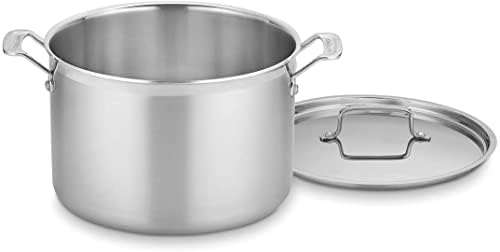
- Updated cast-stainless-steel handle stays cool to the touch and comes riveted for strength
- 12-quart saucepot made of 18/10 stainless steel with solid aluminum core
- Rims are tapered for drip-free pouring
Included in Cuisinart’s Chef’s Classic cookware line, this 3.5-quart sauté pan features an aluminum encapsulated base that heats quickly and distributes heat evenly on induction cooktops. The pure stainless steel interior won’t react with acidic foods, and the helper handle opposite the main handle provides balanced control when moving the pan. The tight-fitting stainless steel lid locks in heat and moisture for perfect braising results.
Key specs to look for:
- Tri-ply construction (stainless steel with aluminum core)
- 3.5-quart capacity
- Helper handle for balance
- Tight-fitting stainless steel lid
- Oven-safe to 500°F
- Dishwasher-safe
Best for: Home cooks who want one versatile pan for searing, sautéing, braising, and one-pan dinners with the flexibility to finish dishes in the oven.
Best Saucier or Saucepan for Induction
Sauciers feature gently curved sides that make whisking smooth sauces, risottos, and pastry creams easier, while traditional saucepans have straight sides better suited for boiling grains, heating liquids, and cooking pasta. Both are essential for everyday cooking tasks like reheating soups, making oatmeal, blanching vegetables, and preparing side dishes.
For induction use, prioritize even heating to prevent scorching delicate sauces—fully clad stainless steel construction distributes heat uniformly from base through the walls. Look for comfortable, ergonomic handles that stay cool, pouring rims for clean transfers, snug-fitting lids, and 2–3 quart capacity for typical household tasks. Some sauciers and saucepans come with measurement markings etched inside, a helpful feature for recipes.
Cuisinart Chef’s Classic Stainless Steel Saucepan, 3-Quart

- Stainless Steel
- Imported
- EXCEPTIONAL DESIGN: Enjoy mirror finish, classic look and professional performance. Aluminum encapsulated base heats qui…
Cuisinart’s 3-quart saucepan with lid delivers professional-quality performance at a consumer-friendly price, featuring an aluminum encapsulated base for even heating and induction compatibility. The pure stainless steel cooking surface maintains food flavors without reactivity, while the tight-fitting lid helps retain heat and nutrients. Measurement markings inside the pan eliminate guesswork when following recipes.
Key specs to look for:
- Stainless steel construction with aluminum core base
- 3-quart capacity
- Interior measurement markings
- Tight-fitting lid
- Oven-safe to 500°F
- Dishwasher-safe
Best for: Everyday cooking tasks requiring medium-sized pots with precise temperature control and even heating to prevent scorching.
Best Small Pan for Induction (Eggs, Butter, Sauces)
Small 1–2 quart saucepans and 6–8 inch mini skillets are incredibly useful for single servings, warming baby food, melting butter, making small-batch sauces, toasting spices, and cooking one or two eggs. On induction, small pans must still have sufficient base diameter to trigger the burner sensor reliably—typically 4–5 inches minimum.
Look for lightweight but well-balanced construction, responsive heating for quick tasks, comfortable handles sized appropriately for one-handed use, and nonstick coating if you’ll primarily use it for eggs. Small pans heat and cool quickly on induction, making them ideal for tasks requiring precise, responsive temperature control.
Cuisinart Chef’s Classic Stainless Steel Saucepan, 1.5-Quart

- Stainless Steel
- Chef’s Choice Stainless: Mirror finish. Classic looks, professional performance.
- Unsurpassed Heat Distribution: Aluminum encapsulated base heats quickly and spreads heat evenly. Eliminates hot spots.
Perfect for single servings and small-batch cooking, Cuisinart’s 1.5-quart saucepan features the same aluminum encapsulated base technology as the larger pans in the line, ensuring even heating on induction cooktops. The compact size heats quickly for tasks like melting butter, warming sauces, or making oatmeal for one, while the stay-cool handle provides comfortable control.
Key specs to look for:
- Stainless steel with aluminum core base
- 1.5-quart capacity
- 5+ inch base diameter for induction sensor activation
- Tight-fitting lid
- Oven-safe to 500°F
- Dishwasher-safe
Best for: Small households, solo cooks, and anyone who frequently prepares single servings, sauces, or small-batch recipes requiring nimble, responsive cookware.
Best Induction-Compatible Cookware Set
Cookware sets offer convenience and value by bundling essential pieces at a lower per-item cost than buying individually, but quality varies widely. The best induction-compatible sets feature fully clad or well-designed disk-bottom construction across all pieces, a smart mix of sizes without filler items like tiny saucepans you’ll never use, and lids that fit multiple pans for versatility.
Avoid sets with pieces that overlap in function (three nearly identical saucepans) or include low-quality nonstick that will need replacing within a year. The ideal starter set includes an 8–10 inch skillet, 12-inch skillet or sauté pan, 2-quart and 3-quart saucepans, and an 8-quart stockpot—enough to handle most cooking tasks. Premium sets may add specialty pieces like sauciers, grill pans, or steamers.
Cuisinart Chef’s Classic Stainless Steel 10-Piece Cookware Set

- 10 piece cookware set includes 8 and 10 inch fry pans, 2 and 3 quart covered saucepans, 3 quart covered sauté pan, 8 qua…
- Fast and Even Heat – D3 tri-ply is fully bonded to the rim for professional performance & durability. The high quality 1…
- Design You Will Love – D3 has a professionally polished stainless steel finish. Our classic, double riveted stainless st…
Cuisinart’s Chef’s Classic set delivers exceptional value with professional-grade construction at a consumer-friendly price point. The 10-piece collection includes 8-inch and 10-inch skillets, 1.5-quart and 3-quart saucepans with lids, 3.5-quart sauté pan with helper handle and lid, and 8-quart stockpot with lid—covering all essential cooking tasks. Each piece features an aluminum encapsulated base for quick, even heating on induction, while the pure stainless steel interiors won’t react with foods and maintain their mirror finish over time.
Key specs to look for:
- Fully encapsulated aluminum base (induction-ready)
- 10 pieces total (6 pans + 4 lids)
- Pure stainless steel cooking surfaces
- Tight-fitting stainless steel lids
- Oven-safe to 500°F
- Dishwasher-safe
- Lifetime warranty
Best for: New home cooks setting up a kitchen from scratch, or experienced cooks replacing an entire incompatible collection and wanting cohesive performance across all pieces.
How To Choose Cookware Compatible With Induction (Buyer’s Checklist)
Use this checklist to evaluate any induction cookware purchase and ensure it meets your needs:
Material & construction: Cast iron and enameled cast iron offer unbeatable heat retention and searing but are heavy; stainless steel (especially fully clad) balances responsiveness, durability, and versatility; carbon steel provides fast heating and natural nonstick when seasoned; aluminum with magnetic bases heats quickly but coating lifespan is limited; ceramic nonstick avoids PTFE but requires gentle care.
Base thickness & flatness: Thick, flat bases ensure even heating, minimize buzzing noises from electromagnetic vibration, and resist warping when exposed to high induction power over time. Warped bases create air gaps that cause hot spots and may trigger auto-shutoff. Check reviews specifically mentioning induction performance and longevity.
Pan size vs induction zone: Match cookware base diameter to your cooktop’s burner zones for efficient heating and to avoid sensor errors. Measure your induction zones and ensure primary cookware has bases within the compatible range—typically 4–12 inches, depending on zone size. Oversized pans waste energy; undersized pans may not activate the burner.
Weight & ergonomics: Balance between sturdy construction and manageable weight matters, especially for frequently used pieces like skillets and sauté pans. Look for comfortable handles that stay cool during cooking, riveted (not welded) handle attachments for durability, and helper handles on pieces over 3 quarts or 3 pounds for safe maneuvering when full.
Oven-safety & temperature limits: Verify maximum oven-safe temperatures, particularly for nonstick and pans with plastic, silicone, or wooden components. Bare cast iron and stainless steel typically handle 500°F+, while nonstick and ceramic coatings often max out at 350–450°F. Lid handles may have different limits than pot handles.
Care & maintenance: Dishwasher-safe stainless steel offers convenience, but hand-washing extends cookware life regardless of claims. Cast iron and carbon steel require seasoning, immediate drying, and hand-washing. Enameled cast iron needs gentle cleaners and avoidance of thermal shock. Nonstick and ceramic coatings last longer with hand-washing, low-medium heat, and soft utensils despite “dishwasher-safe” labels.
Budget tiers: Excellent induction cookware exists at every price point—you don’t need premium brands to get good performance. Budget options ($20–60 per piece) work well for starter sets and frequently replaced items like nonstick skillets. Mid-range ($60–150 per piece) offers better materials and construction for heirloom-quality pieces. Premium ($150+ per piece) provides top-tier materials, craftsmanship, and warranties but isn’t necessary for most home cooks.
Care and Maintenance Tips for Induction Cookware
Proper care protects both your cookware and your induction cooktop’s glass surface, extending the life of both investments.
To avoid scratching the glass cooktop, always lift heavy pans—especially cast iron and enameled cast iron—instead of sliding them across the surface. Keep cookware bases clean and completely dry before placing them on the cooktop, since burned-on residue or moisture can cause sticking and damage. Wipe up spills immediately before they bake onto the warm glass around the pan.
Cast iron & carbon steel: Build and maintain seasoning by cooking with oil regularly, avoiding long soaks in water that strip seasoning, and thoroughly drying after washing to prevent rust. Re-season as needed when food starts sticking or rust spots appear. Store with a paper towel between the pan and lid to allow air circulation.
Enameled cast iron: Use gentle, non-abrasive cleaners like baking soda paste for stubborn stains; avoid metal utensils that can chip enamel; never expose hot cookware to cold water or vice versa to prevent thermal shock that can crack enamel. Heat and cool gradually rather than shocking the cookware with extreme temperature changes.
Stainless steel & multi-clad: Remove rainbow discoloration and heat stains with white vinegar or Bar Keeper’s Friend; use non-abrasive sponges and cleaners; deglaze hot pans with water or wine to prevent stuck-on food; dishwasher-safe but hand-washing preserves shine.
Nonstick & ceramic: Use low to medium heat only—high heat degrades coatings rapidly; avoid cooking sprays that build up sticky residue and damage nonstick surfaces; use only silicone, wood, or plastic utensils; hand-wash even if labeled “dishwasher-safe” to extend coating life. Replace nonstick pans when coating shows scratches, peeling, or food begins sticking.
Avoid sudden temperature shocks on induction, such as running cold water into a pan heated to maximum power, as this thermal stress can promote warping in thinner cookware over time. Let pans cool naturally for a minute before washing, or use warm water for rinsing.
FAQs About Cookware Compatible With Induction
How do I know if a pan is induction compatible?
Use the magnet test: place a refrigerator magnet flat against the bottom of the pan, and if it sticks firmly without sliding off when inverted, the cookware is induction compatible. You can also check for an induction symbol (coiled spring) stamped on the bottom or in product descriptions, or look for terms like “induction ready” or “suitable for all cooktops” on packaging.
Can I use induction cookware on gas and electric stoves?
Yes, almost all induction-compatible cookware works perfectly on gas, electric coil, and radiant glass cooktops with very few exceptions. Induction compatibility requires magnetic properties, but those properties don’t interfere with traditional heating methods—in fact, many cooks prefer induction-ready cookware for its quality construction regardless of cooktop type.
Do I need special pans for induction or will my current set work?
Test your current pans first using the magnet test before buying replacements. Many existing stainless steel, cast iron, and carbon steel pans already work on induction. You may only need to replace non-magnetic pieces like aluminum or copper cookware without magnetic bases, potentially saving hundreds of dollars versus buying a complete new set.
Why does my induction cooktop make noise with some pans?
Buzzing, clicking, or humming sounds occur when electromagnetic fields cause vibration between thin metal layers in the cookware base. Lightweight pans with thin magnetic base plates or loose-bonded disk bottoms are most prone to noise. Heavier, thicker pans with solid construction typically run much quieter, and the noise doesn’t indicate damage or poor performance—just physics at work.
Is cast iron safe to use on a glass induction cooktop?
Yes, cast iron works beautifully on induction cooktops with proper handling. Keep the base clean and smooth to avoid scratching. Always lift rather than slide the pan, and be mindful of the weight when setting it down. Consider placing a thin silicone mat or towel under the pan if you’re concerned about scratches, though this slightly reduces heating efficiency.
Can induction-friendly cookware go in the oven?
It depends on the specific materials and components—always check manufacturer guidelines. Cast iron and most stainless steel pieces are oven-safe to 500°F or higher, while many nonstick pans max out at 350–450°F, depending on coating type and handle materials. Lids may have different temperature limits than the pan body, especially if they feature plastic, silicone, or wooden components.
Final Verdict
Once you understand what makes cookware compatible with induction—a magnetic, flat, well-constructed base in materials suited to your cooking style—choosing the right pans becomes straightforward. Test what you already own with a simple magnet before shopping, and you may discover that your favorite stainless skillet and cast-iron Dutch oven work perfectly. Then invest strategically in a few high-impact upgrades like a quality nonstick skillet for eggs, a stockpot for batch cooking, and perhaps a carbon steel wok for stir-fries rather than replacing everything at once. With the right induction-compatible cookware, you’ll enjoy faster heating, precise control, and energy-efficient cooking that transforms your kitchen experience.