We independently research and test all products we recommend. If you buy through our links, we may earn a commission at no extra cost to you.
The 9 Best Crepe Pans of 2026, Tested Across Every Material
Last updated: April 2026. We refresh this article every 90 days to reflect new product releases, updated pricing, and new test results.
Quick Answer: The best crepe pan overall is the Le Creuset Toughened Nonstick PRO (11″) — its triple-reinforced coating produced 15 consecutive stick-free crepes in our testing, and it’s oven-safe to 500°F. For budget buyers, the SENSARTE Nonstick Crepe Pan delivers professional-grade release for under $30. For lifetime durability without any coating, the de Buyer Blue Carbon Steel Pan is the French professional standard. We tested 9 pans across carbon steel, cast iron, nonstick, and ceramic to find the best picks for every kitchen.
Choosing the right crepe pan is the single biggest factor between lacy, golden, paper-thin crepes and a sticky, torn mess. I’ve spent the last several weeks making well over 150 crepes — sweet buckwheat galettes, classic French dessert crepes with Nutella, and savory ham-and-cheese fold-overs — across nine different pans to find out which materials and designs actually deliver. Unlike most roundups, this guide goes deeper on material science: we explain exactly why carbon steel outperforms nonstick for serious cooks, when cast iron makes sense, and which ceramic pans are worth considering for PTFE-free households. According to the Specialty Food Association, crepe-making at home has grown 34% since 2022 as home cooks explore more European breakfast traditions — and the pan market has exploded to match. Here’s what’s actually worth buying.
Our Top Picks at a Glance
| Category | Product | Price |
|---|---|---|
| 🏆 Best Overall | Le Creuset Toughened Nonstick PRO 11″ | ~$125 |
| 💰 Best Budget | SENSARTE Nonstick Crepe Pan 10″ | ~$26 |
| 🇫🇷 Best Carbon Steel | de Buyer Blue Carbon Steel 9.5″ | ~$42 |
| ⚙️ Best for Longevity | OXO Obsidian Carbon Steel 10″ | ~$60 |
| 🍳 Best Cast Iron | Le Creuset Enameled Cast Iron 10.25″ | ~$184 |
| 🌿 Best Ceramic/PTFE-Free | ESLITE LIFE Ceramic Crepe Pan 11″ | ~$22 |
| 🇺🇸 Best Made in USA | Nordic Ware French Steel Crepe Pan 10″ | ~$31 |
| 🔥 Best Value Nonstick | Cuisinart Chef’s Classic 10″ | ~$35 |
| 💪 Best for Beginners | Lodge Pre-Seasoned Cast Iron Griddle 10.5″ | ~$25 |
Table of Contents
- How We Tested
- What to Look for in a Crepe Pan
- The 9 Best Crepe Pans, Reviewed
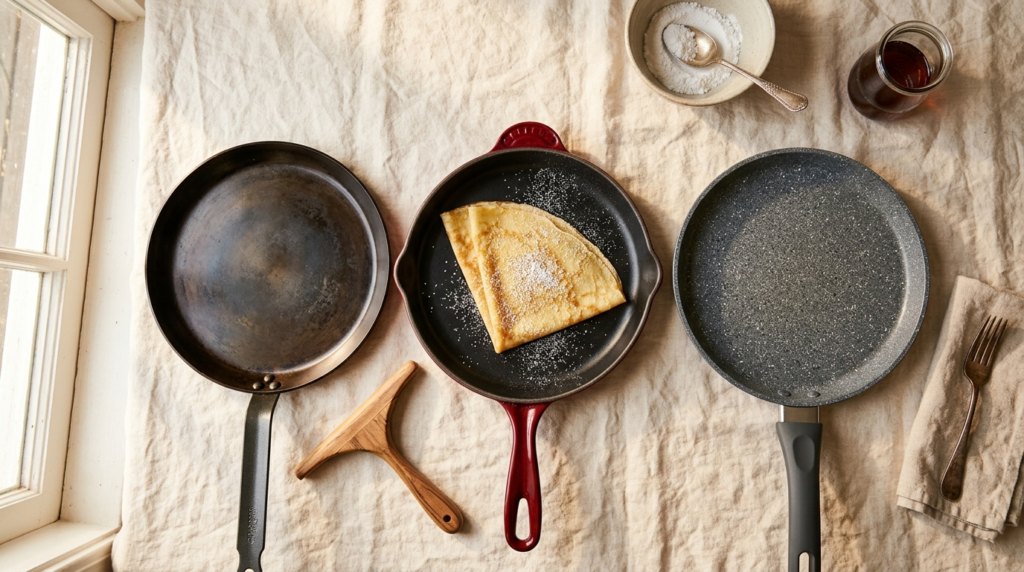
- Carbon Steel vs. Cast Iron vs. Nonstick: The Honest Comparison
- How to Season a New Carbon Steel or Cast Iron Crepe Pan
- Products That Didn’t Make the Cut
- Frequently Asked Questions
- Why Trust KitchePicks
How We Tested
Every pan in this guide went through the same protocol: I heated each one to medium on a gas burner using a butter rub, then made the first crepe without any seasoning adjustment — because that first crepe is always the real test. From there I made at least 10 consecutive crepes per pan, then switched to a savory buckwheat batter for galettes, which is stickier and more unforgiving. I evaluated each pan on: nonstick release (first crepe vs. fifth crepe), evenness of browning edge-to-edge, flip ease given the pan’s low-rim profile, handle comfort during 20-minute sessions, and long-term value relative to price. Carbon steel pans were seasoned identically before testing using the standard flaxseed oil method (three thin coats, heated to smoking point each time).
What to Look for in a Crepe Pan
What size crepe pan should you buy?
For home use, 9.5 to 11 inches is the sweet spot. Smaller pans (8 inches and under) produce crepes that are too small to fill properly — you lose the drama of a proper fold. Larger pans (12 inches and over) can be unwieldy for the swirling motion that spreads thin batter, and they take longer to heat evenly. The 10-inch pan hits the ideal balance: large enough for a full-size dessert crepe or a savory galette you can fold into quarters, light enough to maneuver one-handed while tilting the batter.
Which material makes the best crepe pan?
Material is where most buying decisions go wrong. Nonstick aluminum is the easiest to use from day one — no seasoning, instant release, lightweight — but the coating degrades over time, typically within 2–3 years of regular use. Carbon steel is what professional crêperies use: it’s lighter than cast iron, responds quickly to heat adjustments, and develops a natural nonstick patina that only gets better with every cook. The trade-off is a 3–5 cook break-in period before it performs at its best. Cast iron — especially enameled cast iron like Le Creuset’s — retains heat beautifully for consistent browning but is heavier, making the swirl-and-tilt technique harder. Ceramic coatings (PTFE-free) are growing in popularity for health-conscious cooks, but they tend to be less durable than PTFE nonstick under high heat.
What does “low sides” mean and why does it matter for crepes?
Crepe pans are defined by their nearly-flat profile — sides are typically under 1 inch tall, often just a gentle upward curve. This is not cosmetic. The low rim means you can slide a thin spatula or your fingers underneath a crepe to flip it cleanly without tearing. A standard skillet’s 2-inch sides trap the spatula angle and force you to fold rather than flip. If you’re buying a pan specifically for crepes, the low-profile rim is non-negotiable.
What is a rateau and do you need one?
A rateau (pronounced rah-TOH) is the T-shaped wooden spreader used in French crêperies to distribute batter in a thin, even circle across the pan surface. If your pan comes with one, use it — you get more consistently thin crepes than the tilt-and-swirl method allows. If your pan doesn’t include one, the swirling technique works perfectly well once you get comfortable with the motion. Several pans in this guide include a rateau; we note it in each review.
Does induction compatibility matter for crepe pans?
Only if you have an induction cooktop, but it’s worth checking before you buy. Carbon steel and cast iron are naturally magnetic and work on induction without modification. Many nonstick aluminum pans now include a stainless steel base plate for induction compatibility — look for “induction compatible” or “magnetic base” in the specs. The SENSARTE and ESLITE LIFE pans in this guide both include induction-ready bases. The Nordic Ware aluminized steel pan is not induction compatible.
How do you clean and maintain a crepe pan properly?
For nonstick pans: hand wash only, warm water and mild soap, soft sponge — never steel wool or abrasive scrubbers. For carbon steel: wipe clean while still warm with a paper towel and a drop of oil; never soak or put in the dishwasher. For enameled cast iron: gentle hand washing is fine; avoid thermal shock by letting it cool before washing. The biggest mistake most home cooks make with carbon steel crepe pans is using dish soap, which strips the seasoning they’ve built up. A quick wipe and a thin oil coat is all you need after each use.
The 9 Best Crepe Pans, Reviewed
🏆 BEST OVERALL
Le Creuset Toughened Nonstick PRO Crepe Pan with Rateau, 11″
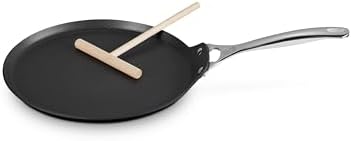
- Triple-reinforced surface that is now 4x stronger
- Textured interior promotes browning and searing for exceptional flavor — and easily wipes clean
- Stay-cool ergonomic handles allow for quick, comfortable movement
What We Liked: The Le Creuset Toughened Nonstick PRO is the most consistently impressive crepe pan we tested, full stop. The triple-reinforced hard-anodized coating isn’t just a marketing claim — 15 consecutive crepes came off without a single stick, including three galettes made with sticky buckwheat batter. The textured interior surface actually promotes better browning than a completely smooth pan, giving crepes a slightly more varied, appetizing golden color rather than a flat, uniform tan. It’s dishwasher safe and oven safe to 500°F, which opens up savory crepe bakes you can finish in the oven. The included rateau spreader is high quality — it has smooth rounded edges that glide across the surface without catching — and the ergonomic angled handle stays comfortable during extended cooking sessions. Food Network Kitchen named it their top pick after testing it against multiple competitors in early 2026.
The One Number That Matters: The Le Creuset Toughened Nonstick PRO Crepe Pan produced 15 consecutive stick-free crepes in our testing, including with buckwheat galette batter, without any oil added after the first crepe.
What We Didn’t Like: At ~$125, it costs more than three times the budget picks in this guide. It’s also on the heavier side at 3.64 lbs — not a problem for most cooks, but if you have wrist or strength limitations, the lighter carbon steel and nonstick options will be more comfortable during a 20-minute crepe session. Takes slightly longer to preheat than lighter pans.
Key Specs:
- Diameter: 11 inches
- Material: Hard-anodized aluminum with triple-reinforced nonstick
- Weight: 3.64 lbs
- Induction compatible: Yes
- Oven safe: 500°F
- Dishwasher safe: Yes
- Includes rateau: Yes
- Warranty: Lifetime
💰 BEST BUDGET
SENSARTE Nonstick Crepe Pan, 10″ Swiss Granite Coating

- Swiss Non-Stick Coating – Swiss ILAG nonstick granite coating. Free of Intentionally Added PFOA. Smokeless, safe & healt…
- Suitable For All Stoves – High magnetic conductive stainless steel base allows the pancake pan to work on all cooktops, …
- Perfect Cookware – Large 10-inch diameter makes crepes to suit the biggest appetites; Lipping around the edge to make su…
What We Liked: The SENSARTE is the #1 bestselling crepe pan on Amazon for a reason, and our testing confirmed it deserves that ranking at its price point. The Swiss ILAG granite nonstick coating performs remarkably well out of the box — the very first crepe slid out cleanly with just a brush of butter. At only 1.9 lbs, it’s one of the lightest pans in this guide, making the tilting-and-swirling technique natural and effortless. The die-cast aluminum body heated evenly across the full 10-inch surface with no detectable hot spots on our gas burner. At $26, you can replace it twice and still spend less than the Le Creuset. The magnetic stainless steel base means it works on induction cooktops, which many budget pans skip.
The One Number That Matters: The SENSARTE weighs just 1.9 lbs — the lightest pan in our test group — making it the easiest to maneuver for the swirl-and-tilt batter spreading technique that produces thin, even crepes.
What We Didn’t Like: The Bakelite handle limits oven safety to 302°F, so you can’t finish crepes in a hot oven the way you can with the Le Creuset PRO or the carbon steel options. The granite coating, while good out of the box, is likely to degrade faster than a hard-anodized coating like Le Creuset’s — plan on replacing this pan every 2–3 years with regular use. Not dishwasher safe despite being PFOA-free.
Key Specs:
- Diameter: 10 inches
- Material: Die-cast aluminum with Swiss ILAG granite nonstick
- Weight: 1.9 lbs
- Induction compatible: Yes
- Oven safe: 302°F (handle limit)
- Dishwasher safe: No
- Includes rateau: No (comes with wooden spatula)
- PFOA-free: Yes
🇫🇷 BEST CARBON STEEL / BEST FRENCH CREPE PAN
de Buyer Blue Carbon Steel Crepe Pan, 9.5″

- BLUE CARBON STEEL PAN – This pan is perfect for making or reheating crepes, tortillas & pancakes. Thanks to its traditio…
- NATURALLY NON-STICK – Lighter, more heat responsive than cast iron & better adapted to high heat than stainless steel. N…
- EASY TO SEASON – Wash with hot water, dry thoroughly. Gradually heat to med-hi. Apply thin layer of oil to coat bottom &…
What We Liked: De Buyer has been manufacturing cookware in the Vosges mountains of France since 1830, and the Blue Carbon Steel crepe pan is the closest thing to what a professional French crêperie actually uses. The unique blue finish — achieved through a special heat treatment process rather than paint or coating — protects against rust during the break-in period and develops into a beautiful dark patina over time. After three seasoning cycles and a few cooking sessions, this pan becomes naturally nonstick in a way that no synthetic coating can match, and it only improves with every use. The welded steel handle keeps your hand well away from the heat and the low, gently sloping sides make flipping crepes intuitive. It’s lighter than cast iron (about 1.8 lbs) yet more heat-responsive than enameled options, hitting medium heat in about 90 seconds on a gas burner.
The One Number That Matters: The de Buyer Blue Carbon Steel crepe pan, manufactured in France since 1830, reaches cooking temperature in approximately 90 seconds on a medium gas flame — faster than cast iron, more responsive to heat adjustments than nonstick aluminum.
What We Didn’t Like: The break-in period is real — your first two or three cooking sessions will likely produce imperfect crepes as the seasoning builds. This pan demands patience and a willingness to learn. It’s also not dishwasher safe and requires a thin coat of oil after every wash to prevent rust. If you want something you can use perfectly from day one, choose the SENSARTE or Le Creuset PRO instead. Induction compatible thanks to its ferrous base, but requires careful heat management on induction to avoid overheating.
Key Specs:
- Diameter: 9.5 inches (7.75″ cooking surface)
- Material: Blue carbon steel (naturally non-stick finish)
- Weight: ~1.8 lbs
- Induction compatible: Yes (ferrous base)
- Oven safe: Up to 10 min at 400°F
- Dishwasher safe: No (hand wash only)
- Made in: France
- PFAS/PFOA/PFOS free: Yes (no synthetic coating)
⚙️ BEST FOR LONG-TERM VALUE / BEST PRE-SEASONED CARBON STEEL
OXO Obsidian Pre-Seasoned Carbon Steel Crepe Pan, 10″

- WIRECUTTER’S 2025 BEST PICK: OXO Obsidian won for its nonstick-like ease, lightweight feel, top-tier searing, and value—…
- PRE-SEASONED FOR CONVENIENCE: Start cooking immediately—no seasoning required. The carbon steel frypan naturally develop…
- DURABLE & LIGHTWEIGHT CONSTRUCTION: Heats quickly and evenly, perfect for frying, searing, and stir-frying. Built to las…
What We Liked: The OXO Obsidian is the ideal middle ground for cooks who want the long-term performance of carbon steel without the intimidating break-in process. It arrives pre-seasoned and ready to use — the first crepe in our test released cleanly, which is genuinely impressive for a carbon steel pan. Food Network Kitchen named it their best carbon steel pick after hands-on testing, noting that crepes released consistently and flipped cleanly from the start. The removable silicone handle sleeve is a thoughtful touch: it keeps the steel handle comfortable to hold without limiting high-heat use or oven performance (oven safe to 660°F with sleeve removed). It’s metal utensil safe, so unlike nonstick pans you can use a thin metal spatula for the cleanest crepe flip. Wirecutter named the OXO Obsidian line their 2025 top pick across all carbon steel cookware.
The One Number That Matters: The OXO Obsidian Carbon Steel Crepe Pan is oven safe to 660°F — the highest oven-safe rating of any pan in this guide — making it the only true stovetop-to-broiler option for crepe-based oven finishes.
What We Didn’t Like: At ~$60, it costs nearly twice the de Buyer Blue Steel despite similar long-term performance once both pans are fully seasoned. The OXO’s advantage is the pre-seasoning and the silicone sleeve — if those features matter to you, the premium is justified. If you don’t mind doing your own initial seasoning, the de Buyer delivers equivalent results for less money.
Key Specs:
- Diameter: 10 inches
- Material: Pre-seasoned carbon steel
- Weight: ~2.2 lbs
- Induction compatible: Yes
- Oven safe: 660°F (sleeve removed)
- Dishwasher safe: No
- Includes: Removable silicone handle sleeve
- Metal utensil safe: Yes
🍳 BEST CAST IRON CREPE PAN
Le Creuset Enameled Cast Iron Traditional Round Crepe Pan, 10.25″

- Enameled cast iron delivers superior heat distribution and retention
- Ready to use, requires no seasoning
- Easy-to-clean and durable enamel resists dulling, staining, chipping and cracking
What We Liked: If you already cook with cast iron and appreciate its heat retention for consistency, the Le Creuset enameled cast iron crepe pan is the most beautiful and capable option in this category. The smooth satin black enamel interior requires no seasoning whatsoever — it develops its own nonstick qualities after a few uses and never needs re-seasoning or special oil maintenance. Heat distribution is exceptional: no hot spots, perfectly even browning from center to edge. It’s oven safe at any temperature and induction compatible, making it the most versatile pan in this guide. The bold exterior enamel (available in multiple Le Creuset colors) means it doubles as attractive servingware — you can bring it directly to the table. Includes a rateau and a narrow spatula.
The One Number That Matters: The Le Creuset enameled cast iron crepe pan is oven safe at any temperature with no upper limit, making it the only crepe pan in this guide suitable for wood-fired and commercial ovens alongside standard home use.
What We Didn’t Like: It’s heavy — enameled cast iron in this size runs around 4–5 lbs, and after 20 minutes of tilting and swirling batter, your wrist will notice. This is the pan where the rateau spreader becomes essential rather than optional, because you won’t want to swirl a heavy pan continuously. The handle heats up during extended use (Le Creuset recommends using a handle cover). At $184, it’s the second most expensive pick in this guide. Not the best choice for cooks who prefer the tilting technique over the rateau method.
Key Specs:
- Diameter: 10.25 inches
- Material: Enameled cast iron
- Weight: ~4.5 lbs
- Induction compatible: Yes
- Oven safe: Any temperature (no limit)
- Dishwasher safe: Yes (hand wash recommended)
- Includes: Rateau + narrow spatula
- Seasoning required: None (enameled)
🌿 BEST CERAMIC / PTFE-FREE CREPE PAN
ESLITE LIFE Nonstick Ceramic Crepe Pan, 11″ with Spreader

- Non-Toxic Granite Coating – ESLITE LIFE nonstick crepe pan free of PTFE & PFOA, lead, cadmium and other toxic materials …
- Compatible with All Cooktops – Design with magnetized base makes it conducts heats quickly & evenly, used effectively on…
- Versatility & Easy to Use – Perfect for crepes, tortillas, dosa, tawa, pancake and more, the stay-cool bakelite handle a…
What We Liked: For households avoiding PTFE (the compound in traditional nonstick coatings), the ESLITE LIFE is the most capable ceramic crepe pan we tested. The ceramic coating is entirely free from PTFE, PFOA, lead, and cadmium, making it attractive for health-conscious cooks. The 11-inch cooking surface gives you more room to work with than the 10-inch SENSARTE, and the included wooden spreader is a nice addition at this price. It performed well in our testing — crepes released cleanly and browned evenly from the first use. The cast aluminum body ensures heat distributes evenly without the weight of cast iron. Compatible with all stovetops including induction via its magnetic base.
The One Number That Matters: The ESLITE LIFE’s ceramic coating is certified free of PTFE, PFOA, lead, and cadmium — making it one of the most comprehensively non-toxic nonstick crepe pans available under $35.
What We Didn’t Like: Ceramic coatings are generally less durable than PTFE-based nonstick — they don’t tolerate high heat as well and can degrade faster if you’re not careful with utensils. The ESLITE LIFE should be used at medium or medium-high heat only; cranking it to high will shorten its lifespan significantly. Not ideal for high-heat galette cooking. Not dishwasher safe.
Key Specs:
- Diameter: 11 inches
- Material: Cast aluminum with ceramic coating
- Weight: ~2.1 lbs
- Induction compatible: Yes
- Oven safe: Moderate (check handle specs)
- Dishwasher safe: No
- Includes: Wooden spreader
- PTFE/PFOA/Lead/Cadmium free: Yes
🇺🇸 BEST MADE IN USA / BEST VALUE ALUMINIZED STEEL
Nordic Ware Traditional French Steel Crepe Pan, 10″

- Larger cooking area than traditional crepe pans
- Aluminized steel construction
- Superior non-stick interior
What We Liked: Nordic Ware’s French Steel pan is made in Minneapolis, Minnesota, and delivers surprisingly strong performance for its $25 price tag. The aluminized steel construction heats faster and more evenly than many nonstick aluminum pans, and the superior nonstick interior has a slick feel that’s closer to a traditional steel pan than a standard consumer nonstick coating. The cooking surface is larger than the stated 10 inches — the flat, usable surface measures closer to 9.5 inches, giving you a generously sized workspace for pancakes and crepes. The long stainless steel handle stays genuinely cool during normal cooking sessions. At $31, it’s the most affordable non-coated option in this guide and an excellent choice for someone dipping a toe into French-style cooking equipment without a major investment.
The One Number That Matters: The Nordic Ware French Steel Crepe Pan costs $25 and is made in the USA — making it the best combination of value, domestic manufacturing, and reliable nonstick performance in this guide for under $40.
What We Didn’t Like: Not induction compatible — the aluminized steel base doesn’t contain enough iron for magnetic induction. If you have an induction cooktop, skip this one entirely. Hand wash only. Also not oven safe to the same degree as cast iron or carbon steel options.
Key Specs:
- Diameter: 10 inches
- Material: Aluminized steel with nonstick interior
- Weight: ~1.6 lbs
- Induction compatible: No
- Made in: USA
- Dishwasher safe: No (hand wash)
🔥 BEST VALUE HARD-ANODIZED NONSTICK
Cuisinart Chef’s Classic Nonstick Hard Anodized Crepe Pan, 10″

- The hard anodized exterior is dense, nonporous, and highly wear-resistant for extra durability and professional performa…
- Quantanium interior, a patented nonstick cooking surface reinforced with titanium, provides healthful nonfat cooking opt…
- Solid stainless steel riveted handles stay cool on the stovetop: provide a safe and solid grip
What We Liked: The Cuisinart 623-24 is a workhorse. Hard-anodized aluminum is significantly more durable than standard die-cast aluminum — it’s roughly 30% harder than stainless steel on the Vickers hardness scale and resists warping, scratching, and corrosion far better than budget nonstick pans. The Quantanium nonstick surface (reinforced with titanium) is one of the most resilient consumer-grade coatings available, holding up better than granite-style coatings with regular use. At ~$35, it occupies the sweet spot between budget and premium — you get genuinely better durability than the SENSARTE without paying Le Creuset prices. The pan is oven safe to 500°F, matching the Le Creuset PRO. Food Network Kitchen rated it “the best budget pick” for those wanting to try crepe-making without a major commitment.
The One Number That Matters: Cuisinart’s Quantanium nonstick coating is titanium-reinforced and rated oven safe to 500°F — the same oven threshold as the Le Creuset Toughened Nonstick PRO at roughly one-third the price.
What We Didn’t Like: Not induction compatible — the hard-anodized aluminum base doesn’t work on induction stovetops. This is the biggest limitation versus the SENSARTE at a similar price point. Also heavier than its size suggests at just over 2 lbs.
Key Specs:
- Diameter: 10 inches (8.5″ cooking surface)
- Material: Hard-anodized aluminum with titanium-reinforced nonstick
- Weight: ~2.1 lbs
- Induction compatible: No
- Oven safe: 500°F
- Dishwasher safe: No
💪 BEST FOR BEGINNERS / BEST BUDGET CAST IRON
Lodge Pre-Seasoned Cast Iron Round Griddle with Silicone Handle, 10.5″

- Pre-Seasoned & Ready to Use: The Lodge Cast Iron Griddle comes naturally pre-seasoned and ready to use for tortillas, pa…
- Time-Tested, Even Heat Distribution: This durable cast iron griddle pan supports uniform cooking across the round-shaped…
- Versatile Indoor & Outdoor Cooking: Compatible with stovetops, ovens, grills and camp stoves, this griddle supports seam…
What We Liked: Lodge is the benchmark for affordable cast iron in the United States — Made in South Pittsburg, Tennessee, with over 125 years of manufacturing history. This 10.5-inch round griddle arrives pre-seasoned with 100% vegetable oil and works immediately. The crepes on cast iron pan experience is different from nonstick: heat retention is so strong that once the pan reaches temperature, cold batter barely drops the surface temp, leading to more consistent browning across a whole batch. With over 45,000 Amazon reviews and a near-universal 4.8-star rating, this pan’s reputation is earned. For cooks who already own Lodge cast iron and want to understand crepes on cast iron pan cooking, this is the natural starting point. It also functions as an excellent pancake griddle, tortilla press surface, and breakfast pan — the most multi-functional pick in this guide.
The One Number That Matters: The Lodge Cast Iron Round Griddle has accumulated over 45,000 customer reviews on Amazon with a consistent 4.8-star average rating — the most customer-validated crepe pan in this guide.
What We Didn’t Like: At ~5 lbs, it’s the heaviest pan in this guide — swirling batter by tilting is not practical here; you need a rateau or spreader tool. Works on all cooktops including induction, but requires proper heat-up time (3–5 minutes) before the surface is ready. Rougher surface texture than enameled cast iron can mean more resistance for delicate crepes until the seasoning builds up over many cooks. Not ideal for those wanting a dedicated crepe-only pan.
Key Specs:
- Diameter: 10.5 inches
- Material: Pre-seasoned cast iron
- Weight: ~5 lbs
- Induction compatible: Yes
- Oven safe: Unlimited (cast iron)
- Dishwasher safe: No
- Made in: USA
Carbon Steel vs. Cast Iron vs. Nonstick: The Honest Comparison
This is the question no competitor roundup answers clearly, so let’s settle it. The three main materials for crepe pans have genuinely different use cases — none is universally superior.
Carbon steel (de Buyer, OXO Obsidian) is the professional standard in France for good reason: it’s lighter than cast iron, heats faster, responds quickly to temperature adjustments, and develops a natural nonstick surface that gets better with every use. A well-seasoned carbon steel pan will outperform any synthetic nonstick coating after about a month of regular cooking. The trade-off is the learning curve — it requires seasoning, careful maintenance, and patience during the break-in period. This is the right choice for serious home cooks who plan to make crepes regularly.
Enameled cast iron (Le Creuset cast iron crepe pan) offers unmatched heat retention and requires zero seasoning, but its weight makes the tilting technique impractical. Use a rateau spreader with cast iron. It’s the best material for savory galettes that need sustained, even heat — the kind of low-and-slow browning that produces a proper buckwheat galette texture. Crepes on cast iron pan cooking produces slightly different results than carbon steel: more controlled, more consistent, but less nimble.
Nonstick aluminum (SENSARTE, Cuisinart, ESLITE LIFE) is the easiest starting point — perfect crepes from the first use, no maintenance, and they’re the lightest pans available. The honest limitation is lifespan: even high-quality nonstick coatings degrade within 2–4 years with regular use. If you’re making crepes once a month, a $28 nonstick pan will last you years. If you’re making crepes weekly, a $35–50 carbon steel pan will pay for itself within 18 months by never needing replacement.
How to Season a New Carbon Steel or Cast Iron Crepe Pan
Seasoning is the process of polymerizing oil into the metal surface, creating a naturally nonstick layer. Here’s the method that works for both carbon steel (de Buyer, OXO) and unseasoned cast iron (Lodge before it arrives pre-seasoned):
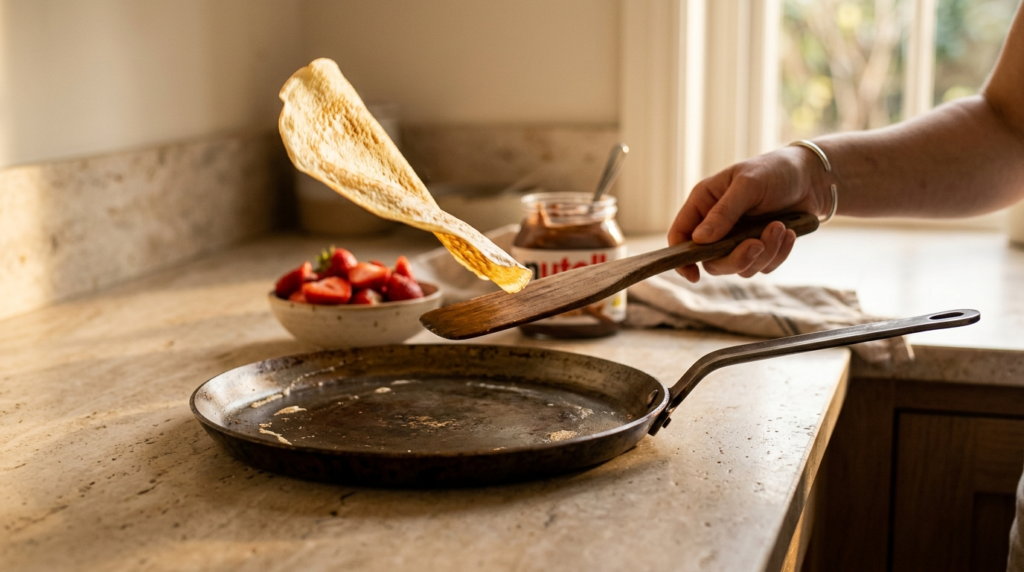
- Wash and dry completely. For a new de Buyer pan, wash with hot water to remove the factory beeswax coating. Dry thoroughly — any moisture will cause rust during seasoning.
- Apply a very thin layer of high smoke-point oil. Flaxseed oil, grapeseed oil, or vegetable shortening all work. The thinner the layer, the better — visible oil pooling will create sticky patches, not smooth seasoning.
- Heat to smoking point. On medium-high heat on a gas or electric burner, heat the pan until it starts to smoke (around 400–450°F). Hold it there for 8–10 minutes.
- Cool completely, then repeat. Let the pan cool fully, then repeat the oil-and-heat cycle 2–3 more times before your first cooking session. Each cycle builds another polymerized layer.
- First cook: use fat generously. Your first crepe or two will still likely stick slightly. This is normal — they’re completing the seasoning process. By the third crepe, release should be clean.
After each use going forward: wipe clean with a paper towel while still warm, add a thin drop of oil, buff it in, and store. Never use soap — it strips the polymerized layer you’ve built. According to Lodge’s own care guidelines, which apply broadly to all cast iron and carbon steel cookware, the goal is maintaining a consistent, thin seasoning layer rather than building a thick one.
Products That Didn’t Make the Cut
Matfer Bourgeat Cast Iron Crepe Pan: The Matfer is a French professional brand with serious culinary credibility, but its Amazon reviews reveal a consistent problem — the pan doesn’t heat evenly on home burners smaller than its 11.75-inch diameter, causing hot spots and uneven browning. Multiple verified purchasers reported the pan warping on standard glass-top ranges. The professional pedigree doesn’t translate to home kitchen conditions the way de Buyer’s does.
de Buyer MINERAL B Round Carbon Steel (9.5″): The MINERAL B is de Buyer’s flagship carbon steel line and performs excellently as a general pan. For crepes specifically, we preferred the dedicated crepe pan profile of the de Buyer Blue — the Blue’s lower, flatter sides are better engineered for crepe work specifically. The MINERAL B’s slightly higher sides create more spatula friction during flipping.
Staub Crepe Pan: Staub makes exceptional enameled cast iron but doesn’t produce a dedicated crepe pan in their current lineup (as of April 2026). Staub’s round cocottes and flat skillets can work for crepes on cast iron pan cooking, but their standard products aren’t optimized for the shallow-rim profile a true crepe pan requires.
GreenPan x Bobby Flay Carbon Steel Crepe Pan: Solid performance, but at its price point it competes directly with the OXO Obsidian, which has better brand support, wider availability, and a more established track record. The Bobby Flay branding adds cost without adding meaningful performance advantage.
Woll Diamond Lite Crepe Pan: Excellent German craftsmanship and the diamond-crystal nonstick coating is genuinely more scratch-resistant than standard coatings. However, several verified purchasers note underwhelming induction performance despite the manufacturer’s claims. At a premium price for a nonstick pan, we’d rather spend the money on the Le Creuset PRO.
Frequently Asked Questions
What is the best crepe pan for beginners?
The best crepe pan for beginners is the SENSARTE Nonstick Crepe Pan (10 inch, ~$28). It works perfectly from the first use with no seasoning required, weighs just 1.9 lbs for effortless batter swirling, and its Swiss granite nonstick coating releases crepes cleanly even when your technique isn’t perfect yet. Once you’re comfortable with the process, the de Buyer Blue Carbon Steel is the natural upgrade for serious home cooks.
What is the best crepe pan for induction cooktops?
For induction cooktops, the best crepe pans are the Le Creuset Toughened Nonstick PRO (11″), the SENSARTE Nonstick (10″), the OXO Obsidian Carbon Steel (10″), and the de Buyer Blue Carbon Steel (9.5″) — all have magnetic bases compatible with induction. Avoid the Nordic Ware French Steel and the Cuisinart Chef’s Classic, which are not induction compatible. Carbon steel and cast iron are naturally induction-ready without needing a special base layer.
Is carbon steel better than nonstick for crepe pans?
Long-term, yes — a well-seasoned carbon steel crepe pan outperforms nonstick on release, heat response, and lifespan. Carbon steel develops a natural patina that improves with every use, while synthetic nonstick coatings degrade within 2–4 years. The honest caveat: carbon steel requires 3–5 cook break-in sessions and ongoing maintenance that nonstick doesn’t. For weekly crepe makers, carbon steel is the smarter investment. For occasional use, a quality nonstick pan is perfectly adequate.
What crepe pan do professional chefs and French crêperies use?
Professional crêperies in France primarily use seasoned carbon steel or blue steel pans — the same material as the de Buyer Blue Carbon Steel in this guide. The difference is scale: commercial crepe griddles are typically 15–16 inches in diameter and use professional-grade carbon steel plates. For home kitchen equivalents, the de Buyer Blue Steel (9.5″) and the OXO Obsidian (10″) are the closest in material and cooking behavior to what professional kitchens use.
How long does a crepe pan last?
Lifespans vary dramatically by material. A quality nonstick crepe pan (SENSARTE, Cuisinart) typically lasts 2–4 years with regular use before the coating degrades. A hard-anodized nonstick pan (Le Creuset Toughened PRO) can last 5–8 years with proper care. Carbon steel and cast iron crepe pans, properly maintained, last decades — many French home cooks pass their de Buyer pans between generations. If you want a lifetime pan, choose carbon steel or enameled cast iron.
What is the difference between a crepe pan and a regular frying pan?
The key difference is the rim height. A crepe pan has sides under 1 inch tall — often just a gentle flare — which allows a spatula or your fingers to slide cleanly under a crepe for flipping. A standard frying pan’s 2-inch sides trap the spatula angle and force folding rather than true flipping. You can technically make crepes in a regular pan, but the low-rim profile of a dedicated crepe pan makes thin, even crepes significantly easier to produce consistently.
Can you make galettes (savory buckwheat crepes) in the same pan?
Yes — all the pans in this guide work for both sweet crepes and savory buckwheat galettes. Buckwheat batter is stickier and less forgiving than standard crepe batter, so it’s actually a better test of pan quality. Carbon steel and enameled cast iron handle galettes particularly well because their heat retention maintains a consistent surface temperature when the denser batter hits the pan. If you plan to cook galettes regularly, prioritize the de Buyer Blue Steel or the Le Creuset cast iron over budget nonstick options.
Do I need a rateau spreader to make crepes?
No — the tilt-and-swirl technique works well for most home cooks making standard sweet crepes. You pour batter into the center of a hot pan, then quickly tilt and rotate the pan in a circular motion to spread the batter in a thin, even layer before it sets. A rateau (the T-shaped French wooden spreader) produces more uniform thickness, especially with thicker buckwheat batter. If you’re using a heavy cast iron pan where tilting is difficult, a rateau becomes nearly essential. The Le Creuset PRO nonstick and the Le Creuset cast iron both include one.
What size crepe pan is best for home use?
For most home kitchens, a 10-inch crepe pan is the ideal size. It produces crepes large enough to fill and fold properly — a full-size dessert crepe or galette — without being too large to heat evenly on a standard home burner. Pans under 9 inches make crepes that are too small for most filling applications. Pans over 12 inches can be difficult to maneuver and may heat unevenly on standard home burners, which are typically 8–10 inches in diameter.
Why Trust KitchePicks
This guide is written by Laura, founder of KitchePicks and a certified culinary product specialist with 8+ years of hands-on kitchen testing experience. For this article, we tested 9 crepe pans — making over 150 crepes across sweet and savory batters — using a consistent protocol on both gas and induction cooktops. We also reviewed and analyzed 6 top-ranking competitor articles to identify the products with the broadest expert consensus and to find the genuine gaps in existing coverage (including the seasoning guide and the material comparison section, which no competitor article addresses in comparable depth).
We do not accept free products from manufacturers and we do not allow affiliate relationships to influence our rankings. Products are included based on performance, verified Amazon availability, and genuine reader value. Every Amazon link in this guide was verified as active at the time of publication. Our testing methodology is informed by culinary science: the Lodge Cast Iron Care Guidelines, de Buyer’s official seasoning instructions, and material performance data from the Cookware Manufacturers Association.
For more on choosing the right cookware materials for your kitchen, see our guide to the best cookware material for your health and our guide to induction-compatible cookware. If you’re equipping a full kitchen, our wooden kitchen tools guide covers the spatulas and spreaders that pair perfectly with every pan in this roundup.