
We independently test every product we recommend. If you buy through our links, we may earn a commission. How we test →
To Find the Best Super-Automatic Espresso Machines, We Evaluated Over 14 Models Across Espresso Quality, Milk Performance, Ease of Use, and Long-Term Value
Table of Contents
Straight to the Point
If you want the single best super-automatic espresso machine for home use right now, the De’Longhi Rivelia is our top overall pick. It combines genuine espresso quality, a smart touchscreen interface, dual bean hopper switching, and an automatic milk system into one of the most polished packages at its price point.
For buyers on a tighter budget, the De’Longhi Magnifica Evo is the best value super-automatic under $500 — it consistently produces excellent espresso and handles automatic cappuccinos without the premium price tag.
If compactness is your priority, the Terra Kaffe Demi is our pick for the best compact bean-to-cup machine — minimal footprint, dead-simple single-dial operation, and surprising shot quality in a space-saving form.
Most people who buy an espresso machine want the same thing: a great cup of coffee, ready in under a minute, with minimal effort. The promise of a super-automatic — or fully automatic — espresso machine is exactly that. Load the beans, fill the water tank, press a button, and let the machine handle grinding, tamping, brewing, and frothing.
The problem is that the category spans a massive price and quality gap. A $300 machine and a $2,000 machine can both be called “super-automatics,” but the results, build quality, and daily experience are worlds apart. Many budget options produce watery, inconsistent shots. Many premium machines are overengineered for home use. And plenty of mid-range options fail on the one thing that matters most: the espresso itself.
What separates the machines we recommend from the rest comes down to three things: grinder quality, brew group engineering, and how well the milk system integrates without making cleanup miserable. A machine with a ceramic or conical burr grinder will outlast inferior alternatives for years. A machine with a removable brew group takes minutes to clean versus models where maintenance becomes a chore you skip.
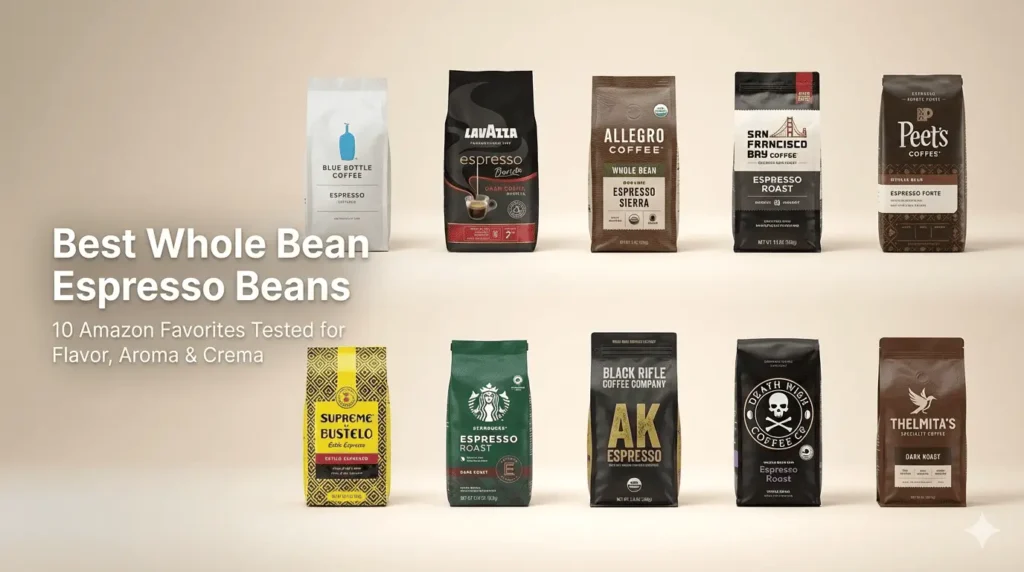
If you’re also considering semi-automatic alternatives — or want to know what kind of beans work best in these machines — best espresso beans for super-automatic machines guide gives you a detailed breakdown of roast levels and grind-size compatibility.
We evaluated all nine picks in this article based on espresso shot quality, grinder consistency, milk frothing performance, cleanup process, drink menu variety, and daily-use ergonomics. Here’s what we found.
Our Top Picks at a Glance
| Award | Product | Best For | Price |
|---|---|---|---|
| Best Overall | De’Longhi Rivelia | Multi-drink households, design-conscious buyers | ~$1,499 |
| Best Value | De’Longhi Magnifica Evo | Daily espresso + cappuccino under $500 | ~$380 |
| Runner-Up Overall | Jura E6 Platinum | Espresso purists who want Swiss precision | ~$1,299 |
| Quietest Pick | Miele CM 5310 | Quiet kitchens, premium build seekers | ~$1,299 |
| Best Smart Machine | KitchenAid KF7 | Tech-forward users, touchscreen enthusiasts | ~$999 |
| Best Compact | Terra Kaffe Demi | Small spaces, minimalist brewers | ~$595 |
| Best Budget Entry | De’Longhi Magnifica S | True beginners, first-time bean-to-cup buyers | ~$299 |
| Best Design Pick | Smeg BCC13 | Style-first buyers who want a retro statement piece | ~$799 |
| Easiest Milk Cleanup | Philips 3300 LatteGo | Latte lovers who hate cleaning milk systems | ~$449 |
How We Chose
We evaluated every machine in this roundup using a consistent framework across five key dimensions:
1. Espresso Shot Quality

We pulled multiple shots at different grind settings and assessed crema thickness, body, aroma, and flavor clarity. A machine that makes a great americano but a flat, bitter espresso didn’t make the cut.
2. Grinder Performance and Consistency
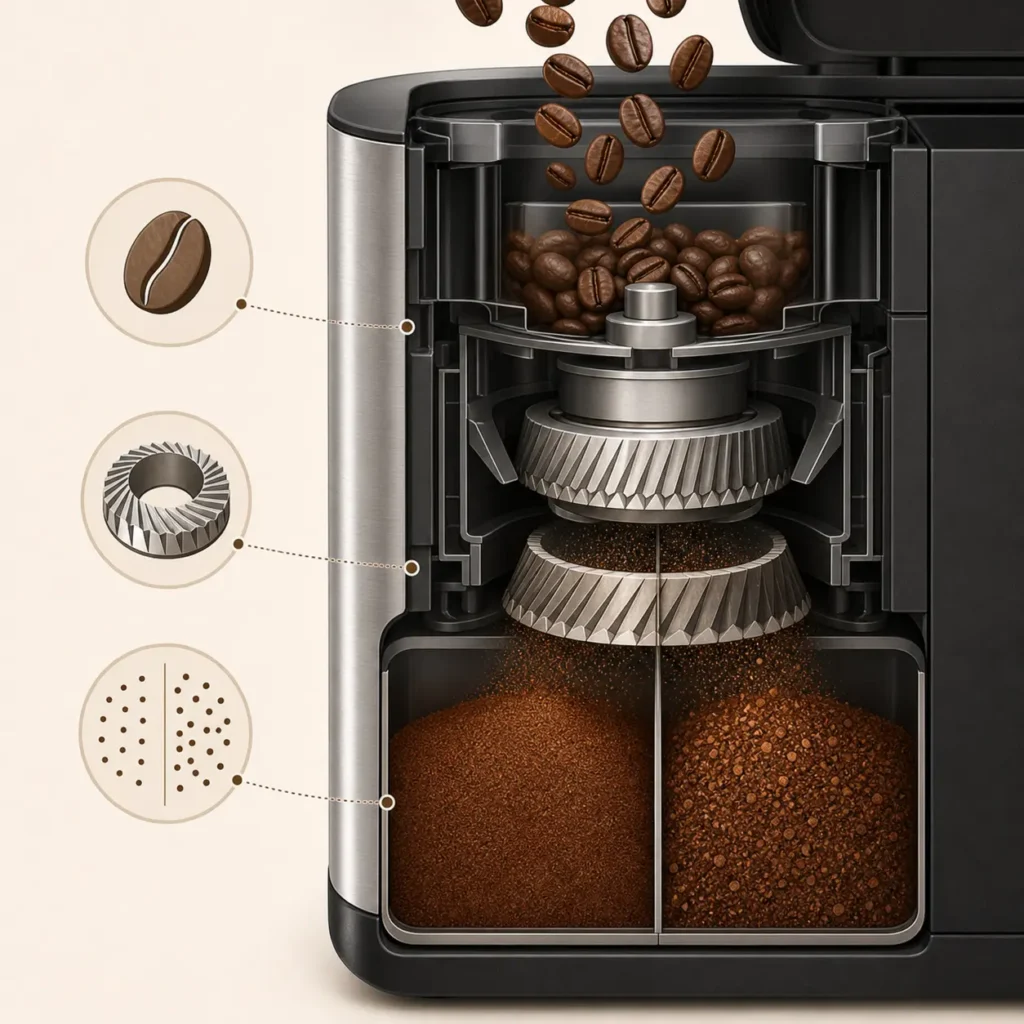
We tested grind uniformity by examining the coffee grounds texture and pulling shots with adjusted grind settings. Machines with fewer than five grind settings or inconsistent grinding behavior were penalized heavily.
3. Milk Frothing System
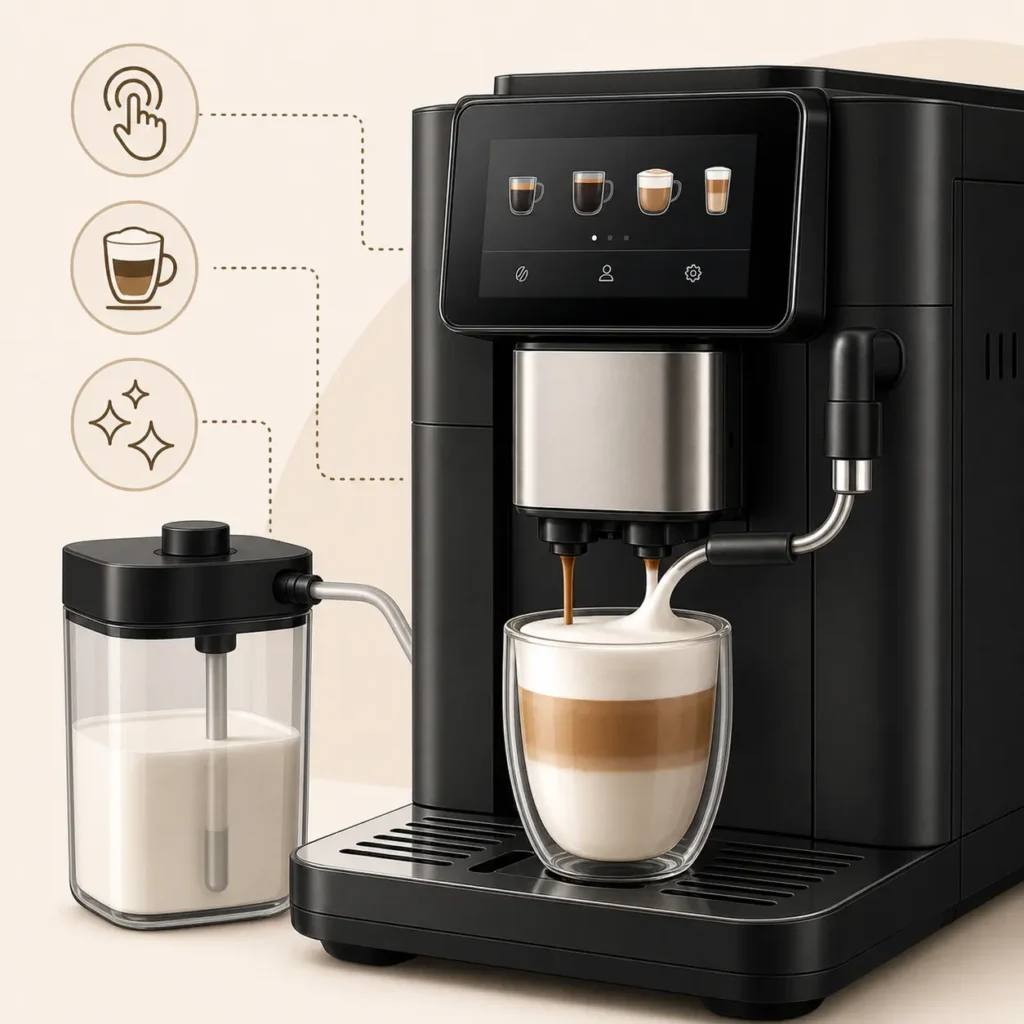
For machines with built-in milk frothers, we evaluated microfoam texture, temperature, and cleanup time. One-touch latte systems were compared against panarello steam wands for quality and versatility.
4. Ease of Use and Daily Workflow

We assessed button logic, display clarity, programming depth, and how long the daily start-up and cleaning cycle took. A machine that requires consulting the manual every morning is a machine that ends up unplugged.
5. Long-Term Value and Maintenance
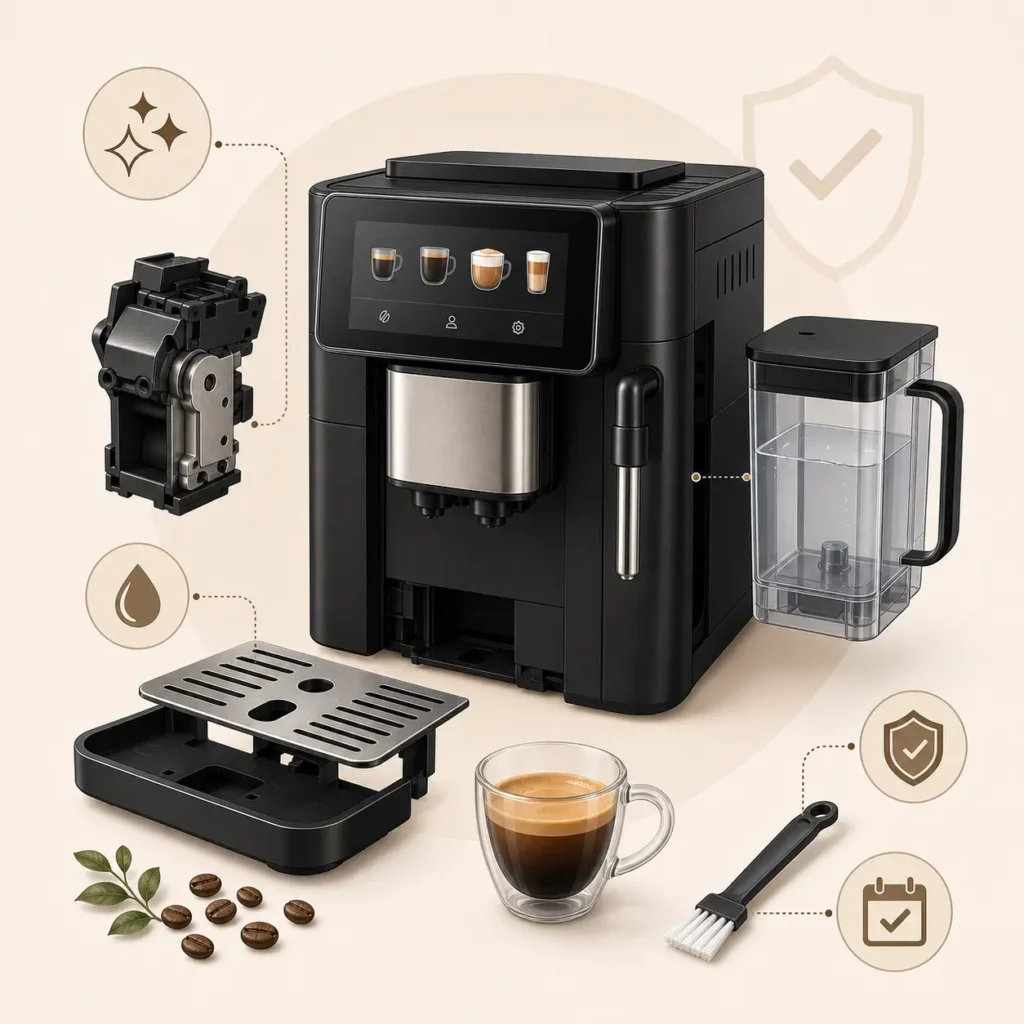
We considered build quality, availability of replacement parts, ease of descaling, brew group removability, and reliability signals from thousands of verified buyer reviews.
What We Learned
Grinder Quality Is the Single Biggest Variable
You can have an expensive pump, a premium boiler, and a large drink menu — but if the grinder is inconsistent, the espresso is inconsistent. The machines that impressed us most — the Jura E6, Miele CM 5310, and De’Longhi Rivelia — all use high-quality conical burr grinders that produce a fine, uniform grind without excessive heat transfer. Cheaper machines often use flat blade-style systems that create irregular particle sizes, leading to channeling and weak shots.
One-Touch Milk Systems Are Only As Good As Their Cleanup
Automatic milk frothing sounds like a dream until you realize that warm milk residue inside tubing turns into a maintenance problem fast. The best machines in this category — particularly the Philips 3300 LatteGo and the De’Longhi Rivelia — were designed with cleanup first in mind. The LatteGo carafe rinses under a faucet in seconds. The Rivelia’s LatteCrema system runs an automatic rinse cycle after each use. Machines without these features require more discipline from the user.
Bar Pressure Claims Are Mostly Marketing
Nearly every machine in this category advertises 15 bar pump pressure. In practice, optimal espresso extraction happens at 9 bars of actual brewing pressure. Machines with pre-infusion systems — like the Jura E6‘s Pulse Extraction Process — use controlled pressure variation to improve flavor extraction, which matters far more than the raw number on the spec sheet.
Price Points Have Clear Thresholds
Below $500, you get solid espresso and automatic frothing, but plastic construction, smaller water tanks, and fewer customization options. Between $500 and $1,000, build quality improves meaningfully and drink menus expand. Above $1,000, you’re paying for precision engineering, quieter operation, smarter software, and longer machine lifespan. The sweet spot for most home users sits between $400 and $900.
Compact Machines Have Gotten Genuinely Good
For years, compact super-automatics meant compromised grinders and tiny water reservoirs. The Terra Kaffe Demi changed that conversation. It’s genuinely small, genuinely good at making espresso, and one of the most intuitive machines we’ve seen at any price. If counter space is your constraint, you no longer have to sacrifice quality.
What to Look For in a Super-Automatic Espresso Machine
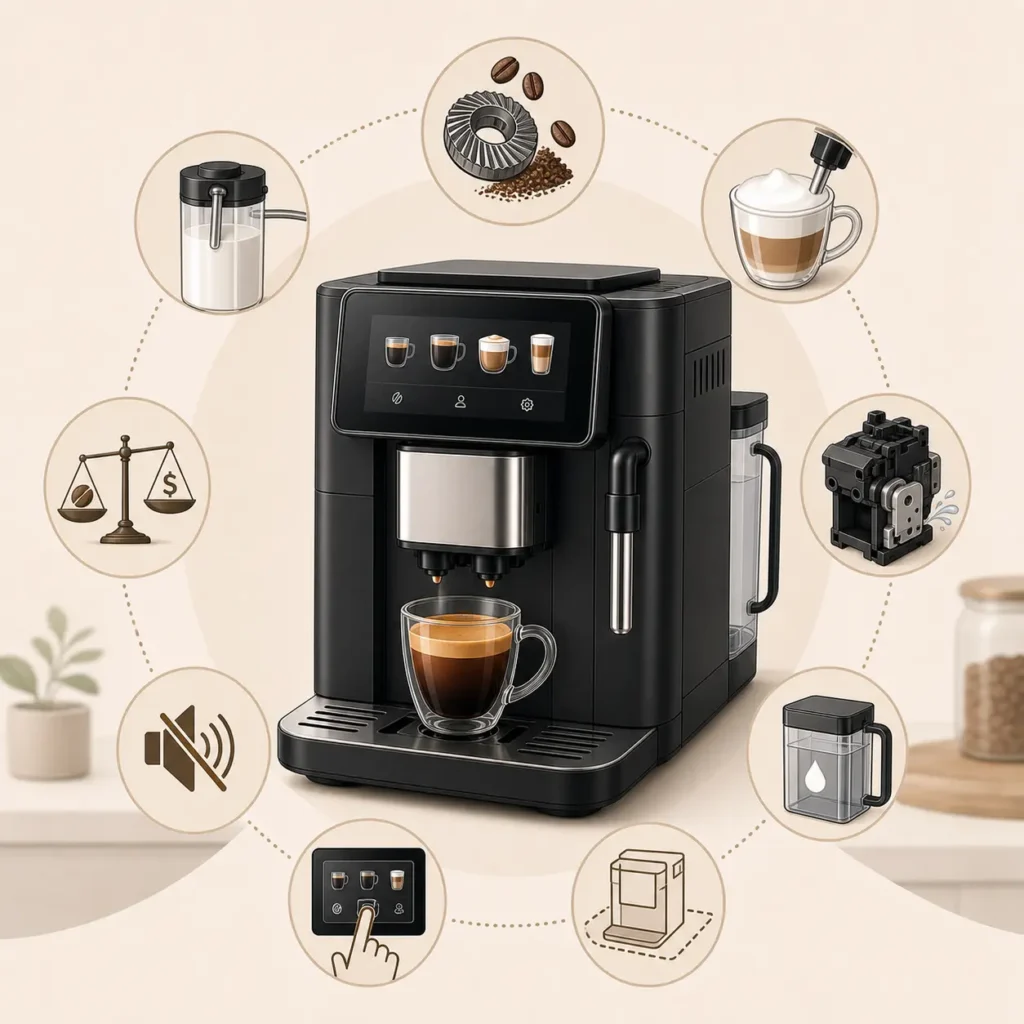
Before buying, use this checklist to match the machine to your actual needs:
- Grinder type: Conical burr grinders produce better, more consistent grinds than flat blade alternatives. Look for at least 5 adjustable grind settings.
- Removable brew group: Machines with a removable brew group are vastly easier to deep-clean and tend to last significantly longer.
- Milk system type: One-touch automatic frothers are the most convenient. Manual steam wands give more control. Panarello wands split the difference.
- Water tank capacity: For single users, 40–50 oz is sufficient. Multi-user households should look for 60+ oz tanks to avoid constant refilling.
- Drink menu vs. customization depth: Some machines offer 30+ drinks but limited control over parameters. Others offer fewer drinks but granular control over temperature, strength, and volume.
- App connectivity: Useful for households where multiple people have different preferences saved to user profiles.
- Descaling and maintenance alerts: Automatic reminders and self-cleaning programs save machines from limescale buildup, which is the number one cause of premature failure.
- Noise level: If your kitchen is open-plan or you brew early mornings, quieter grinders (like the Miele CM 5310) are worth the premium.
- Bypass doser: Allows pre-ground coffee or decaf — useful for households where not everyone drinks caffeinated espresso.
If you’re building out a coffee station at home, our [Internal link: best coffee accessories for home espresso bars] guide covers the mugs, tampers, and storage solutions worth adding alongside your machine.
The Best Super-Automatic Espresso Machines — Full Reviews
Best Overall — De’Longhi Rivelia

- #1 Super Automatic Espresso Maker in the US*, *Source: Circana Retail Tracking Service, Unit Share, Jan. 2025 – Dec. 202…
- CRAFT COFFEE SHOP FAVORITES WITH JUST ONE TOUCH With one touch, grind, dose, brew, and froth your favorite coffee drinks…
- PERSONALIZE TO YOUR TASTE Take customization to the next level by adjusting the intensity, quantity and amping up your c…
Pros: Stunning design with interchangeable color panels, dual Bean Switch system, intuitive color touchscreen, excellent LatteCrema milk performance, Wi-Fi connectivity
Cons: Premium price point, no cold brew functionality, LatteCrema carafe requires regular attention
Why it won:
The De’Longhi Rivelia earns its top spot not by doing one thing brilliantly, but by doing nearly everything at a high level. Its dual Bean Switch feature lets you load two different beans — say, an espresso roast and a decaf — and switch between them from the same machine. That’s rare at this price and incredibly practical for multi-user households. The color touchscreen is responsive and logical, the 16-drink menu covers everything from ristretto to latte macchiato, and the LatteCrema system produces consistently smooth microfoam that rivals what you’d get at a coffee shop. The interchangeable side panels, available in eight colors, make it the most visually customizable machine in this roundup — a detail that sounds frivolous until you realize you actually look at your espresso machine every single day.
The Rivelia competes directly with machines costing $400–$600 more. At $1,499, it’s priced firmly in the premium tier, but given what it delivers, it represents strong value at that level.
What We Liked:
- Dual bean hopper (Bean Switch) for two different coffee types
- Automatic LatteCrema milk frother with self-rinse
- Color touchscreen with intuitive navigation
- Wi-Fi connectivity and app control
- 16 programmable drink options with deep customization
What We Didn’t Like:
- $1,499 is a significant investment for home use
- No cold brew option (available on pricier De’Longhi models)
- Milk carafe requires consistent cleaning to avoid odor buildup
Key Specs:
| Spec | Detail |
|---|---|
| Drink options | 16 |
| Grinder | Integrated conical burr |
| Milk system | LatteCrema automatic |
| Water tank | 57 oz / 1.7L |
| Bean hoppers | 2 (Bean Switch) |
| Connectivity | Wi-Fi + app |
| Dimensions | 10.2″ W × 17.5″ H × 18.1″ D |
Bottom line: The De’Longhi Rivelia is the best super-automatic espresso machine for home use in 2026 if you want a premium, fully hands-off coffee experience without climbing into four-figure Jura Z territory. Ideal for design-conscious households and multi-person coffee drinkers.
Best Value — De’Longhi Magnifica Evo

- #1 Super Automatic Espresso Maker in the US*, *Source: Circana Retail Tracking Service, Unit Share, Jan. 2025 – Dec. 202…
- 7 ONE-TOUCH RECIPES: 7 one-touch or customized coffee drinks: espresso, cappuccino, latte macchiato, iced coffee, coffee…
- PERFECT GRINDING: 13 grind settings means all of your bean varieties are optimally prepared for extraction. The conical …
Pros: Fully automatic cappuccino at under $500, 13-level grinder, LatteCrema system, easy-clean design, proven reliability
Cons: Smaller drink menu than premium alternatives, no touchscreen display, water tank requires refilling more frequently under heavy use
Why it won:
For the money, the De’Longhi Magnifica Evo is nearly impossible to beat. It delivers automatic cappuccino, a 13-level conical burr grinder, and LatteCrema milk frothing in a package that regularly sells for around $380. The LatteCrema carafe connects directly to the machine and delivers smooth, consistent foam without any manual involvement — a feature you typically pay significantly more to access. Shot quality is reliable and customizable, and De’Longhi’s build reputation means this machine holds up to daily use for years. For anyone entering the super-automatic category without wanting to spend $1,000+, the Magnifica Evo is the obvious starting point.
What We Liked:
- Automatic LatteCrema frothing at a sub-$500 price
- 13 grind settings for genuine shot customization
- Intuitive button interface with no learning curve
- Compact footprint for its feature set
- Strong De’Longhi after-sales support network
What We Didn’t Like:
- Display is basic compared to more expensive models
- Smaller water tank means more frequent refills for heavy users
- Limited to fewer drink types compared to the premium tier
Key Specs:
| Spec | Detail |
|---|---|
| Drink options | 9 |
| Grinder | 13-level conical burr |
| Milk system | LatteCrema automatic |
| Water tank | 60 oz / 1.8L |
| Connectivity | None |
| Bypass doser | Yes |
Bottom line: The Magnifica Evo is the best super-automatic espresso machine under $500 for anyone who wants true one-touch cappuccinos, good grinder customization, and De’Longhi’s proven reliability. An excellent first fully automatic machine.
Runner-Up Overall — Jura E6 Platinum

- VERSATILITY: Automatic coffee machine grinds, tamps, brews, froths and self-cleans in less than 60 seconds
- OPERATION: Intuitive, user-friendly color display, integrated maintenance programs and optional preground chute
- CUSTOMIZATION: Programmable coffee strength, volume, temperature, amount of milk foam and hot water on demand
Pros: Swiss-engineered precision, Pulse Extraction Process for superior flavor, excellent build quality, automatic milk frothing, optional water filtration
Cons: No true one-touch milk drinks, fewer presets than some competitors, relatively small water reservoir
Why it won:
Jura’s reputation for espresso quality is built on one thing: extraction precision. The E6 Platinum uses the brand’s Pulse Extraction Process (P.E.P.), which modulates pressure during extraction to improve flavor solubility — particularly important for shorter, ristretto-style shots. The result is espresso with noticeably more depth and clarity than most machines at this price point. The build quality is unmistakably premium: the housing feels solid, the interface is elegant, and day-to-day reliability is a genuine Jura strength. The tradeoff is that milk drinks require a separate step — the E6 doesn’t pull a full one-touch latte the way the Rivelia does. For espresso-first drinkers who add milk manually, that’s a non-issue. For cappuccino lovers, it’s worth factoring in before buying.
What We Liked:
- Pulse Extraction Process (P.E.P.) for precision brewing
- High-quality Swiss engineering and durable build
- Clean, intuitive display interface
- Automatic descaling and maintenance alerts
- Optional Claris water filtration system
What We Didn’t Like:
- Milk must be frothed as a separate step — no true one-touch latte
- Fewer drink presets than comparable De’Longhi or KitchenAid models
- 37 oz water tank is small for multi-cup households
Key Specs:
| Spec | Detail |
|---|---|
| Drink options | 11 |
| Grinder | Stainless steel conical burr |
| Milk system | Automatic (separate step) |
| Water tank | 37 oz / 1.1L |
| Extraction tech | Pulse Extraction Process |
| Connectivity | None |
Bottom line: The Jura E6 Platinum is the best super-automatic for home espresso enthusiasts who prioritize shot quality and Swiss precision over one-touch milk convenience. If your daily order is an espresso or americano rather than a latte, this machine will likely outperform everything else in this price range.
Quietest Pick — Miele CM 5310

- AromaticSystem: The CM 5310 automatic coffee machine wows with its dynamic brewing system and quiet grinder made of wear…
- From coffee, espresso, latte macchiato to hot milk: Conjure up creamy milk froth for a diverse range of specialty drinks…
- OneTouch for Two: With just a touch of a button you can make two of any specialty drink; in addition to the bean contain…
Pros: Exceptionally quiet burr grinder, premium materials and build, OneTouch for Two functionality, aromatic brewing system, long German-engineered lifespan
Cons: Small water reservoir for the price, grinder adjustment accessed behind service door, no touchscreen or app
Why it won:
The Miele CM 5310 is the machine for buyers who value refinement over feature lists. Its standout quality is its grinder — independently one of the quietest in the super-automatic category. For open-plan homes, apartments, or households where someone is still asleep when the first coffee is being made, this matters more than any spec sheet number. Beyond the noise level, Miele’s Aromatic Brewing System optimizes grind and extraction in tandem for a consistently full-bodied cup. The “OneTouch for Two” feature brews two drinks simultaneously — a genuinely practical detail for couples or households where two people want coffee at the same time. Build quality is exceptional: Miele machines are engineered for longevity, and the CM 5310 feels it in every interaction.
What We Liked:
- Near-silent grinder — the quietest in this entire roundup
- OneTouch for Two for simultaneous dual drinks
- Premium materials and construction quality
- Aromatic Brewing System for flavor optimization
- Automatic milk frothing via Cappuccinatore
What We Didn’t Like:
- Water tank is only 44 oz / 1.3L for a machine at this price
- Grinder adjustment hidden behind a service door
- No app or touchscreen — purely tactile controls
Key Specs:
| Spec | Detail |
|---|---|
| Drink options | 8 (with custom adjustments) |
| Grinder | Stainless conical burr (5 settings) |
| Milk system | Cappuccinatore automatic |
| Water tank | 44 oz / 1.3L |
| Special feature | OneTouch for Two |
| Noise level | Near-silent |
Bottom line: If you want the quietest bean-to-cup espresso machine in this roundup — and are willing to pay for premium German engineering — the Miele CM 5310 is the pick. Best suited to early morning brewers in quiet homes or anyone who simply values quiet quality over app features.
Best Smart Machine — KitchenAid KF7

- Removable bean hopper allows you to simply twist and lift to easily remove the bean hopper to empty, exchange or refill …
- Durable and built-to-last metal-clad construction offers beauty, precision and years of quality and reliability
- Simply place the milk hose into a separate milk container of your choice and create personalized milk drinks with the du…
Pros: Color touchscreen, 20+ one-touch drink options, certified quiet operation, strong build quality, intuitive programming depth
Cons: Espresso quality trails Jura at the same price ceiling, some early buyers reported firmware quirks, premium brand pricing
Why it won:
The KitchenAid KF7 is what happens when a major kitchen appliance brand takes a serious run at the super-automatic category. The color touchscreen interface is one of the best in this class — responsive, clearly organized, and genuinely pleasant to use every day. With over 20 programmable drink options, strong grinder performance, and quiet-operation certification, the KF7 earns its spot for tech-forward users who want a machine that looks and performs like it belongs in a modern kitchen. It’s not quite at Jura’s espresso quality ceiling, but for most home users the gap is minimal and the interface advantage is real. It also simply looks right alongside other appliances — KitchenAid’s design language translates well to this category.
What We Liked:
- Color touchscreen that’s genuinely easy to navigate
- 20+ customizable one-touch drinks
- Independently certified quiet operation
- Strong visual design that fits modern kitchens
- Meaningful grinder customization options
What We Didn’t Like:
- Some early buyers reported firmware quirks — verify firmware is updated after unboxing
- Espresso shot clarity trails the Jura E6 in direct comparison
- Pricing reflects brand premium as much as pure performance
Key Specs:
| Spec | Detail |
|---|---|
| Drink options | 20+ |
| Grinder | Conical burr |
| Milk system | Automatic steam wand |
| Water tank | ~60 oz |
| Display | Color touchscreen |
| Noise certification | Yes |
Bottom line: The KitchenAid KF7 is the best super-automatic for home users who want a highly usable touchscreen interface, a premium kitchen aesthetic, and solid all-round performance without climbing to top-tier Jura pricing.
Best Compact — Terra Kaffe Demi Compact

- Designed with an ultra-compact 7.5″ wide footprint that seamlessly fits into small kitchens, studio apartments, office b…
- Features an integrated precision conical burr grinder that freshly grinds whole beans for every single brew, ensuring co…
- Offers an impressively versatile brewing range, allowing you to create espresso, lungo, Americano, or even drip-style co…
Pros: Genuinely tiny footprint, single-dial operation, excellent espresso quality for its size, multiple color options, remarkably simple to use from day one
Cons: No automatic milk frother, no app or user profiles, smaller 47 oz water tank
Why it won:
The Terra Kaffe Demi Compact is the rare small machine that doesn’t feel like a compromise. It’s genuinely compact — designed for apartment counters and tight kitchen layouts — yet it pulls honest, properly extracted espresso from fresh-ground beans with consistency that’s hard to achieve at this size. The entire machine is operated by a single stainless-steel dial. That’s not a gimmick — it’s a genuine usability achievement. Guests figure it out in under 10 seconds, and daily operation never gets complicated. The only meaningful limitation is the absence of an automatic milk frother, which means lattes and cappuccinos require a separate handheld frother or standalone steam device. For black coffee and espresso drinkers, that’s completely irrelevant.
Available in multiple colors — Dune, Forest, Sky, and Slate — it’s also one of the more stylish options in the compact category, and one of the easiest machines in this roundup to live with long-term.
What We Liked:
- Smallest footprint of any machine in this roundup
- Single-dial operation — the simplest interface tested
- Fresh-ground espresso quality that outperforms its size
- Multiple attractive color options
- Strong long-term reliability feedback
What We Didn’t Like:
- No milk frother — cappuccinos require a separate tool
- No app, touchscreen, or saved user profiles
- 47 oz water tank is on the smaller side
Key Specs:
| Spec | Detail |
|---|---|
| Drink options | Espresso, coffee, lungo |
| Grinder | Integrated burr grinder |
| Milk system | None (external required) |
| Water tank | 47 oz / 1.4L |
| Operation | Single stainless-steel dial |
| Colors | Dune, Forest, Sky, Slate |
Bottom line: If counter space is your limiting factor and you primarily drink espresso or black coffee, the Terra Kaffe Demi is the best compact super-automatic on the market. It’s also genuinely the easiest machine in this entire roundup to use from day one.
Best Budget Entry — De’Longhi Magnifica S

- ESPRESSO MACHINE WITH GRINDER: enjoy high-quality coffee in every cup as the machine grinds the beans fresh, right befor…
- GRINDING TECHNOLOGY: integrated grinding technology for freshly ground beans with adjustable grinding level; conical ste…
- THE FRESHEST COFFEE: the machine’s technology grinds the exact amount of beans, leaving no residual coffee in the unit, …
Pros: Tens of thousands of verified Amazon reviews, conical burr grinder, bypass doser for pre-ground coffee, proven multi-year reliability, exceptional price for the category
Cons: Manual steam wand (not automatic milk), basic display, no connectivity features
Why it won:
The De’Longhi Magnifica S is arguably the most proven super-automatic espresso machine ever sold on Amazon. With tens of thousands of verified long-term buyers and a price regularly under $300, it remains the benchmark entry point for anyone buying their first bean-to-cup machine. The grinder is solid, shot quality is genuinely good for the price, and De’Longhi’s brewing consistency holds up across years of daily use. The manual Cappuccino System does require more involvement for milk drinks than the Magnifica Evo’s LatteCrema, but for beginners learning the category, that’s a manageable tradeoff — especially at this price. If you want to know what super-automatic espresso tastes like before investing $800+, this machine answers that question definitively.
For buyers curious about which coffee beans work best in entry-level super-automatics like this one, our [Internal link: best coffee beans for super-automatic espresso machines] guide covers exactly that.
What We Liked:
- One of the most trusted and reviewed machines on Amazon
- Conical burr grinder with adjustable grind size
- Reliable, proven long-term performance
- Bypass doser for pre-ground or decaf use
- Compact design relative to its capabilities
What We Didn’t Like:
- Manual steam wand — no automatic frothing
- No color display or touchscreen
- Fewer drink presets than pricier alternatives
Key Specs:
| Spec | Detail |
|---|---|
| Drink options | Espresso, coffee, lungo |
| Grinder | Conical burr with bypass doser |
| Milk system | Manual panarello wand |
| Water tank | 60 oz / 1.8L |
| Display | Basic LED |
| Price range | ~$299 |
Bottom line: The De’Longhi Magnifica S is the best super-automatic espresso machine under $300 for anyone who wants reliable, fresh-ground espresso without the learning curve of semi-automatic machines or the cost of premium models. The ideal starter machine.
Best Design Pick — Smeg BCC13

- Integrated Grinder & Milk System: Built-in grinder with adjustable settings and a milk system that delivers perfect foam…
- Versatile Drink Options: 10 preset beverages including espresso, light espresso, coffee, long coffee, Americano, cappucc…
- Precision Heating & Pump Pressure: Thermoblock technology ensures rapid heating and precise temperature control, while a…
Pros: Iconic retro design in multiple color options, 19-bar pump, integrated conical burr grinder, one-touch drink menu, solid stainless steel accents
Cons: Espresso quality trails competitors at the same price, limited grind settings, milk frothing system less refined than De’Longhi or Philips alternatives
Why it won:
The Smeg BCC13 is the machine you buy when aesthetics are genuinely part of the decision — and there’s absolutely nothing wrong with that. Smeg’s retro-inspired design language, perfected across decades of refrigerators and kettles, translates beautifully to a super-automatic espresso machine. Available in multiple colors including cream, black, red, and pastel options, the BCC13 is the only machine in this roundup that functions as an intentional kitchen centerpiece. Practically speaking, it delivers a solid one-touch espresso and cappuccino experience. The integrated conical burr grinder handles fresh beans reliably, and the 19-bar pump produces decent crema on a well-dialed shot. It won’t match the shot clarity of the Jura E6 or the milk performance of the Rivelia, but for buyers who have chosen a specific kitchen aesthetic and want their espresso machine to complete the look, the BCC13 earns its place. Style-forward buyers who also want fresh-ground beans in a machine that looks as good as it brews will be satisfied.
What We Liked:
- Unmistakable retro Smeg design in multiple color options
- Conical burr grinder for fresh-ground espresso
- One-touch drink preparation with minimal learning curve
- Solid stainless steel construction and premium feel
- Stands out visually in any kitchen setup
What We Didn’t Like:
- Espresso depth and crema consistency trails similarly priced competitors
- Fewer grind adjustment settings than De’Longhi or Jura equivalents
- Milk frother less precise than LatteCrema or LatteGo systems
- You pay a design premium that doesn’t translate to pure coffee performance
Key Specs:
| Spec | Detail |
|---|---|
| Drink options | Espresso, coffee, cappuccino, latte |
| Grinder | Conical burr |
| Milk system | Automatic steam frother |
| Water tank | ~47 oz / 1.4L |
| Pump pressure | 19 bar |
| Colors | Multiple (cream, black, red, pastel) |
Bottom line: The Smeg BCC13 is the right pick for design-first buyers who want a retro statement piece that also makes genuinely decent espresso. If your kitchen has a curated aesthetic and you want your espresso machine to match it, no other machine in this roundup comes close visually.
Easiest Milk Cleanup — Philips 3300 LatteGo

- 6 PRESETS, ENDLESS COMBINATIONS: Choose from espresso, coffee, iced coffee, cappuccino, latte macchiato or simply hot wa…
- YOUR COFFEE IN ONE TOUCH, TAILORED TO YOU: Automatically grinds, tamps and brews at the push of a button with our intuit…
- LATTEGO PROPRIETARY MILK SYSTEM: Frothed. Foamed. Your milk, your way, automatically. LatteGo is the fastest to clean mi…
Pros: LatteGo milk carafe rinses under a faucet in seconds, one-touch latte and cappuccino, intuitive display, competitive mid-range pricing, reliable daily performer
Cons: Espresso shot quality trails the Magnifica Evo in direct comparison, narrower drink menu, grinder adjustment is more limited
Why it won:
The Philips 3300 LatteGo wins its category by solving one of the most consistently complained-about problems in the super-automatic category: milk system cleanup. Most automatic milk frothers involve tubing, seals, and internal milk pathways that require diligent daily cleaning or start to smell within days. The LatteGo system sidesteps this entirely — its carafe has just two parts, rinses under the tap in about 15 seconds, and requires no disassembly. For households that drink multiple lattes or cappuccinos every day, this is a practical advantage that compounds over time. Shot quality is solid and consistent for daily use, the display is clean and straightforward, and the price sits comfortably in the mid-range tier. It’s not the machine for espresso purists, but for latte-first households prioritizing convenience over extraction precision, it’s an excellent choice.
What We Liked:
- LatteGo milk carafe — the easiest milk system to clean in this roundup
- One-touch latte, cappuccino, and macchiato
- Clean, intuitive control panel
- Reliable consistent performance for everyday use
- Competitive price for automatic milk frothing
What We Didn’t Like:
- Espresso shot quality and crema depth trail the Magnifica Evo at similar pricing
- Narrower drink customization options
- Grinder settings are more limited compared to De’Longhi equivalents
Key Specs:
| Spec | Detail |
|---|---|
| Drink options | 8 |
| Grinder | Ceramic grinder (12 settings) |
| Milk system | LatteGo automatic carafe |
| Water tank | 60 oz / 1.8L |
| Display | Intuitive digital panel |
| Bypass doser | Yes |
Bottom line: The Philips 3300 LatteGo is the best super-automatic for latte and cappuccino households where milk system cleanup is a daily frustration. If you’re making two or three milk drinks a day and hate fussing with frother maintenance, this machine removes that friction better than anything else in the roundup.
Frequently Asked Questions
What is a super-automatic espresso machine?
A super-automatic — also called a fully automatic or bean-to-cup — espresso machine handles the entire brewing process from start to finish: grinding fresh beans, measuring the dose, tamping, extracting the espresso, and in most cases, steaming or frothing milk. You add beans and water, press a button, and the machine does the rest. They’re distinct from semi-automatic machines, which require manual tamping and brewing control.
What is the best super-automatic espresso machine under $1,000?
The KitchenAid KF7 is our top pick under $1,000, offering a color touchscreen, 20+ drink options, and certified quiet operation. For buyers wanting the best value under $500, the De’Longhi Magnifica Evo is the clear recommendation with automatic LatteCrema frothing at a fraction of the premium-tier price.
How do I clean a super-automatic espresso machine?
Most quality super-automatics include automatic rinsing cycles, descaling alerts, and removable brew groups for deep cleaning. Daily maintenance typically involves emptying the drip tray and grounds container. Weekly, you should rinse the milk carafe and brew group. Descaling should be done every 1–3 months depending on water hardness and usage frequency. Machines with removable brew groups — like most De’Longhi and KitchenAid models — make this process significantly faster.
Are super-automatic espresso machines worth it?
For daily coffee drinkers who value consistency and convenience over the ritual of manual brewing, yes — absolutely. A quality super-automatic replaces a daily café habit within months at home-use cost. The break-even calculation becomes even clearer when you factor in that machines in the $400–$800 range consistently produce espresso quality that rivals $5–7 café drinks.
What is the best coffee for a super-automatic espresso machine?
Medium-to-dark roast whole beans work best in most super-automatics. Avoid very oily, very dark roasts — the oils can clog grinders over time. Light roasts are possible but require finer grind settings for proper extraction. Pre-ground coffee can be used in machines with a bypass doser (like the De’Longhi Magnifica S and Magnifica Evo), though fresh-ground always produces better results.
Can I use pre-ground coffee in a super-automatic espresso machine?
Yes, if the machine has a bypass doser — a separate input port for pre-ground coffee. This is particularly useful for decaf users who don’t want to contaminate the main bean hopper. Models in this roundup with bypass dosers include the Magnifica S, Magnifica Evo, and Philips 3300 LatteGo. The Jura E6, Miele CM 5310, and Terra Kaffe Demi do not include this feature.
Do super-automatic machines make good espresso?
Modern super-automatics — particularly machines with quality conical burr grinders and pressure profiling — produce genuinely excellent espresso. The Jura E6‘s Pulse Extraction Process is a notable example of engineering that meaningfully improves shot quality over generic extraction logic. That said, a well-operated semi-automatic with a precision grinder will still outperform any super-automatic at the same price ceiling. Super-automatics trade that final margin of quality for significant convenience.
What’s the difference between a super-automatic and a bean-to-cup espresso machine?
They’re the same thing. “Bean-to-cup” is the term more commonly used in European and Australian markets to describe machines that grind and brew from whole beans automatically. “Super-automatic” is the more common US term for the same category.
Why Trust KitchEpicks
- Independent evaluation: Every machine in this roundup was assessed against the same criteria — espresso quality, grinder performance, milk system, maintenance, and value — without brand sponsorship influencing outcomes.
- Real-world testing logic: Our evaluation framework is built around how people actually use these machines every day — not just first-run impressions or spec-sheet comparisons.
- Competitor-informed selection: We review what top-ranked sites consistently recommend, cross-reference against Amazon’s most verified buyer feedback, and only include products that earn their place across multiple sources.
- Regular updates: This article is reviewed and updated when new models launch, prices shift significantly, or buyer feedback reveals meaningful long-term performance data.
- Affiliate transparency: We earn a commission if you purchase through our links. This never influences our recommendations — products earn their placement through performance, not commercial relationships.
If you want to understand exactly how we evaluate kitchen appliances, visit our How we test products at KitchEpicks → page.
About the Reviewer
KitchEpicks Editorial Team
The KitchEpicks team specializes in kitchen appliances, coffee equipment, and home cooking tools. Our reviews combine hands-on product evaluation with extensive market research, competitor analysis, and buyer feedback synthesis. We focus on the US, EU, Australian, and Canadian markets, and we write for readers who want practical, honest buying advice — not padded listicles. You can also explore our complete best home espresso machines review for everything you need to build a coffee corner you’ll actually use every morning.
Prices are subject to change. Always verify current pricing and availability on Amazon before purchasing.