
Editorial Disclosure: We independently research and test all products we recommend. When you purchase through our links, we may earn a commission — at no additional cost to you. Our recommendations are never influenced by commissions. How we test →
Maple wooden utensils have been the backbone of professional kitchens for over a century — and a 2024 peer-reviewed study published in Chemosphere just gave millions of home cooks a hard reason to finally make the switch. Researchers at Toxic-Free Future and Vrije Universiteit Amsterdam found banned flame retardants in 70% of black plastic kitchen utensil samples — at levels up to 1,200 times the EU safety limit. That’s your everyday black spatula and slotted spoon. The safer answer has been sitting in North American forests the whole time: hard maple, a closed-grain hardwood the FDA’s own Food Code names by species as acceptable for food-contact surfaces. I spent several weeks testing maple utensils and comparing them against the scientific record. Here’s what the research — and my own kitchen — actually shows.
Table of Contents
- What makes maple the best wood for kitchen utensils?
- Are plastic kitchen utensils actually dangerous?
- How do maple wooden utensils compare to other wood types?
- Is maple wood food-safe and FDA-approved for kitchen use?
- How do you clean and care for maple wooden utensils?
- Are maple wooden utensils sustainable and eco-friendly?
- What maple kitchen utensils does every home cook actually need?
- Frequently Asked Questions
What Makes Maple the Best Wood for Kitchen Utensils?
Hard maple scores 1,450 lbf on the Janka hardness scale — one of the hardest domestic hardwoods available — with a closed, tight grain that resists moisture penetration and surface scarring better than nearly every common alternative. That combination of density and grain structure is why maple has been the default material in commercial kitchens for generations.
The Janka hardness test is a standardized measure of force required to embed a steel ball halfway into a wood sample. Hard maple (sugar maple) registers 1,450 lbf, placing it among the hardest domestic woods commonly used in kitchenware. That hardness translates directly to longevity: a maple spoon will resist denting, gouging, and surface wear that would visibly damage a softer wood within months of daily use. If you’re also looking for a maple surface for prep work, our guide to the best John Boos maple cutting board covers the same closed-grain advantages applied to a full butcher-block surface.
But hardness alone doesn’t explain maple’s dominance. Grain structure matters just as much. Maple’s tight, closed grain minimizes moisture absorption, which is the primary vector for bacterial growth and odor in wooden utensils. Porous, open-grained woods like pine or oak absorb water rapidly, creating the warm, damp interior environment that bacteria need to multiply. Maple’s closed grain denies them that environment.
Is Hard Maple Harder Than Walnut or Cherry?
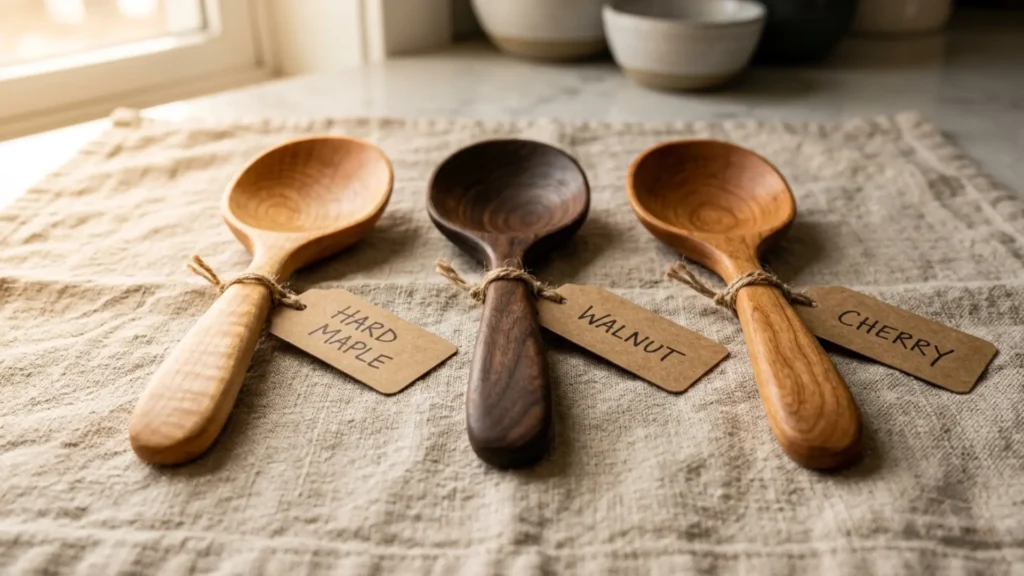
Hard maple (1,450 lbf) significantly outranks both walnut (1,010 lbf) and cherry (950 lbf) on the Janka scale, which means it takes more force to dent or scratch the surface — a meaningful advantage for utensils that spend years hitting pots, pans, and mixing bowls.
The gap isn’t trivial. Maple scores roughly 44% harder than walnut and 53% harder than cherry, which means a maple spoon used daily will show less surface wear and fewer knife-like grooves after two years than either alternative. Those grooves matter: they’re where bacteria and food residue accumulate between washings.
Walnut and cherry are genuinely excellent woods — walnut is lighter and easier on the hands during long cooking sessions, and cherry develops a beautiful patina over time. But for a utensil that will see daily stirring, scraping, and sautéing, maple’s superior hardness gives it a durability edge that neither competitor matches.
Does Maple’s Grain Structure Actually Prevent Bacteria?
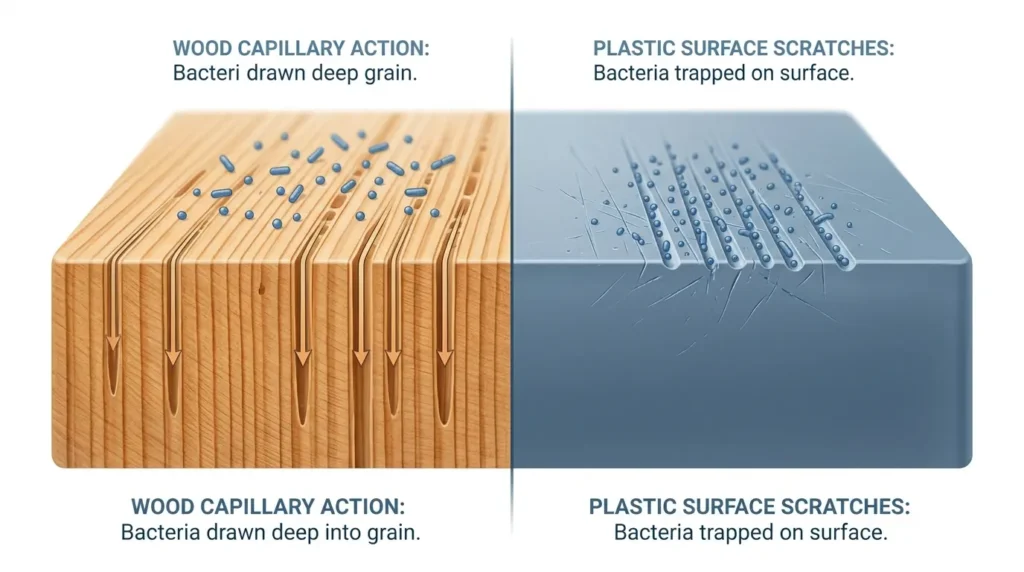
Maple’s closed grain pulls bacteria inward through capillary action, where they die during the drying process — a counterintuitive finding first documented by UC Davis food microbiologist Dr. Dean O. Cliver in a landmark 1994 study that overturned conventional food safety assumptions.
Dr. Cliver and his colleagues at the University of California Davis set out to prove that plastic was safer than wood — and found the opposite. When wooden surfaces were inoculated with food-poisoning bacteria, 99.9% of the bacteria became unrecoverable within three minutes. They weren’t simply being cleaned away; the capillary structure of the wood pulled them inward and the natural drying process killed them. Plastic, by contrast, developed shallow knife scars that trapped bacteria on or near the surface, where they remained viable even after hot-water-and-soap washing.
A subsequent peer-reviewed follow-up published in the Journal of AOAC International confirmed these findings across multiple wood species. The mechanism remains incompletely understood — Cliver himself noted that microbiologists were “mystified” by their inability to isolate a single agent responsible — but the bactericidal outcome is reproducible. Maple’s closed grain means the capillary action is uniform across the surface, with no open pores where bacteria could linger near the surface rather than being drawn deep.
Are Plastic Kitchen Utensils Actually Dangerous?
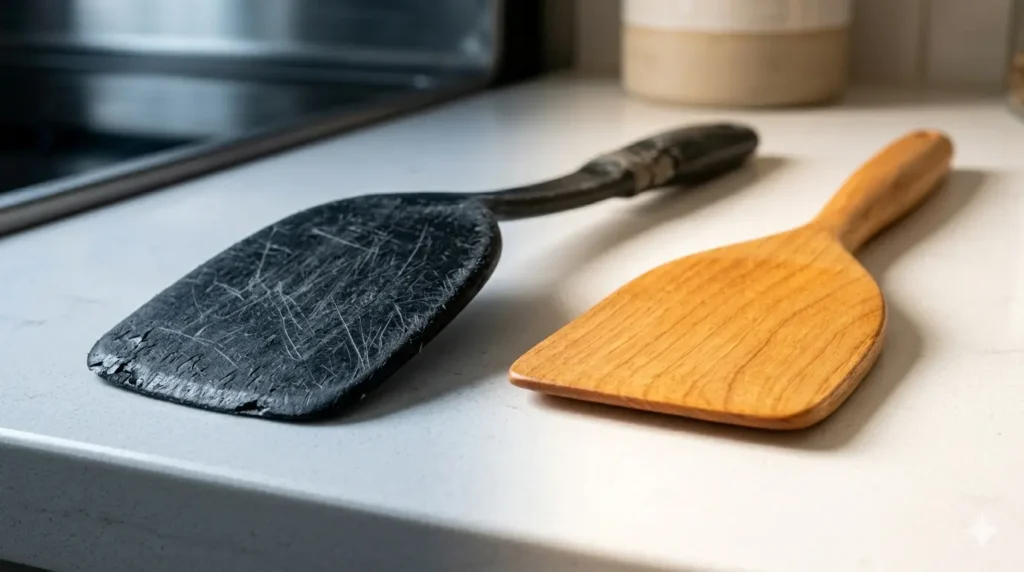
A peer-reviewed study published in Chemosphere in October 2024 found that black plastic kitchen utensils contained banned flame retardants in 85% of bromine-positive samples — with decaBDE present at concentrations up to 1,200 times the European Union’s allowable limit of 10 parts per million.
The study, conducted by Toxic-Free Future and researchers at Vrije Universiteit Amsterdam, tested common black plastic household items sold in the United States — spatulas, slotted spoons, takeout containers, and food trays. The contamination traced back to recycled e-waste: when the outer casings of televisions and electronics (which contain flame retardants by design) are mixed into the plastic recycling stream, those chemicals end up in the finished consumer products. Your black spatula may have started life as a television casing. If you’re actively working to eliminate plastic from your kitchen, our roundup of the best non-toxic kitchen utensil swaps gives you a practical category-by-category replacement guide.
The Environmental Working Group noted that kitchen utensils showed among the highest flame retardant concentrations of all consumer product categories tested. There is no label or warning that identifies which utensils are contaminated — you cannot tell by looking.
My own switch away from plastic started before I knew any of this. I was making eggs one morning when I spotted black flecks from a worn spatula ending up in the pan. That was it. I replaced it with an olive wood kitchen utensil the same week — and the first thing I noticed was the smell, or rather the absence of it: no more faint chemical warmth when the tool hit a hot pan. After a few weeks, the non-stick surface on my skillet looked visibly less scratched. The food just tasted cleaner — less noise between me and what I was actually cooking.
What Chemicals Leach From Plastic Cooking Utensils Into Food?
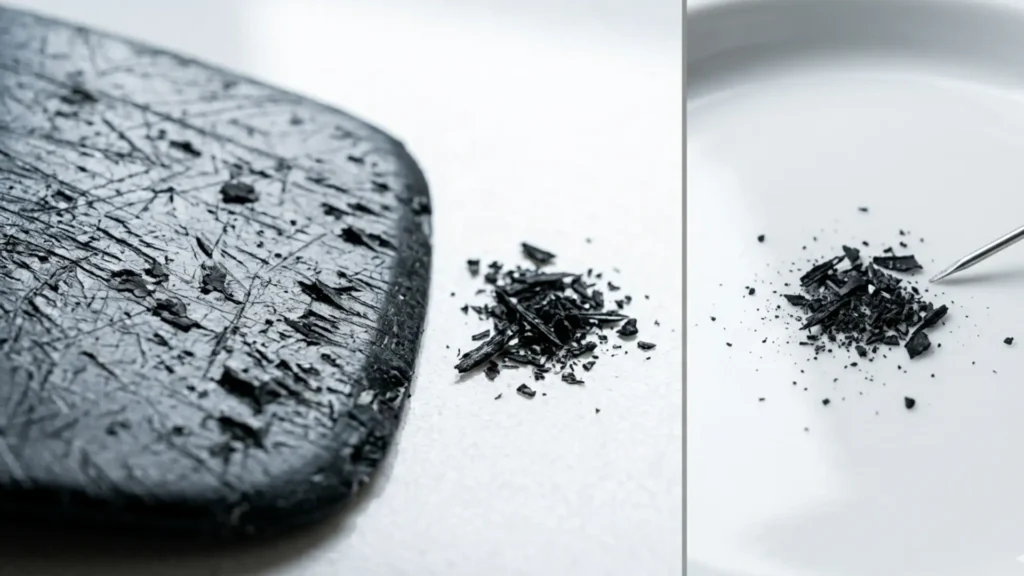
The chemical risk in plastic utensils runs deeper than BPA. Plastics used in kitchenware can release BPA, phthalates, and — in the case of recycled black plastics — brominated flame retardants including decaBDE, which is classified as carcinogenic and linked to endocrine disruption, neurotoxicity, and reproductive harm.
BBC Science Focus reported that microplastics released from plastic chopping boards and utensils accumulate in the body over time, with cumulative long-term effects that remain largely unknown. The particles are less than 5mm in size and are freed with every cut and scrape against a plastic surface. A single meal can introduce thousands of microplastic particles.
Decabromodiphenyl ether (decaBDE) — the specific flame retardant found in 70% of black plastic utensil samples in the 2024 Chemosphere study — was fully banned by the US Environmental Protection Agency in 2021. People with the highest blood levels of PBDEs were approximately 300% more likely to die from cancer than those with the lowest levels, according to a separate April 2024 study cited by CNN.
Are “BPA-Free” Plastic Utensils Actually Safe?
BPA-free labeling indicates that one specific chemical has been removed — it does not mean the utensil is free from other plasticizers, flame retardants, or heavy metals that may carry equal or greater health risks.
Of the approximately 16,000 chemicals associated with plastics, at least 25% are considered highly hazardous to human health and the environment. Black plastic specifically — regardless of BPA status — showed contamination with brominated flame retardants, phthalates, and in some samples, heavy metals including antimony, lead, cadmium, and chromium. BPA-free does not mean chemical-free. It means one named chemical has been replaced, often with structurally similar alternatives whose long-term safety profiles are not yet established.
How Do Maple Wooden Utensils Compare to Other Wood Types?
Maple beats beech on hardness, walnut on price, and teak on availability — while outperforming cherry on moisture resistance. For daily stovetop cooking, it hits the best balance of density, food safety, and value of any common hardwood. Our dedicated guide to the best woods for cutting boards goes deeper on how these species perform as food-contact surfaces across longer prep sessions.
Here’s how the major wood options stack up across the metrics that actually matter in a kitchen:
| Wood | Janka Hardness (lbf) | Grain Type | Moisture Resistance | Best For | Price Range |
|---|---|---|---|---|---|
| Hard Maple | 1,450 | Closed | Good (needs oiling) | Daily stirring, sautéing, all-purpose | $120 |
| Walnut | 1,010 | Semi-closed | Good | Long sessions, serving, gifting | $40 |
| Cherry | 950 | Fine, closed | Moderate | Serving spoons, light cooking | $105 |
| Beech | 1,300 | Fine, uniform | Moderate | Budget sets, everyday use | $ |
| Teak | 1,070 | Closed + natural oils | Excellent | Wet environments, heavy use | $59 |
| Bamboo (grass, not wood) | ~1,380 | Laminated | Variable | — | $ |
Is Maple Better Than Bamboo for Kitchen Utensils?
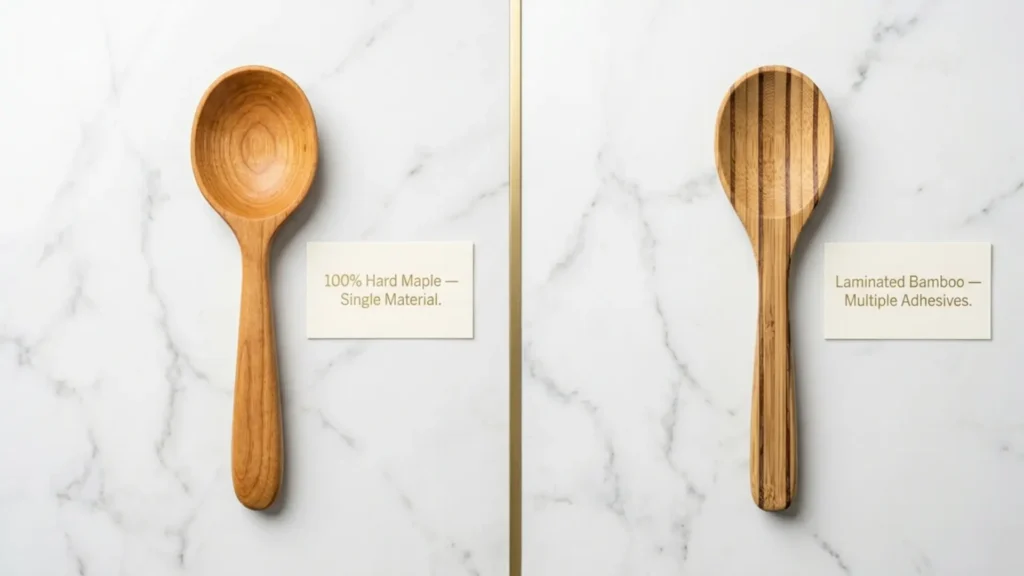
Maple is a true single-species hardwood with no adhesive concerns; bamboo is a laminated grass product that may contain formaldehyde-based resins depending on the manufacturer — and its silica content makes it rougher on both cookware surfaces and knife edges.
For health-conscious cooks specifically avoiding chemical exposure in the kitchen, this distinction matters. A maple spoon is one material, one grain, no glue. A bamboo utensil is multiple laminated strips held together by a binder you generally cannot verify from the label. TeakHaus notes that bamboo’s sustainability story is also less clean than advertised: most bamboo boards carry no third-party environmental certification, making the green marketing claim difficult to substantiate.
Is Maple or Walnut Better for Wooden Spoons?
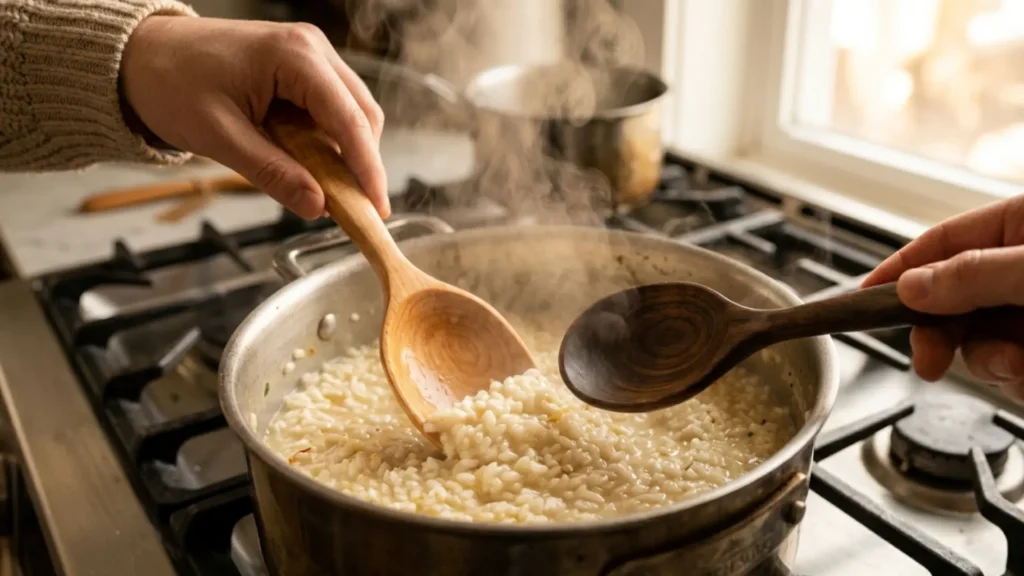
Maple is harder and more stain-resistant; walnut is lighter and more comfortable during extended cooking sessions. For everyday use — stirring risotto, scraping a fond, mixing batter — maple’s durability advantage is meaningful. For serving or light mixing, walnut’s softer weight is easier on the wrist.
Walnut registers 1,010 lbf on the Janka scale versus maple’s 1,450 lbf — a 44% difference. In daily kitchen terms, that means a maple spoon will show less surface wear, fewer stain marks, and fewer gouges after years of use. Walnut makes an excellent upgrade spoon for serving and presentation. Maple is the workhorse.
Is Maple Wood Food-Safe and FDA-Approved for Kitchen Use?
The FDA’s 1999 Food Code — the federal regulatory framework for food contact surfaces in restaurants and retail — explicitly permits cutting boards and utensils made from maple or similar close-grained hardwood. Maple is one of the only woods named by species in federal food safety guidance.
This is not a marketing claim. It comes directly from Dr. Dean Cliver’s published research, which notes that the U.S. Food and Drug Administration’s Food Code permits use of cutting boards made of maple or similar close-grained hardwood for food service operations — and that neither the FDA nor the USDA’s Meat and Poultry Inspection Manual specifically authorizes plastic surfaces in the same way. The implication is significant: the federal food safety apparatus does not consider plastic categorically safer than maple.
Does the FDA or USDA Recommend Wooden Utensils?
The USDA’s Meat and Poultry Inspection Manual and the FDA’s Food Code both permit maple hardwood for food-contact surfaces. The USDA conducted extensive testing comparing wood and plastic and found wood consistently showed lower bacterial counts after use and cleaning.
Dr. Cliver’s research was initiated after the USDA told his team they had no scientific evidence to support their recommendation that plastic be used instead of wood in home kitchens. That admission led to the research that ultimately proved wood’s bactericidal advantage. The myth that plastic is the government-approved safer choice has no scientific or regulatory foundation.
Can Maple Wooden Spoons Be Used With Raw Meat Safely?
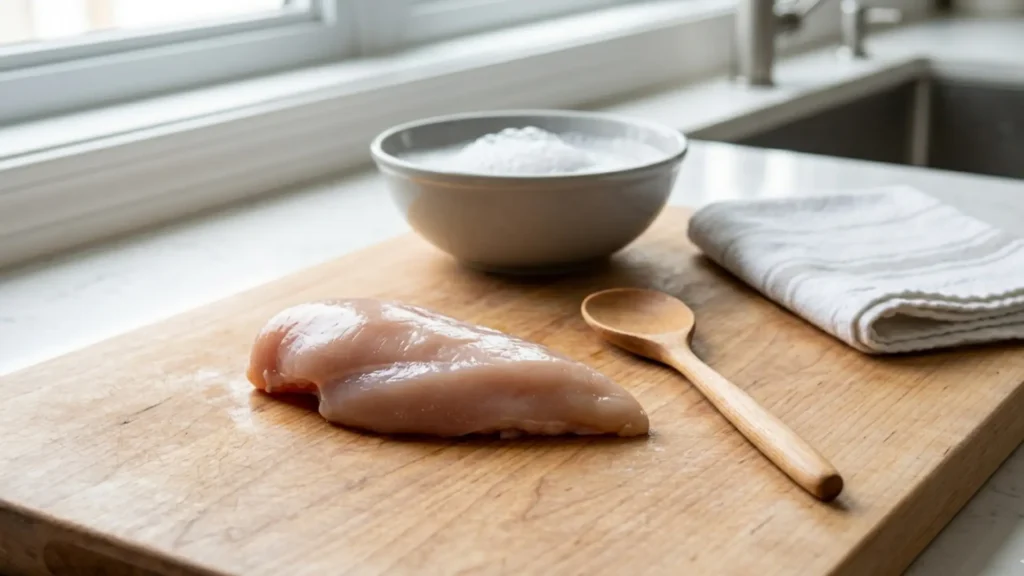
Yes. The USDA states that hardwoods like maple naturally resist bacteria and can be safely used with raw meat when washed promptly with hot soapy water and allowed to dry fully. The capillary mechanism that pulls bacteria inward and kills them during drying is the same process Cliver documented.
The critical variable is drying. Bacteria that penetrate wood generally die within hours — the capillary action of fine-grained hardwoods pulls fluid downward and away from the surface, and the natural drying process completes the kill. If a wooden utensil is stored damp — left in a sink, stacked wet, or kept in an enclosed drawer before drying — that mechanism is disrupted. Dry it fully after every wash and the antimicrobial advantage is real.
How Do You Clean and Care for Maple Wooden Utensils?
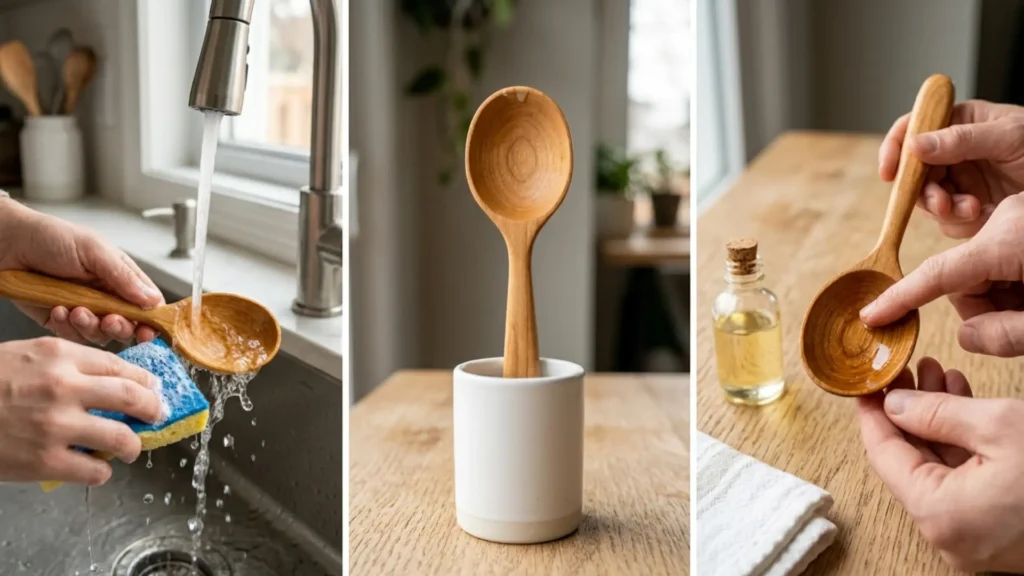
Hand-wash with warm soapy water immediately after use, dry upright in open air, and apply food-grade mineral oil every three to six weeks — or whenever the wood looks pale, dry, or thirsty. Never soak. Never put in the dishwasher.
Maple is the hardest common kitchen wood, but it is still more moisture-absorbent than teak or walnut because of its relatively open pore structure. That means maple requires more consistent oiling than equivalent hardwoods to keep the grain sealed — especially in the first months of use. The good news is that the routine, once established, takes about five minutes.
What Oil Should You Use on Maple Wooden Spoons?
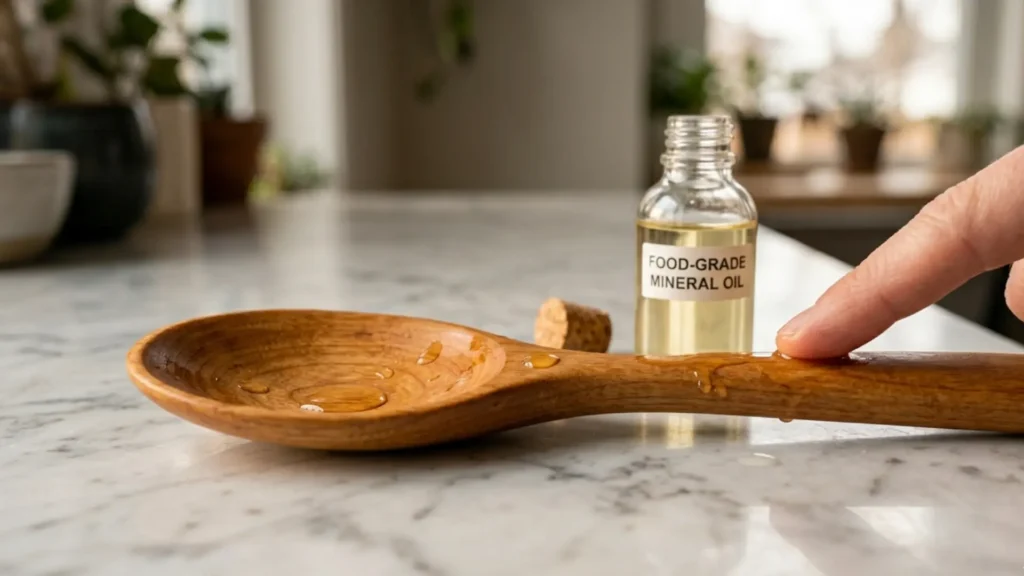
Food-grade mineral oil is the correct choice: it’s odorless, tasteless, non-rancid, and widely available. Olive oil, vegetable oil, and coconut oil all go rancid inside the grain, creating the sour or musty smell that makes people think their wooden utensil has gone bad.
Holland Bowl Mill recommends food-grade mineral oil or beeswax blends for sealing maple kitchenware. Beeswax butter (a mix of beeswax and mineral oil) provides slightly more water resistance and a subtle sheen. Our full guide to food-grade mineral oil for wooden kitchenware covers application frequency, the best products to buy, and how to tell when your wood genuinely needs conditioning versus just looking dull from normal use.
How Often Should You Oil Maple Kitchen Utensils?
New maple utensils should be oiled generously before first use and left to absorb overnight. After that, oil every three to six weeks for daily-use utensils — more frequently if the wood looks pale or feels rough, less if you cook only occasionally.
Earlywood Designs recommends oiling about every six months for their hard maple utensils — but that guidance assumes moderate use and relatively low ambient humidity. In a busy home kitchen where utensils are washed daily, closer to monthly conditioning keeps the grain fully sealed. The wood will tell you: when it goes from warm amber to pale and flat, it’s ready for oil.
My own care routine is simple: food-grade mineral oil applied with my fingers every three to four weeks — that tactile approach matters more than I expected. You can feel exactly where the wood is thirsty. I leave it overnight and wipe clean in the morning. The one change that made everything better: I stopped oiling damp wood. Moisture trapped under oil is exactly how you get that sour smell over time. Dry it completely first — not just towel-dry, fully air-dry — and the wood will outlast anything plastic ever did.
Can You Put Maple Wooden Utensils in the Dishwasher?
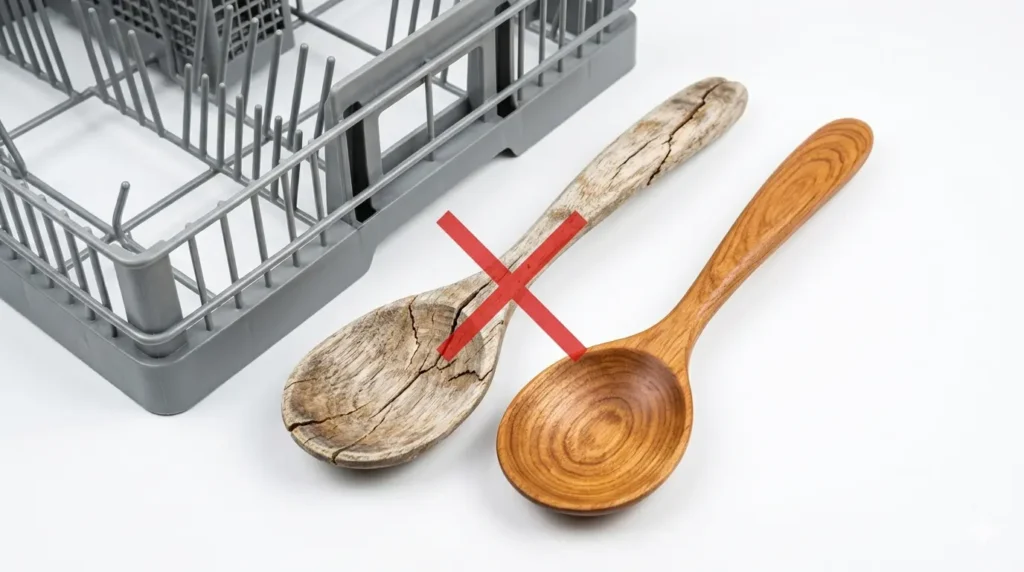
No. Dishwashers are the single fastest way to destroy a maple utensil. The combination of sustained high heat, prolonged water exposure, and harsh detergents strips the wood’s natural oils, causes swelling during the cycle and rapid drying afterward, and produces warping, cracking, and splitting within a handful of cycles.
FaucetFam’s care guide lists dishwasher use as the top cause of premature utensil failure, followed closely by soaking. Even a brief soak — leaving a spoon submerged in a pot of water while you prep — starts the swelling cycle that leads to cracking. Thirty seconds of hand-washing is enough. The long-term cost of dishwasher use is a utensil that fails in months instead of decades.
Are Maple Wooden Utensils Sustainable and Eco-Friendly?
North American hard maple grows from managed forests, is widely available in FSC-certified form, and is fully biodegradable at end of life. It is a renewable alternative to petroleum-based plastic utensils that take centuries to decompose — and that shed microplastics into food and waterways throughout their useful life.
The environmental math on plastic utensils is worse than most people realize. An estimated 40 billion plastic utensils are discarded in the United States each year. Once discarded, they fragment into microplastics over decades, polluting soil and waterways — and those microplastics carry the same chemical payload (flame retardants, plasticizers, heavy metals) documented in the kitchen. The biodegradable advantage of maple is not just atmospheric; it ends the chemical cycle.
Is Maple Wood FSC-Certified?
Hard maple from North American suppliers is readily available with FSC (Forest Stewardship Council) or SFI (Sustainable Forestry Initiative) certification. Look for the FSC logo on product packaging — without third-party certification, “sustainably sourced” is a marketing claim, not a verified standard.
Minelli Group’s industry analysis confirms that maple is readily available in FSC-certified forms, making it one of the more environmentally accountable choices for kitchenware brands and consumers alike. Domestic maple’s rapid growth rate and well-managed North American supply chain give it a lower deforestation risk than imported exotic hardwoods like teak or acacia — where supply chain verification is harder and third-party certification less consistent.
After the switch, I started paying attention to sourcing labels. Most mass-market maple utensils carry no certification at all — just “natural wood” on the packaging. The ones worth buying specify hard maple (not just “maple”), and ideally FSC or SFI certification. That took some digging, but once I knew what to look for, the difference was visible in the product itself: tighter grain, cleaner finish, more consistent weight. Certified wood is better wood.
What Maple Kitchen Utensils Does Every Home Cook Actually Need?
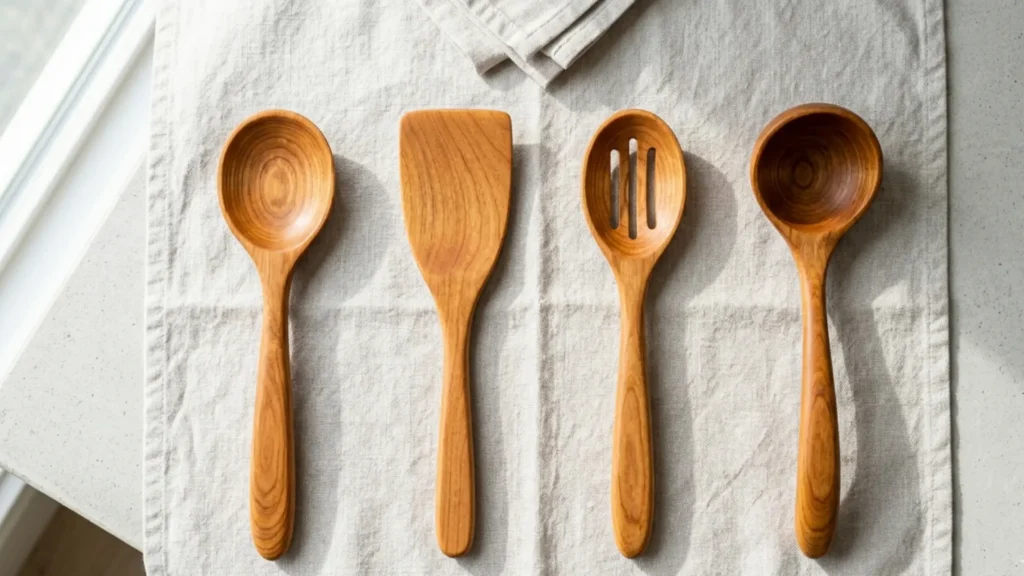
Four utensils cover 90% of stovetop cooking: a maple wooden spoon, a flat spatula, a slotted spoon, and a ladle. Start there before adding specialty pieces — those four will handle stirring, scraping, draining, and serving across virtually every recipe.
Maple wooden spoon — The all-purpose workhorse. Use it for stirring sauces, scraping fond from a pan, folding batters, and tasting. The rounded bowl distributes pressure evenly when stirring thick mixtures like polenta or risotto. Look for a spoon with a slightly angled or flat-bottomed bowl — it reaches the corners of a straight-sided sauté pan more effectively than a perfectly round spoon.
Flat maple spatula — Essential for sautéing vegetables and folding delicate mixtures. The flat edge gets under food cleanly without the leverage disadvantage of a metal blade. Particularly important for nonstick and ceramic cookware, where metal tools create microscopic scratches that degrade the coating over time.
Slotted spoon — For draining pasta, lifting dumplings, or scooping from braising liquid while leaving the fat behind. A maple slotted spoon is gentler on pot interiors than a metal equivalent.
Ladle — For soups, stews, and sauces. Maple handles don’t conduct heat, so even a ladle left resting against a hot pot won’t burn your hand.
When shopping, verify three things: (1) the species is specifically listed as hard maple or sugar maple — not just “maple wood,” which can include softer varieties; (2) the finish is food-grade mineral oil or unfinished — avoid varnish, lacquer, or any coating not explicitly labeled food-safe; and (3) the grain is visible and tight — wide, irregular grain suggests a lower-quality cut or a softer wood.
Frequently Asked Questions
Do maple wooden spoons absorb bacteria?
Maple’s capillary structure draws bacteria away from the surface and into the grain, where the natural drying process kills them. UC Davis microbiologist Dr. Dean Cliver found that 99.9% of bacteria became unrecoverable from wood surfaces within three minutes of inoculation — an outcome not replicated on plastic, where bacteria survive in surface grooves even after washing.
How long do maple wooden utensils last?
A well-maintained maple wooden spoon — hand-washed, dried fully, and oiled every three to six weeks — can last decades. Maple’s Janka hardness of 1,450 lbf means it resists surface scarring that would compromise a softer wood within a year or two. The limiting factors are almost always care failures (dishwasher use, prolonged soaking, improper oiling) rather than the wood’s inherent durability.
What’s the difference between hard maple and soft maple for cooking utensils?
Hard maple (sugar maple, Acer saccharum) scores 1,450 lbf on the Janka scale. Soft maple covers several species (Acer rubrum, Acer saccharinum) ranging from 700–1,000 lbf — meaningfully softer. For kitchen utensils, always specify hard maple. Soft maple is more prone to surface gouging, staining, and shorter service life under daily use.
Can maple utensils scratch my nonstick pans?
No. Maple is softer than the metal substrate beneath any nonstick coating, so it cannot scratch through the coating the way a metal spatula or spoon can. Maple utensils are safe for use in nonstick, ceramic, enamel, and cast iron cookware. The non-scratch property is one of the primary reasons professional cooks reach for wood when working with coated cookware.